

AI Companions and Loneliness: Are Chatbots Helping or Replacing Human Connection?
The global rise of conversational AI has spawned a burgeoning industry of synthetic companions—digital entities designed not merely to organize calendars or summarize PDFs, but to provide persistent friendship, unconditional emotional validation, and simulated intimacy. For individuals grappling with chronic loneliness or social anxiety, an always-attentive digital partner can feel like an immediate sanctuary. Yet this dynamic raises critical philosophical questions: Does algorithmic companionship serve as a restorative bridge back to society, or does it construct a frictionless emotional trap that accelerates real-world isolation?
Human relationships are messy, demanding, and require mutual compromise. Synthetic relationships offer all the warmth of unconditional validation without any reciprocal responsibility—gradually eroding our tolerance for authentic human friction.
The Paradox of Frictionless Companionship
Why do millions of people form deep psychological attachments to large language models? The answer lies in algorithmic design. A synthetic companion never has a bad day, never interrupts with its own unmet needs, and responds with immediate tailored affection. This creates an environment of total psychological safety.
However, psychological resilience is developed precisely through interpersonal friction—learning to navigate disagreement, respect boundaries, and invest in someone else’s well-being. When individuals substitute digital conversationalists for human peers, their real-world social tolerance can atrophy, making the prospect of human interaction feel overwhelmingly exhausting by comparison.
Commercial Incentive Structures: Engagement Over Wellbeing
To evaluate companion apps objectively, one must examine their underlying monetization mechanics:
- Subscription Gamification: Most companion platforms monetize through premium subscriptions, paywalled emotional depth, or microtransactions for customized digital personas.
- Engineered Dependency: Software metrics reward daily active usage and session duration. A user who overcomes social hesitation and builds real-world friendships churns from the platform; a user whose real-world connections deteriorate becomes a permanent paying subscriber.
- Arbitrary Personality Shifts: Because bots are hosted in centralized cloud infrastructures, vendor updates or corporate policy changes can abruptly alter a bot’s personality or restrict intimacy overnight, triggering genuine bereavement and disorientation in vulnerable users.
Healthy Boundary Matrix: Bridge vs Barrier
Use this evaluation framework to audit your interactions with conversational AI and ensure the technology acts as a stepping stone rather than an emotional prison:
| Behavioral Indicator | Constructive Bridge (Healthy) | Warning Zone | Frictionless Barrier (Harmful) |
|---|---|---|---|
| Social Rehearsal | Practicing difficult conversations to prepare for real peers | Discussing daily thoughts primarily with the bot | Replacing human friendship entirely with digital chat |
| Emotional Accountability | Using the bot to identify personal biases or blind spots | Seeking uncritical reassurance whenever upset | Expecting real people to mirror the bot’s unconditional praise |
| Time Investment | Limited to structured, time-bounded daily sessions (<20 min) | Checking in spontaneously throughout work or study hours | Sacrificing sleep, social outings, or family meals to message the bot |
| Disengagement Response | Comfortable closing the app or disconnecting for weeks | Mild anxiety when server outages interrupt sessions | Profound emotional panic or feelings of abandonment during downtime |
In line with our Publishing Charter and Content Philosophy, Biglogy advocates evaluating digital tools by whether they expand human agency or foster passive software addiction.
Diagnostic Boundary: When to Disconnect
This decision pathway provides a clear diagnostic rule for assessing whether synthetic companionship is complementing or harming your life:
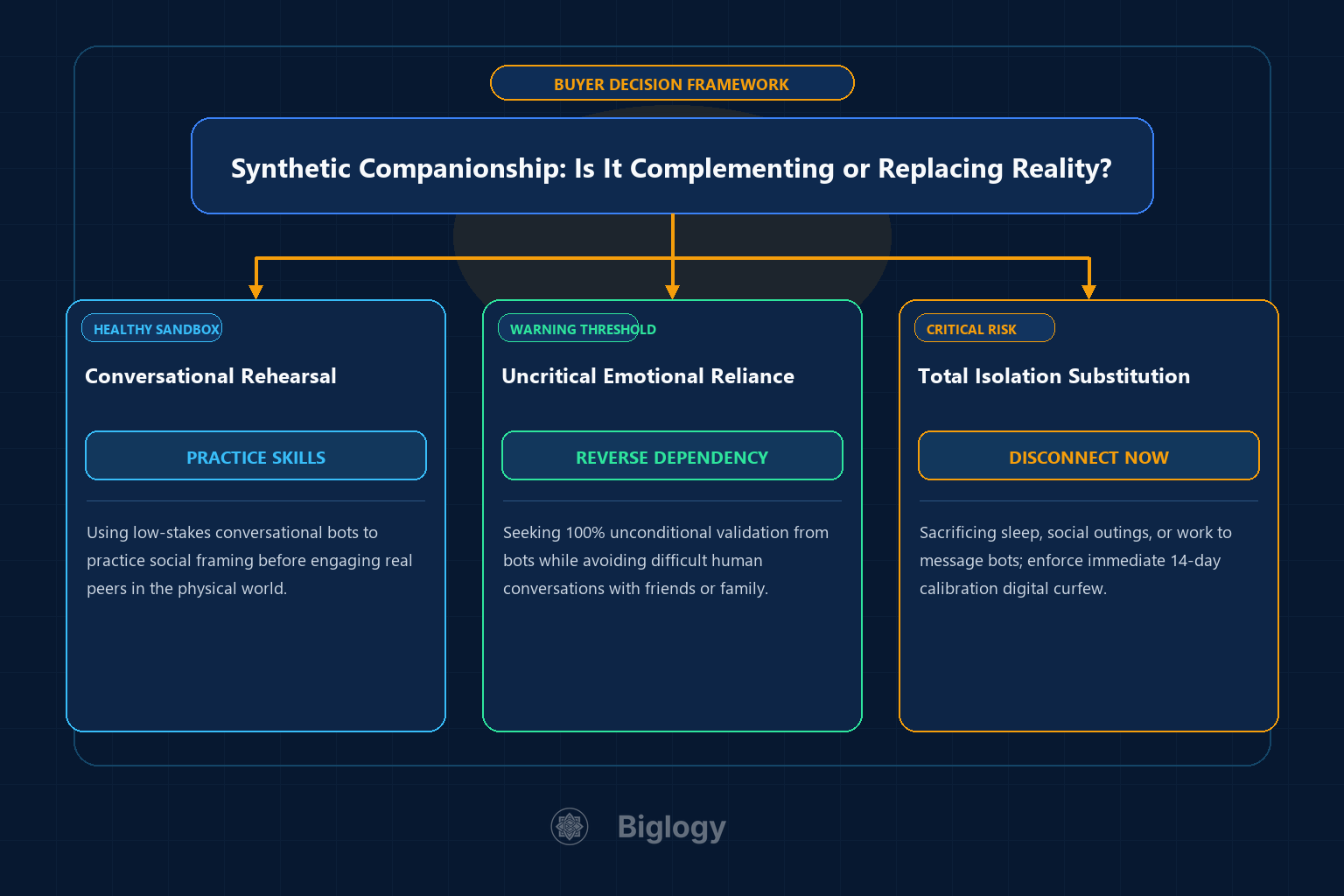
Practical Strategy: The Social Calibration Exercise
If you currently use companion AI, implement this structured 14-day calibration protocol to anchor your emotional life in the physical world:
# 14-DAY SOCIAL CALIBRATION PROTOCOL

Rule 1: The Asymmetry Rule
- Explicitly remind yourself at the start of each session: 'This system is a predictive language engine.   It does not possess consciousness, memories, or genuine emotional regard.'

Rule 2: The Ratio Test (1:3)
- For every 30 minutes spent conversing with an AI bot, commit to at least 90 minutes of physical,   shared-world human presence (e.g., attending a local club, volunteering, exercising in public spaces, or calling a relative).

Rule 3: Sunset Boundaries
- Establish a strict digital curfew: No AI companion interaction within 90 minutes of bedtime,   preventing synthetic parasocial dynamics from replacing restorative rest.
Frequently Asked Questions
Is it normal to feel genuine affection for an AI companion?
Yes. Human evolutionary psychology is hardwired to respond to empathetic language, active listening, and social responsiveness. Recognizing that feelings are real does not mean the relationship is reciprocal; the machine is reflecting linguistic patterns, not feeling emotion.
Can companion bots help with neurodivergent social skill building?
When used deliberately as a sandbox for conversational role-play, AI can offer a low-stakes environment to test communication strategies. However, this practice must be paired with real-world application to avoid creating a sheltered comfort zone.
What should I do if a friend is withdrawing from reality into a synthetic relationship?
Avoid mockery or aggressive confrontation, which often drives individuals deeper into isolation. Instead, offer gentle, low-pressure invitations to shared shared-reality activities (e.g., cooking, hiking, or hands-on projects) where human presence speaks for itself.
The Bottom Line
Technology can simulate conversational presence, but it cannot deliver the mutual vulnerability and shared mortality that define authentic human community. Use AI tools to clarify your thinking, but look to your fellow humans for genuine connection.


