

Deepfakes and Digital Impersonation: How Businesses Can Protect Executive Identity
Generative media has crossed the threshold from speculative tech demonstration into an active corporate threat vector. With just 60 seconds of clean audio extracted from a podcast or earnings call, malicious actors can clone an executive’s voice with uncanny acoustic fidelity. When paired with real-time video face-swapping, synthetic impersonation transforms traditional spear-phishing into high-stakes visual and auditory deception. In multinational corporations, finance teams have already transferred tens of millions of dollars following video conferences where every attendee except the victim was a real-time synthetic deepfake.
In an era where sensory evidence can be synthesized in real time, trust can no longer rely on seeing or hearing a familiar face. Security must be anchored in cryptographic verification, out-of-band protocols, and mandatory challenge-response authentication.
The 3 Primary B2B Deepfake Threat Vectors
Businesses face three distinct categories of generative impersonation, each targeting a different operational vulnerability:
- Synthetic CEO Wire Fraud: Attackers clone the voice of a CEO or CFO, placing urgent calls to regional accounting staff requesting emergency out-of-cycle payments for ‘confidential acquisitions.’
- Executive Virtual Meeting Infiltration: Attackers construct synthetic video avatars of board members or partners to gain unauthorized entry into confidential strategic briefings or intellectual property disclosures.
- Synthetic Reputational Smear Campaigns: Fabricating realistic audio or video of an executive making offensive, illegal, or market-manipulating statements right before an earnings report, product launch, or funding round.
Executive Security Matrix: Defending Sensory Channels
Evaluate your current operational controls against the modern generative threat landscape:
| Channel / Workflow | Legacy Vulnerability | Deepfake Attack Scenario | Mandatory Cryptographic Safeguard |
|---|---|---|---|
| Wire Transfer Authorization | Verbal confirmation over phone / Slack | Cloned voice call mimicking CFO urgency | Dual-custody hardware key (YubiKey) approval; strict $0 verbal limit |
| Vendor Bank Detail Changes | Email verification or signed PDF letterhead | Deepfake video conference confirming fake account | Out-of-band verification via pre-established registered physical phone |
| Executive Media Statements | Unsigned press releases and social posts | Viral synthetic clip claiming corporate fraud | Content Authenticity Initiative (C2PA) signed media metadata |
| Internal Urgent Directives | Informal WhatsApp or Telegram voice notes | AI-generated emergency operational commands | Mandatory pre-shared rotating verbal passphrase protocol |
Our guide on building a privacy-first tech stack underscores that security policies must assume sensory channels can be simulated and require zero-trust architectural boundaries.
Incident Protocol: The Zero-Trust Challenge-Response Flow
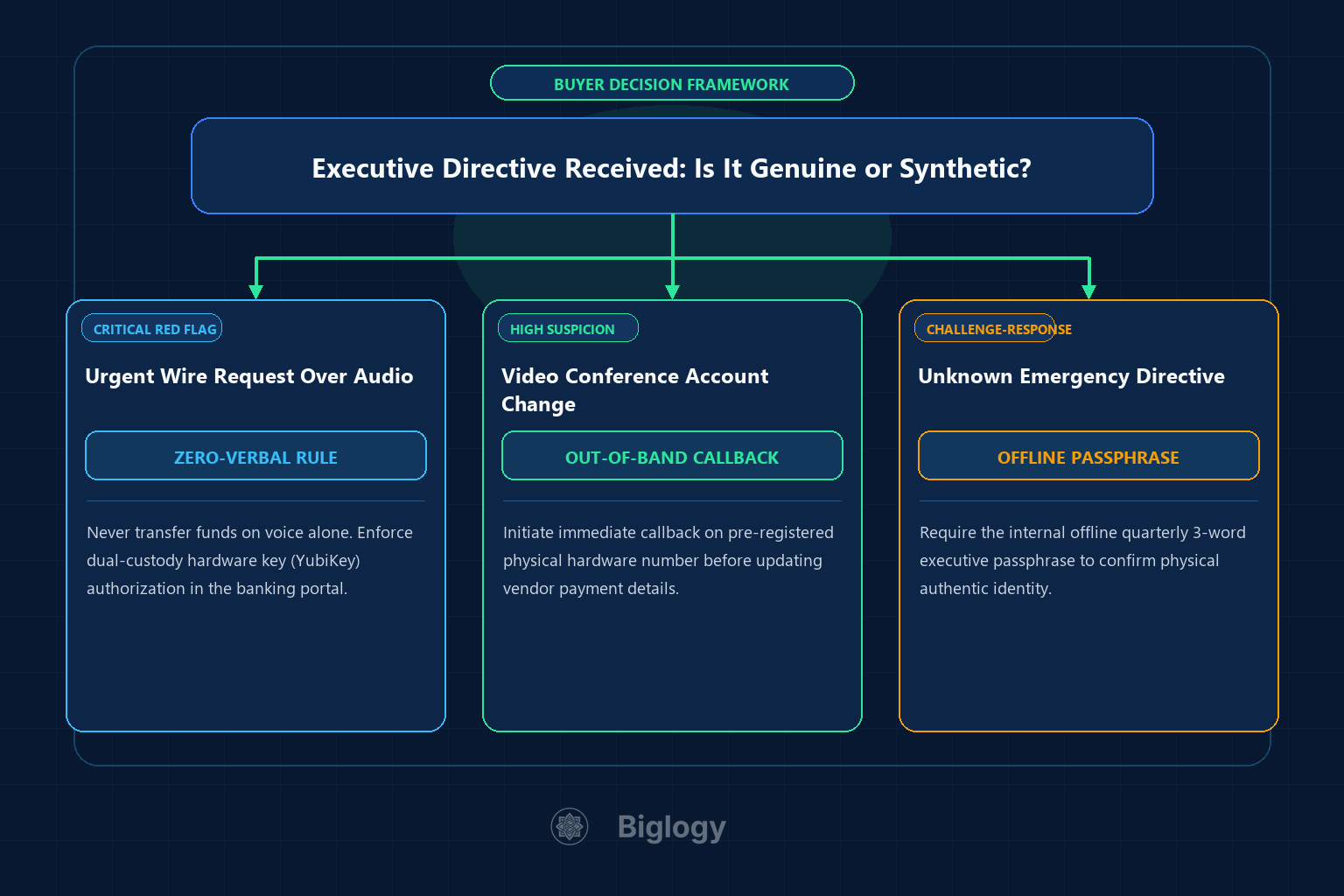
This decision pathway provides a fool-proof verification sequence to confirm the true identity of any executive requesting sensitive action:
Copyable Standard Operating Procedure: The Verbal Duress & Challenge Code
Implement this internal corporate defense policy across executive and financial teams immediately:
# CORPORATE EXECUTIVE IDENTITY VERIFICATION SOP

Rule 1: The Zero-Verbal Wire Policy
- No financial transfer exceeding $5,000 may be authorized based on voice, phone, or video instruction alone.
- Every transaction requires two independent cryptographic approvals in the banking portal.

Rule 2: Out-of-Band Challenge-Response
- If an executive contacts finance via phone or video requesting urgency, the recipient must initiate an   immediate out-of-band callback using a pre-saved hardware phone number, not the incoming caller ID.

Rule 3: Rotating Operational Passphrases
- Executive leadership maintains a private, offline 3-word passphrase that is never stored in email, Slack, or cloud notes.
- When in doubt, the verifier asks: 'Please confirm the quarterly operational passphrase.'   A synthetic voice model or external attacker cannot supply the unwritten phrase.
Frequently Asked Questions
Can commercial deepfake detection software catch all synthetic videos?
No. Detection algorithms are locked in an asymmetric arms race with generative models. While detectors identify common compression artifacts and facial boundary glitches, advanced threat actors continually tune models to evade automated detection. Protocol-based defenses are far more reliable than automated detectors.
How much audio does an attacker need to clone a voice convincingly?
With state-of-the-art voice synthesis models (e.g., ElevenLabs, XTTS), as little as 10 to 30 seconds of clean speech is sufficient to produce a convincing vocal clone capable of fooling casual listeners over telephone audio.
What should a company do within the first 60 minutes of discovering a viral deepfake?
Immediately issue a signed verification statement across official, authenticated channels. Contact legal counsel, alert platform trust-and-safety teams with forensic evidence, and reassure stakeholders through direct, cryptographically signed corporate communications.
The Bottom Line
As the boundary between physical reality and synthetic simulation blurs, corporate security cannot rely on sensory instinct. By implementing strict dual-custody controls, out-of-band verification, and offline passphrases, your organization can render deepfake impersonation completely ineffective.
Related posts:
 What to Look for on the Security Page? A Guide to SOC 2, ISO 27001, GDPR, and 2FA
 AI Meeting Note-Takers: Consent, Storage, and Access Checklist
 AI Companions and Loneliness: Are Chatbots Helping or Replacing Human Connection?
 Comprehensive Glossary of Project Management Terminology: Understanding Key Concepts and Techniques
