
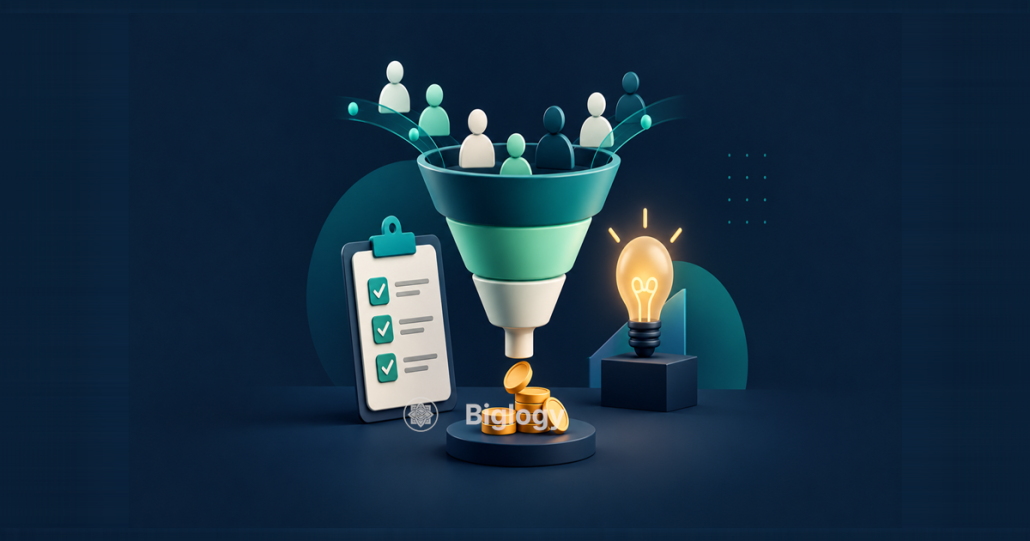
What You Need to Know Before Setting Up a Sales Funnel
Short Answer
The most important thing to understand before setting up a sales funnel is this: a funnel does not repair a weak offer or an unclear customer problem. A funnel works when it is built on a clear target audience, a specific problem, a coherent offer, trust-building elements, a follow-up system, and measurable steps in the customer journey.
From Biglogy’s perspective, a sales funnel is not a manipulative mechanism designed to pressure people into buying quickly. It is a decision journey that helps the right person understand a problem, evaluate options, and move toward a purchase more consciously.
Who Is This Guide For?
This guide is for:
- small business owners
- creators selling digital products, courses, memberships, or consulting
- B2B service providers
- teams asking how landing pages, email, ads, CRM, and checkout should connect
- people who want to build a funnel but are not sure where to begin
- anyone who wants to clarify strategy before choosing a funnel tool
What Is a Sales Funnel?
A sales funnel is a structured plan for the stages a person moves through from first awareness to purchase, onboarding, repeat use, or referral.
A simple funnel may include stages such as:
- Awareness: the person notices a problem, topic, or brand
- Interest: the person engages with content, a guide, a video, a newsletter, or an ad
- Evaluation: the person compares the solution, scope, trust factors, and alternatives
- Decision: the person takes a step such as purchasing, applying, booking, or requesting a demo
- Onboarding: the person starts using the product or service
- Retention or repeat engagement: the person continues, returns, or recommends it
A funnel is not only a sales page. Content, email, CRM, landing pages, checkout, onboarding, and customer experience all work together.
The Biggest Misconception Before Setting Up a Sales Funnel
The most common misconception is this:
“If I build a funnel, sales will increase.”
Sometimes they may improve. But only when the basics are already in place:
- the target audience is clear
- the problem is specific
- the offer is easy to understand
- the value feels credible
- trust factors are visible
- the purchase path is simple
- follow-up and onboarding actually work
- performance can be measured
Without those basics, a funnel usually makes an already weak system more complicated.
Questions to Answer Before Setting Up a Funnel
Before choosing a tool or drawing pages, answer these questions:
- Who is the target customer?
- What urgent or meaningful problem does this person have?
- How would this person describe that problem in everyday language?
- How does the offer solve that problem?
- Can the offer be explained in one sentence?
- Why should this person act now rather than later?
- What objections might appear before purchase?
- What trust signals are needed before a decision feels safe?
- Where does first contact happen?
- What is the next step after that contact?
- What happens after the purchase or application?
- Which metrics will show whether the funnel is working?
If most of these questions do not yet have clear answers, it is usually better to improve the offer and customer understanding before building the funnel.
When Is a Sales Funnel Necessary?
| Situation | Is a Sales Funnel Necessary? | Why? |
|---|---|---|
| Sales happen manually and infrequently | Not always | Personal selling may still be enough |
| Leads arrive regularly | Often yes | Those leads need structure and follow-up |
| Digital products are being sold | Usually yes | Traffic, offer, checkout, and onboarding need to connect |
| B2B services are being sold | Usually yes | Trust-building and evaluation often take longer |
| The target audience is unclear | No | A funnel for the wrong audience does not help |
| The offer is still unclear | No | A funnel cannot rescue an undefined offer |
| Paid traffic or campaigns will be used | Often yes | Traffic needs a clearer path |
| The email list is growing | Often yes | Nurturing and segmentation become more useful |
| The product is not yet validated | Use caution | Manual validation may need to come first |
The Basic Components of a Sales Funnel
1. Target Audience
A funnel is not built for everyone. It is built for a specific audience trying to solve a specific problem.
Examples:
- experts who want to sell online courses
- small businesses that need a CRM
- creators starting email marketing
- teams trying to simplify operations through automation
2. Problem
A strong funnel starts with the problem, not the product.
Weak starting point:
- “Use the best platform.”
Stronger starting point:
- “Are leads coming in but getting lost before proper follow-up?”
3. Offer
The offer combines the product, result, scope, price, delivery method, and expectation management.
A strong offer answers questions such as:
- What am I getting?
- Who is it for?
- What problem does it solve?
- How will I experience value?
- What is included?
- What is not included?
- What happens after I buy it?
4. Trust Factors
Trust plays a central role in the funnel.
Examples of trust factors:
- transparent pricing
- authentic testimonials or reviews
- case studies or examples
- clear return or cancellation terms
- visible support information
- payment and checkout clarity
- privacy and data-handling transparency
- credible expertise or experience indicators
5. Content
Content helps the person move through the decision journey.
Useful content may include:
- short guides
- comparisons
- checklists
- FAQs
- use cases
- common-mistake lists
- case studies
- onboarding emails
6. Follow-Up System
A funnel is rarely about a single visit. Many people need more than one interaction before taking action.
A follow-up system might include:
- email marketing
- CRM tasks
- proposal reminders
- demo follow-up
- post-webinar email flows
- post-purchase onboarding
7. Measurement
A funnel that is never measured cannot be improved reliably.
Useful metrics may include:
- traffic
- landing page conversion
- form completion
- email engagement
- lead or demo rate
- checkout completion
- sales conversion
- refund or cancellation patterns
- customer acquisition cost
- lifetime value
Content Map by Funnel Stage
| Stage | User’s Question | Content Type | Goal |
|---|---|---|---|
| Awareness | What problem am I dealing with? | Blog post, short guide, social content | Make the problem visible |
| Interest | What are the possible solutions? | Checklist, comparison, webinar | Explain the options |
| Evaluation | Is this solution right for me? | Case study, FAQ, demo, use case | Build trust |
| Decision | Should I buy or apply now? | Sales page, proposal, guarantee terms | Reduce friction in the decision |
| Onboarding | How do I begin? | Email sequence, getting-started guide | Deliver initial value |
| Retention | Should I continue or come back? | Advanced guides, updates, support content | Support satisfaction and repeat use |
Funnel Setup Order
A practical funnel setup order looks like this:
- define the target audience
- clarify the core problem
- simplify the offer
- list the main objections before purchase
- prepare trust-building elements
- choose the first traffic source
- create the landing page or sales page
- set up the lead-capture or checkout step
- connect follow-up through email or CRM
- define the onboarding experience
- choose the metrics to track
- make small improvements based on real behavior
A common mistake is starting in the opposite direction:
- choose the tool first
- build the page second
- run traffic third
- only then ask what the offer really is
The healthier sequence starts with the offer and the customer.
A Simple Funnel Example for Small Businesses
| Step | Goal | Example |
|---|---|---|
| Blog or social content | Make the problem visible | “When is CRM needed?” |
| Lead magnet | Gain permission | Checklist or quick guide |
| Welcome email | Set expectations | “What you will get from this series” |
| Nurture emails | Support evaluation | Problem, solution, mistake, example |
| Offer page | Help the decision | Clear scope and pricing |
| Checkout or application | Take action | Payment or form submission |
| Onboarding | Deliver initial value | Welcome email and start guide |
| Feedback | Improve the experience | Survey or feedback request |
For many small businesses, a structure like this is enough for a strong starting point.
Questions to Ask Before Choosing a Funnel Tool
| Question | Why Is It Important? |
|---|---|
| Can it create a landing page? | Needed for the first conversion step |
| Is there form or lead-capture support? | Needed for lead generation |
| Does it support email automation? | Needed for follow-up and nurturing |
| Is there checkout integration? | Needed for sales flow |
| Does it connect to a CRM? | Needed for lead tracking and history |
| Can it handle segmentation? | Needed to send relevant messages |
| Is testing or optimization support available? | Useful for improving pages and messaging |
| Is the analytics visible enough? | Needed for conversion tracking |
| Does it support privacy and consent workflows? | Important for trust and compliance |
| Can cost scale reasonably? | Important as traffic or list size grows |
Tool selection comes after strategy, not before it.
Ethical Boundaries in the Sales Funnel
From Biglogy’s perspective, a sales funnel should remain ethical.
Practices to avoid:
- fake scarcity
- misleading discounts
- exaggerated promises
- hidden costs
- difficult cancellation
- unclear return terms
- manipulative countdowns
- fake social proof
- pressure tactics that exploit urgency
- making subscription cancellation unnecessarily hard
An ethical funnel should:
- clarify the problem honestly
- explain the solution clearly
- define the scope
- leave risks visible
- allow room for a real decision
- fulfill what it promises after purchase
Common Mistakes
1. Building the funnel before the product is clearly defined
A funnel for an undefined offer usually amplifies confusion.
2. Defining the audience too broadly
A funnel designed for everyone usually connects deeply with no one.
3. Moving to sales too quickly without content support
Many people need help understanding the problem and the solution before they are ready to decide.
4. Neglecting trust factors
If pricing, reviews, returns, security signals, and support are unclear, the decision becomes harder.
5. Forgetting follow-up
People who do not act on the first visit may disappear completely without a follow-up system.
6. Making checkout or application too complicated
Once someone is ready, unnecessary friction can stop the decision.
7. Ignoring onboarding
A weak post-purchase experience creates dissatisfaction, refunds, or cancellations.
8. Watching only conversion in isolation
If conversion improves while customer quality drops, the funnel may be getting worse, not better.
The Biglogy Perspective
For Biglogy, a sales funnel should not force people to buy faster. It should help the right person receive the right information in the right order.
A strong funnel:
- explains the problem before the product
- helps the person understand the available options
- keeps trust factors visible
- plans for what happens after purchase
- measures not only revenue but also customer experience
- avoids manipulative pressure
A funnel should not reduce the quality of the reader’s decision. It should improve the clarity of that decision.
Conclusion
Before setting up a sales funnel, the target audience, problem, offer, trust system, content, follow-up, checkout, onboarding, and measurement logic should all be defined clearly.
If those are not yet clear, work on these first:
- customer segments
- problem statement
- offer clarity
- trust-building elements
- manual validation
- basic email or CRM follow-up
- post-purchase experience planning
When built on strong foundations, a sales funnel can become a useful system for small businesses and creators. But a funnel is not a replacement for strategy. The healthiest funnel is built on a solid offer, real trust, a clear decision path, and an ethical follow-up system.
FAQ
What is a sales funnel?
A sales funnel is a structured plan for the steps a person goes through from first awareness to purchase, onboarding, repeat purchase, or referral.
What should be done before setting up a sales funnel?
The target customer, problem, offer, trust factors, content, follow-up system, checkout or application step, onboarding, and measurement logic should be defined clearly first.
Should small businesses set up a sales funnel?
They can benefit from one when lead flow, digital product sales, ads, or repeated manual follow-up create enough complexity to justify a structured journey.
Does a sales funnel increase sales?
Not by itself. It can make the sales process more measurable and easier to improve when it is built on a clear offer, trust, follow-up, and onboarding.
What should be decided before choosing a funnel tool?
The audience, offer, customer journey, lead-generation method, follow-up logic, and success metrics should be defined first.
Is email necessary in a sales funnel?
Not in every case, but email is often useful for follow-up, nurturing, reminders, and onboarding.
What makes a sales funnel ethical?
An ethical funnel avoids false scarcity, misleading claims, hidden costs, and manipulative pressure. It gives the person enough clarity to decide freely.
How does Biglogy evaluate the sales funnel?
Biglogy sees the funnel as a decision-support framework that helps readers or buyers access the right information in the right order.


Trackbacks & Pingbacks
[…] Before modeling stacks, align the four budget buckets evaluated in our checkout, email, and delivery setup guide and pre-launch sales funnel checklist: […]
Leave a Reply
Want to join the discussion?Feel free to contribute!