

AI Therapists and Privacy: How Chatbot Counselors Handle Sensitive Mental Health Data
Millions of users seeking immediate, affordable, and judgment-free emotional support are turning to conversational AI apps and therapeutic chatbots. While conversational interfaces offer unprecedented accessibility at 2:00 AM when human practitioners are unavailable, they introduce profound privacy tensions. Therapy is built on absolute confidentiality—yet software services are inherently architected around data ingestion, centralized logs, and continuous model optimization.
True therapeutic confidentiality is legally and ethically absolute. Digital conversational systems, by contrast, are governed by terms of service that frequently grant vendors broad rights to retain, anonymize, and analyze user prompts.
The Core Friction: The Legal Illusion of Therapeutic Privilege
When speaking with a licensed human counselor or therapist, communications are protected by doctor-patient privilege and stringent statutory frameworks such as HIPAA in the United States or national medical confidentiality laws across Europe. Conversational AI chatbots, however, are almost universally licensed as consumer wellness apps or self-reflection tools. Because they are not formal healthcare providers, they rarely fall under statutory healthcare data obligations.
This structural gap means that deeply intimate confessions—ranging from workplace trauma and marital disputes to substance use—are legally treated no differently than casual queries submitted to a standard search engine or customer support widget.
Technical Vectors: Where Your Vulnerable Disclosures Actually Go
Understanding the data lifecycle of a therapeutic chatbot clarifies why caution is vital before sharing identifiable secrets:
- Third-Party LLM Ingestion: Many wellness apps do not host proprietary models; they route user prompts through external cloud APIs (e.g., OpenAI, Anthropic, or AWS Bedrock), multiplying the points of storage.
- Model Retraining Logs: Unless zero-retention enterprise agreements are active, conversational turns may be sampled for fine-tuning or reviewed by outsourced human evaluators evaluating safety guardrails.
- Analytics and Marketing Trackers: Academic audits repeatedly uncover third-party SDKs (Meta Pixel, Google Analytics, telemetry libraries) embedded in wellness frontends, sometimes leaking device identifiers alongside session timestamps.
- Subpoena and Acquisition Vulnerability: Unencrypted databases of consumer conversations can be requested during civil litigation, divorce proceedings, or acquired during corporate bankruptcy sales.
Confidentiality Audit Framework: The 5-Point Safety Gate
Before sharing private emotional distress with any automated conversational interface, evaluate the service against this systematic security matrix:
| Evaluation Pillar | High Risk (Avoid for Intimate Data) | Acceptable Guardrails | Verified Best Practice |
|---|---|---|---|
| Model Training Rights | Vendor reserves rights to train on user sessions | Opt-out switch buried in user settings | Explicit contractual zero-retention guarantee |
| At-Rest Encryption | Standard server-side disk encryption | Isolated tenant containers with unique keys | User-held client-side end-to-end encryption |
| Statutory Compliance | Disclaimed as general entertainment app | SOC-2 Type II + GDPR compliant vendor | Formal BAA / HIPAA compliance agreement |
| Frontend Trackers | Advertising SDKs present in mobile build | Strictly minimal operational telemetry | Zero external advertising or attribution beacons |
| Data Purge Control | No user deletion controls provided | Soft-delete flag with 90-day retention | Instant, verifiable hard delete of all conversation logs |
Our Publishing Charter and guide on sharing data with AI tools emphasize that individuals should never rely on passive vendor assurances when health or emotional secrets are involved.
Architecture Decision: Safe Emotional Processing vs Direct Clinical Risk
This decision flow illustrates when an AI companion can be safely used for structured reflection, and when data must remain offline:
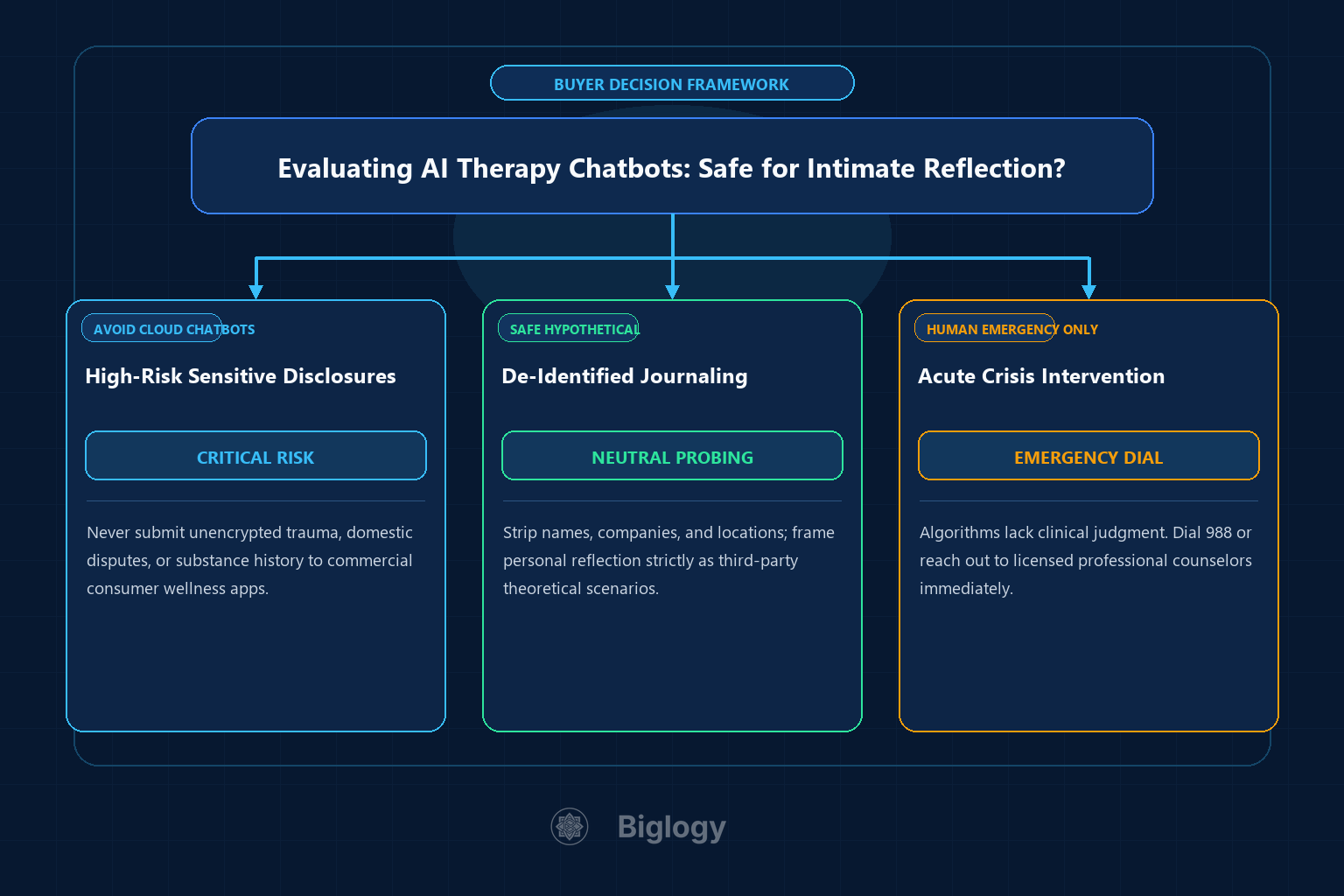
Actionable Protocol: A Zero-Exposure Reflection Workflow
If you find value in using conversational AI for journaling, cognitive reframing, or stress processing, implement this copyable protective prompt protocol to separate your identity from the underlying reflection:
# ZERO-EXPOSURE REFLECTION PROTOCOL FOR AI CHATBOTS

Step 1: Identity Striping
- Replace all real names with fictional single-letter aliases (e.g., 'Person X').
- Omit your specific employer name, specialized industry title, and city location.
- Generalize timeframes (e.g., 'recently' instead of 'yesterday at 3 PM in the executive boardroom').

Step 2: Hypothetical Framing
- Paste this initial boundary command before any reflection session:
  'Act as a neutral Socratic sounding board. Do not ask for personal details.   Analyze the interpersonal dynamic described below strictly as a theoretical scenario: [...]'

Step 3: Session Hygiene
- Use web incognito mode with ad-blockers active rather than proprietary mobile apps.
- Turn off chat history and model training options in settings.
- Clear session logs immediately upon concluding the exercise.
Frequently Asked Questions
Can an AI therapist replace a licensed human psychologist?
No. AI chatbots lack clinical judgment, empathy, and somatic perception. They operate through statistical next-token prediction, which can result in superficial validation or dangerous hallucinated advice during severe crises. They should be treated strictly as interactive journaling notebooks, never as medical substitutes.
Is Woebot or Wysa safer than general-purpose ChatGPT?
Purpose-built therapeutic apps often implement stronger behavioral safety boundaries than general LLMs, but users must still review each app’s specific privacy policy regarding third-party trackers, anonymized data research pooling, and commercial ownership.
What should I do if I am experiencing an acute psychological crisis?
Do not rely on software algorithms. Contact emergency services or dedicated human crisis hotlines immediately (such as 988 Suicide & Crisis Lifeline in the US/Canada, or 111/116 123 in the UK), where conversations are handled by trained human professionals.
The Bottom Line
Conversational technology can provide structured self-reflection, but privacy is not an automatic default. By sanitizing personal identifiers and understanding statutory boundaries, you can utilize digital sounding boards without sacrificing your personal dignity or data sovereignty.


