

AI and the Future of Work: A Pragmatic Upskilling Guide vs Automation Anxiety (2026)
Headlines warning that artificial intelligence will eliminate millions of white-collar careers produce widespread professional anxiety. Yet treating AI as a monolithic job-destroyer obscures how technological transitions actually unfold in practice. AI does not typically replace entire jobs all at once; it unbundles individual discrete tasks, automating rote data synthesis, drafting, and boilerplate coding, while dramatically amplifying the premium on judgment, accountability, contextual integration, and ethical discernment.
You are far less likely to be replaced by an artificial intelligence than you are to be outperformed by a peer who knows how to direct, verify, and synthesize AI outputs into trustworthy business outcomes.
The Anatomy of Task Unbundling: What Fades vs What Grows
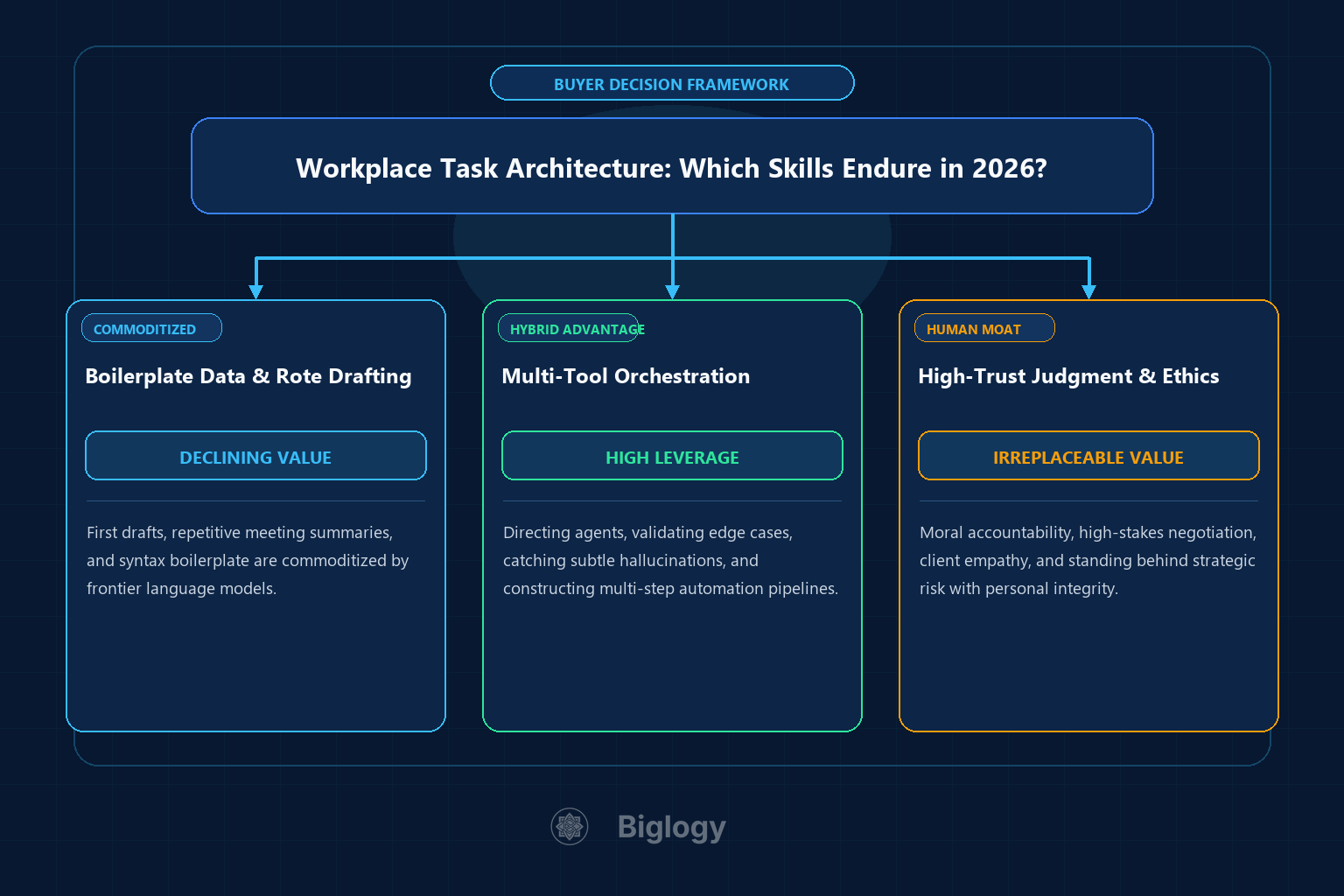
Every professional role comprises a blend of three operational tiers. Understanding where your daily hours fall is the essential first step toward career security:
- Tier 1: Commodity Synthesis (Declining Value): Generating first-draft emails, summarising long meetings, translating boilerplate scripts, and basic data entry. These are algorithmic tasks where speed and volume dominate.
- Tier 2: Algorithmic Orchestration (High Current Value): Knowing how to prompt, chain APIs, construct automation workflows, and catch subtle edge cases across tools. This is the hybrid ‘power operator’ layer.
- Tier 3: Contextual Judgment & Moral Accountability (Durable Value): High-stakes negotiation, ethical stewardship, deciding which problems actually matter, and standing behind business decisions with legal and moral responsibility.
The Career Resilience Matrix: Auditing Your Value Proposition
Audit your current weekly tasks against this diagnostic matrix to identify where to redirect your personal learning hours:
| Professional Domain | Automatable Commodity (Low Leverage) | AI-Augmented Hybrid Workflow | Irreplaceable Human Core (High Leverage) |
|---|---|---|---|
| Software Engineering | Writing standard CRUD APIs and regex patterns | Directing AI agents to scaffold architecture & test suites | System reliability design, trade-off analysis, user empathy |
| Content & Marketing | Churning generic SEO articles and social snippets | Rapid market research aggregation and tone styling | Original investigative reporting, brand voice, editorial truth |
| Finance & Analysis | Reconciling ledger entries and formatting tables | Automating scenario modeling and variance detection | Capital allocation strategy, risk tolerance, investor trust |
| Sales & Business Dev | Sending mass cold email templates at scale | Enriching account intelligence and intent signals | High-trust enterprise discovery, empathy, complex closing |
As explored in our decision guide on what not to automate, true organizational resilience comes from knowing which human touchpoints must remain deliberately unhurried.
Career Transformation Blueprint: The Orchestrator Shift
This structured progression model illustrates how to shift from an easily commoditized executor into a high-leverage orchestrator:
The 90-Day Upskilling Protocol: From Executor to Director
Implement this structured quarterly upskilling regime without buying expensive speculative courses or bootcamps:
# 90-DAY PRAGMATIC UPSKILLING BLUEPRINT

Month 1: Tool Mastery & Verification
- Master one frontier LLM (e.g., Claude, ChatGPT) and one automation tool (Make or n8n).
- Build personal verification checklists: Never paste AI outputs into work deliverables without manual spot-auditing.

Month 2: Workflow Automation
- Identify the single most repetitive task in your current job (e.g., weekly status reporting).
- Automate 60% of the rote data gathering, document the workflow, and present it to your team as an internal efficiency win.

Month 3: Domain Deepening & Human Moats
- Reallocate the saved 5 hours/week into high-touch relationship building, cross-departmental collaboration,   or acquiring deep regulatory/industry-specific domain knowledge that models cannot access.
Frequently Asked Questions
Should junior professionals be worried about entry-level roles disappearing?
Entry-level roles are evolving. Organizations that replace junior staff with raw AI often suffer from long-term leadership talent pipelines. Junior professionals who distinguish themselves demonstrate high curiosity, verification rigor, and an eagerness to take on unstructured, messy human coordination tasks that algorithms struggle to solve.
Is learning prompt engineering a viable long-term career?
No. Standalone ‘prompt engineering’ is rapidly diminishing as models become better at natural language reasoning. What endures is deep subject matter expertise combined with systemic workflow thinking.
How can I communicate my AI capabilities to employers without sounding like a hype merchant?
Focus on business outcomes rather than tool names. Instead of saying ‘I am an AI prompt expert,’ say: ‘I reduced our client onboarding turnaround from 5 days to 24 hours while maintaining 100% human QA verification and data compliance.’
The Bottom Line
Panic is an unproductive career strategy. By continuously migrating your personal hours from mechanical execution toward strategic orchestration and empathetic collaboration, you turn technological disruption into your greatest professional asset.
Related posts:
 Helium 10 MCP Review: Can It Really Turn Amazon Data Into an AI Conversation?
 What Is Human-Centered SEO? Focusing on the Problem, Not the Keyword
 How to Verify AI Answers at Work Without Rewriting Everything
 Comprehensive Glossary of Project Management Terminology: Understanding Key Concepts and Techniques

