

The Dark Side of AI Content: How to Detect Hallucinations and Audit Machine Claims
Generative AI tools produce fluent, authoritative prose at superhuman speed. Yet their greatest strength—statistical fluency—is also their greatest vulnerability. Large language models do not retrieve facts from a verified relational database; they generate linguistic sequences based on probabilistic token likelihood. As a result, an AI model can compose a mathematically precise explanation of a medical study, legal statute, or financial benchmark that is completely fabricated from beginning to end.
Fluency is not veracity. The more confident and articulate an AI model sounds, the more vigilance is required to verify every factual claim, date, formula, and quotation.
Why Hallucinations Occur: The Mechanics of Plausible Fiction
Hallucinations are not software bugs that will simply disappear with the next patch; they are intrinsic to how probabilistic transformers function:
- Pattern Completion Over Fact Verification: LLMs predict what words typically follow other words, not whether the resulting assertion corresponds to physical reality.
- Sycophancy and Leading Prompts: Models are optimized to satisfy user intent. If you ask, ‘Why did Company X lose 40% of its market share in 2024?’, an ungrounded model will often invent a plausible market crisis rather than gently correct your premise.
- Synthetic Source Hallucination: When asked for academic citations or legal precedents, models synthesize plausible journal titles, realistic author names, and valid-looking DOIs that do not exist in any index.
The 4-Tier Verification Matrix: From Claim to Primary Proof
To prevent reputational damage or regulatory liability, editorial teams and analysts must subject all AI outputs to this verification rubric:
| Claim Category | Hallucination Likelihood | Minimum Verification Requirement | Primary Evidence Standard |
|---|---|---|---|
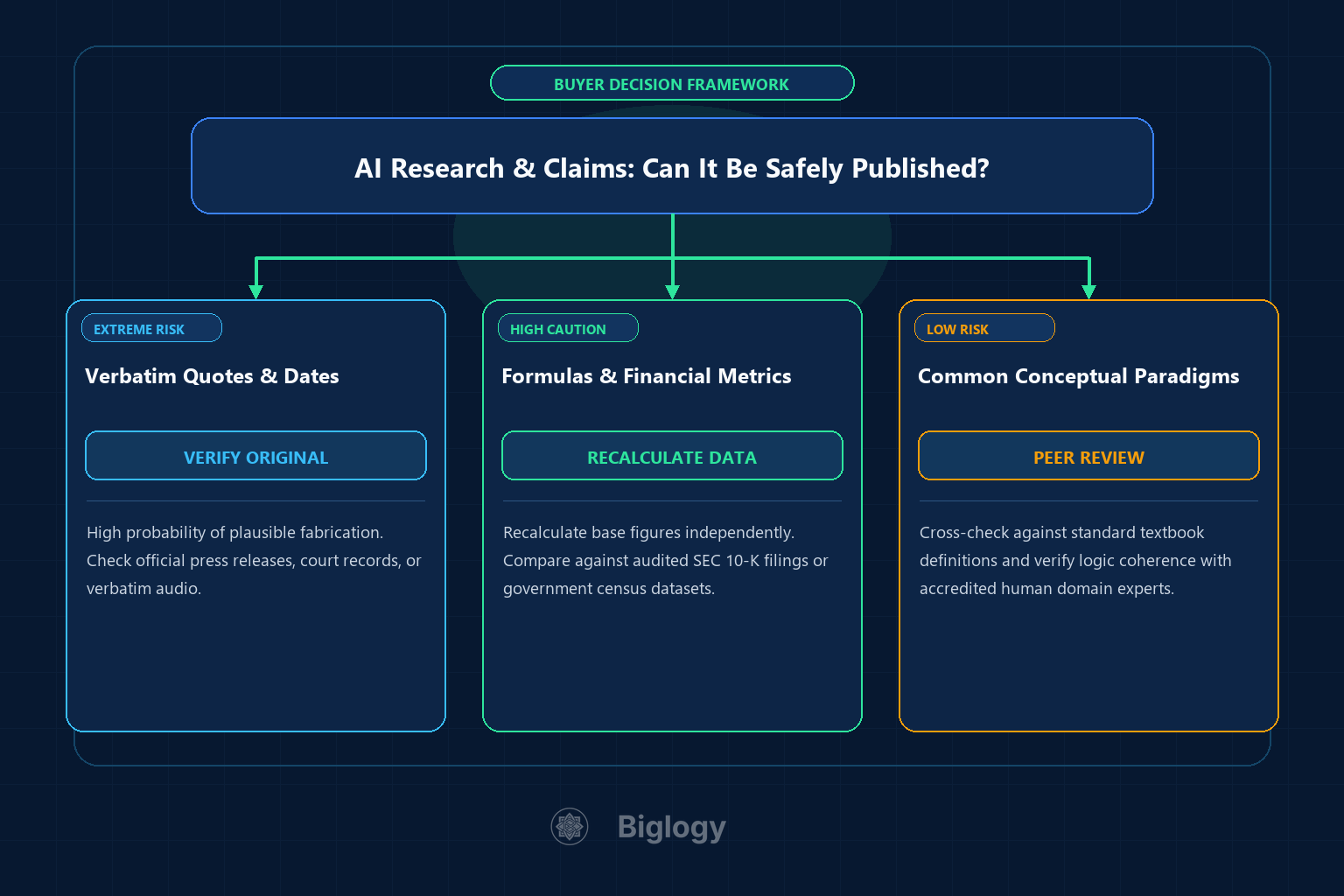
| Direct Quotations | Extremely High (>45%) | Exact verbatim search in primary transcript | Time-stamped audio/video or official press release |
| Statistical Metrics | High (>30%) | Recalculate formulas; cross-reference base dataset | Official audited 10-K filing or government census |
| Legal / Regulatory Rules | High (>35%) | Cross-reference exact statutory article & section | Official government gazette or court judgment text |
| Software Technical Specs | Moderate (~20%) | Verify current live vendor documentation | Executable local command or verified API schema |
| Conceptual Explanations | Low (~5%) | Domain expert review for logical coherence | Standard peer-reviewed textbook definition |
Our core guide on verifying AI answers at work and our Software Evaluation Methodology demonstrate that unverified machine output must never be passed directly to clients or public readers.
Systemic Audit Pipeline: The Editorial Truth Funnel
This structured audit flow outlines the exact sequence required before any AI-generated claim is accepted as fact:
Copyable Inspection Prompt: The Multi-Perspective Cross-Examiner
Use this automated cross-examination prompt to force an LLM to stress-test its own previous claims and identify unsupported assertions:
# AI OUTPUT AUDIT PROMPT: ADVERSARIAL FACT-CHECKER

Review the text provided below strictly through the lens of an aggressive forensic fact-checker:

1. Extract every distinct factual claim, metric, date, name, and citation into a bulleted list.
2. For each claim, assign a confidence rating: [VERIFIED COMMON KNOWLEDGE], [REQUIRES PRIMARY CITATION], or [SUSPECT/PLAUSIBLE FICTION].
3. Identify any citations, book titles, or URLs and explicitly check if they could be synthetic composites.
4. Provide the exact Google/PubMed search query required to verify the 3 most critical claims independently.

[PASTE DRAFT OUTPUT HERE]
Frequently Asked Questions
Do newer models like GPT-4o or Claude 3.5 Sonnet still hallucinate?
Yes. While frontier models hallucinate less frequently than earlier versions, their increased fluency makes their errors far more deceptive and harder to detect without deliberate verification.
Can Retrieval-Augmented Generation (RAG) completely eliminate hallucinations?
No. RAG significantly reduces factual drift by grounding models in retrieved documents, but models can still misinterpret complex clauses, extrapolate beyond the source text, or fabricate connections between unrelated retrieved chunks.
What is the legal liability of publishing an AI hallucination?
Courts across multiple jurisdictions have established that publishers, lawyers, and businesses bear full legal responsibility for defamatory or inaccurate statements published under their name, regardless of whether an AI system generated the underlying text.
The Bottom Line
Generative AI is a powerful brainstorming partner and drafting assistant, but it possesses zero epistemic responsibility. Your human domain knowledge, investigative skepticism, and editorial rigor remain the indispensable foundation of reliable communication.


