

AI in Hiring: How Algorithmic Bias Creeps Into Recruitment Tools (and How to Audit It)
Recruitment departments inundated with thousands of applications for a single open position have enthusiastically embraced automated screening tools. Modern HR platforms promise to scan resumes, analyze video interview cadence, score candidate aptitude, and surface the ‘top 1% of talent’ in seconds. However, these systems do not operate with neutral objectivity. Because algorithms are trained on historical employment data, they frequently learn and institutionalize the exact discriminatory biases that fair hiring legislation was designed to eradicate.
When you train a machine-learning model on historical corporate successes, you are not training it to identify future excellence—you are training it to replicate past demographic privilege.
How Algorithmic Bias Enters Recruitment Pipelines
Bias in hiring algorithms rarely manifests as overt exclusion; it operates through sophisticated, subtle proxy variables:
- Historical Training Imbalances: If an engineering department was historically 85% male, an algorithm will mathematically associate male-correlated markers (such as participation in specific sports clubs or all-male collegiate institutions) with candidate success.
- Proxy Variable Discrimination: Even when explicit demographic data (gender, race, age) is redacted, algorithms pick up proxy indicators—such as postal zip codes, graduation dates, or non-standard employment gaps—effectively reconstructing the protected characteristics.
- Video & Voice Affect Analysis: Automated video platforms that score micro-expressions, speech cadence, and gaze direction severely disadvantage neurodivergent applicants, non-native English speakers, and individuals with speech differences.
Algorithmic Risk Assessment Matrix for HR Platforms
Before procuring or renewing any AI-driven recruitment software, HR teams must audit the technology against this risk hierarchy:
| Recruitment Tool Feature | Inherent Bias Risk Level | Regulatory Exposure (EEOC / EU AI Act) | Recommended Governance Control |
|---|---|---|---|
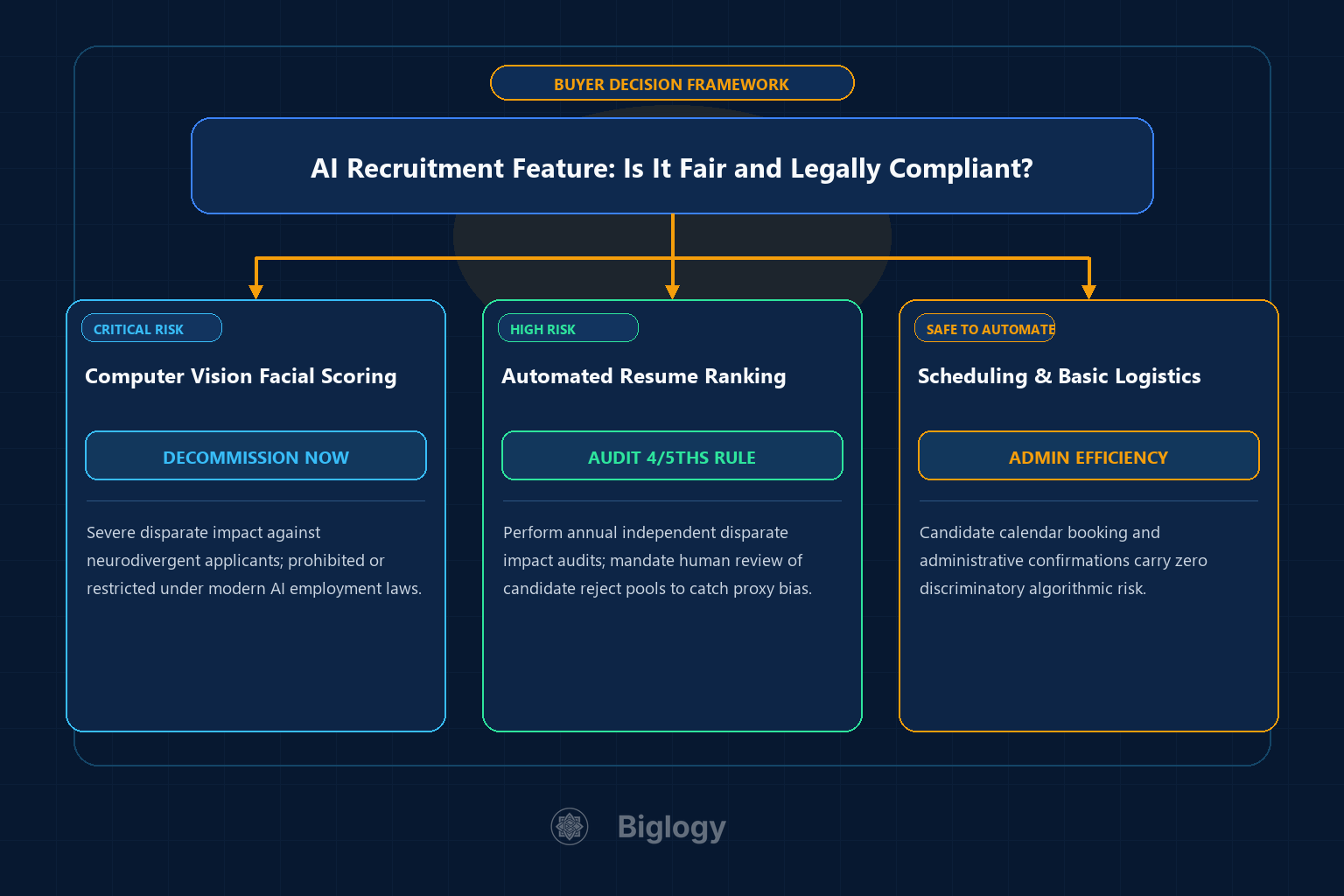
| Computer Vision Affect Scoring | Critical (Severe Disparate Impact) | High Risk / Prohibited in some regions | Immediately decommission; return to structured human interviews |
| Automated Resume Ranking | High (Proxy Discrimination) | Mandatory independent bias audit required | Enforce blind rubric scoring; mandate human review of rejected tiers |
| Psychometric AI Chatbots | Moderate (Cultural Bias) | Potential discrimination under ADA/disability rules | Offer standardized manual accessibility alternatives |
| Automated Interview Scheduling | Low (Administrative) | Negligible regulatory friction | Safe to automate fully without bias monitoring |
Our analysis aligns with our Publishing Charter and the Biglogy Software Evaluation Framework, requiring that technology serve human dignity and fair opportunity rather than opaque corporate filtering.
Governance Framework: The Fair-Hire Algorithmic Filter
This decision workflow maps the essential human oversight checkpoints required at every phase of automated candidate intake:
Copyable HR Audit Template: Vendor Bias Verification Checklist
Submit these mandatory questions to any HR software vendor prior to contract signing or automated deployment:
# MANDATORY HR VENDOR ALGORITHMIC BIAS QUESTIONNAIRE

1. Independent Audit Verification:
   - Has your matching algorithm underwent a formal third-party Disparate Impact Ratio audit?
   - Can you provide the four-fifths rule compliance report across protected demographic classes for the last 12 months?

2. Proxy Data De-identification:
   - Does your parsing engine explicitly strip graduation years, collegiate names, and geographic zip codes before scoring?
   - What safeguards prevent the model from penalizing non-linear career gaps associated with family caregiving?

3. Candidate Recourse & Explanation:
   - Can the platform generate an explainable, plain-language breakdown of why an applicant was disqualified?
   - Does your system provide an immediate opt-out mechanism allowing candidates to request human evaluation?
Frequently Asked Questions
What is New York City Local Law 144, and why does it matter?
NYC Local Law 144 is pioneering legislation that mandates annual independent bias audits for any Automated Employment Decision Tool (AEDT) used to evaluate candidates living in NYC. It reflects a growing global trend holding employers strictly liable for algorithmic discrimination.
How can job candidates protect themselves against algorithmic filtering?
Job seekers should avoid complex graphic resume formats (columns, tables, images) that confuse parsing engines. Use clear, standardized job titles and weave exact keywords from the job description directly into measurable, evidence-based accomplishment bullets.
Can an algorithm ever make hiring completely fair?
Algorithms can remove arbitrary individual human prejudices (such as hiring someone because they went to the same sports game), but only when strictly designed, audited, and constrained by human oversight. They cannot create ethical fairness from uncurated historical data.
The Bottom Line
Efficiency cannot come at the expense of human equity. By conducting rigorous independent bias audits and maintaining mandatory human decision gates, organizations can streamline candidate communication without sacrificing fairness or missing transformative talent.


