

Mangools vs Ahrefs for Budget SEO: 2026 Feature and Cost Comparison
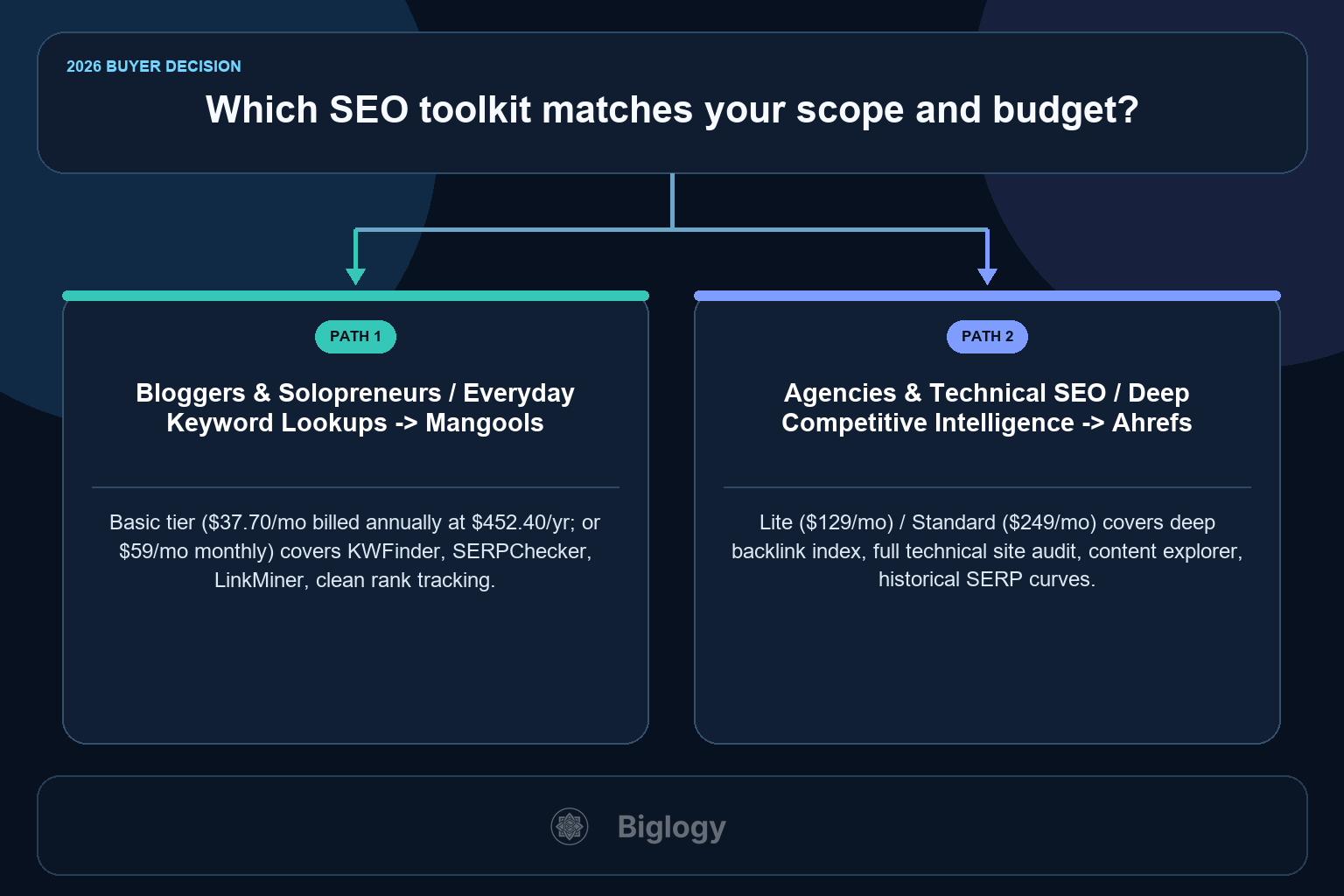
Quick verdict: Choose Mangools if your work is mainly keyword research, SERP review, rank tracking, and light backlink discovery—and you value a lower annual cost and a simpler workflow. Content publishers considering larger all-in-one SEO suites can also read our Semrush review for small content sites or our guide to Surfer alternatives. Choose Ahrefs if technical audits, deep competitor research, historical data, content prospecting, and serious backlink analysis directly contribute to revenue. Ahrefs is the more capable platform; Mangools is often the better-value tool for a smaller job.
Pricing and plan limits were checked on November 11, 2026. Vendors can change prices, limits, and regional taxes, so verify the checkout page before subscribing. This comparison is based on current vendor documentation and workflow analysis, not a controlled hands-on data-accuracy benchmark.
Disclosure: This draft contains no affiliate-tracked links. Mangools operates an affiliate program, which is disclosed later because it creates a potential editorial incentive. The recommendation below is based on user fit, not commission availability.
Mangools vs Ahrefs at a glance
| Decision factor | Mangools | Ahrefs |
|---|---|---|
| Best for | Bloggers, solopreneurs, small businesses, and smaller content teams | SEO consultants, agencies, technical SEO teams, and larger content operations |
| Core strength | Focused, approachable SEO workflow at a lower price | Broad competitive intelligence and deeper backlink, audit, and historical analysis |
| Keyword research | KWFinder with keyword ideas, difficulty, and SERP context | Keywords Explorer with broader research, clustering, intent, and historical workflows depending on plan |
| Backlink research | LinkMiner for focused opportunity review | Site Explorer for deeper backlink profiles, filters, history, and competitor analysis |
| Technical SEO | No full crawler comparable to Ahrefs Site Audit | Site Audit with large crawl allowances and extensive technical checks |
| Content research | Mostly keyword and manual SERP-led | Content Explorer begins on Standard, plus broader competitive reports |
| Rank tracking | 200/700/1,500 tracked keywords on Basic/Premium/Agency; weekly except daily on Agency | 750/2,000/5,000 on Lite/Standard/Advanced; weekly updates on the current pricing table |
| Usage model | Explicit daily lookup and monthly backlink limits | Lite uses credits; Standard and higher use unlimited credits subject to fair usage |
| Closest paid-workflow comparison | Basic: $452.40/year on the annual view | Lite: $129/month; Ahrefs says annual billing charges for 10 months |
The important point is that these are not equivalent products at different prices. Mangools covers a narrower set of recurring SEO jobs. Ahrefs gives you more ways to investigate a site, market, or competitor. Paying for Ahrefs only makes sense if those additional workflows change decisions or save enough billable time to justify the difference.
What each platform actually includes
Mangools separates its workflow into five named tools:
- KWFinder for keyword discovery and difficulty review.
- SERPChecker for localized results-page analysis.
- SERPWatcher for rank tracking.
- LinkMiner for backlink review and link-opportunity discovery.
- SiteProfiler for a quick domain and competitor overview.
That separation is useful for a small team. A writer can open KWFinder, inspect a term, review the live SERP context, and add selected phrases to tracking without learning a large research platform. The tradeoff is scope. Mangools does not offer a technical crawler or a content-research database comparable to Ahrefs Site Audit and Content Explorer.
Ahrefs is a broader marketing and SEO platform. Its current paid plans center on Site Explorer, Keywords Explorer, Site Audit, Rank Tracker, competitive analysis, web analytics, API/MCP access, and reporting. Standard adds Content Explorer, Batch Analysis, more Site Explorer reports, keyword clusters, and additional research features. This breadth matters when the work goes beyond choosing keywords—for example, diagnosing a large site, comparing competitor sections, tracing lost links, or building a prospect list from historical data.
The practical difference is workflow depth. Mangools helps answer, “What should I target, how hard is the SERP, and where do I rank?” Ahrefs can also help answer, “Which competitor sections are growing, what links changed, what technical issues exist at scale, and which content or link opportunities deserve investigation?”
Keyword research: simplicity or investigative depth?
KWFinder is the clearest reason to buy Mangools. It combines keyword ideas, search-volume trends, keyword difficulty, and a SERP preview in a focused interface. For a blogger or a small content team, that may be enough to move from a seed topic to a defensible shortlist without wandering through dozens of reports.
Ahrefs Keywords Explorer is better suited to deeper expansion and prioritization. Depending on the plan, Ahrefs adds larger lists, historical views, clustering, search-intent features, SERP updates, and tighter connections to competitor data. That makes it more useful when keyword research is not a one-off task but part of a repeatable content operation (see our guide on keyword research tools usage and verifying SaaS pricing).
Neither vendor’s metric should be treated as ground truth. Search volume, traffic estimates, and difficulty scores are modeled values. Use them to compare opportunities, then inspect the actual search results and validate performance with first-party data such as Google Search Console once content is live.
Decision: Mangools is the more efficient choice when you need a clear keyword-to-SERP workflow. Ahrefs earns its premium when you regularly connect keywords to competitor history, site sections, backlinks, and broader content research.
Backlinks and competitor research: where Ahrefs pulls away
LinkMiner can surface competitor backlinks, new and lost links, link attributes, and page previews. That is useful for a modest outreach list or a quick look at how a competitor earned links.
Ahrefs Site Explorer is built for a much larger research surface. Ahrefs currently advertises 35 trillion live backlinks, 23 billion pages, and more than 10 years of historical data. Those are vendor-stated index metrics, not independent proof that every result is more accurate. They do, however, show the intended scale of the product, and the platform exposes far more filters, historical comparisons, organic-search reports, paid-traffic context, and competitor views than LinkMiner.
If link building is occasional, Mangools may be enough. If backlink analysis is a service you sell, a recurring acquisition channel, or a core part of digital PR, Ahrefs is the safer operational choice because the research and historical workflows are materially deeper.
Technical SEO and content research
This is the least ambiguous part of the comparison. Mangools does not have a direct replacement for Ahrefs Site Audit. Ahrefs Lite currently includes 100,000 crawl credits per month and a maximum of 25,000 pages per unverified project; Standard increases those figures to 500,000 credits and 50,000 pages. Ahrefs also provides audit access for verified sites through Ahrefs Free, though at much lower limits.
Ahrefs Standard also unlocks Content Explorer. That matters for content teams that research high-performing pages, linkable topics, authors, and prospecting opportunities across a large database. Mangools can support content planning through keyword research and manual SERP analysis, but it is not a substitute for that workflow.
If you run a small brochure site or blog, you may not need this depth every month. If you manage a large ecommerce site, migration, international setup, or client portfolio, technical crawl and historical research can justify Ahrefs on their own.
2026 pricing and the real cost gap
Mangools’ current pricing page presents an SEO + AI bundle and says prices can depend on country and billing cycle. On the annual view checked for this article, the plans were:
| Mangools plan | Effective monthly price on annual billing | Annual charge | Selected limits |
|---|---|---|---|
| Basic | $37.70 | $452.40 | 100 keyword and 100 SERP lookups per 24 hours; 200 tracked keywords; no extra seats |
| Premium | $52.70 | $632.40 | 500 keyword and 500 SERP lookups per 24 hours; 700 tracked keywords; 3 extra seats |
| Agency | $97.70 | $1,172.40 | 1,200 keyword and 1,200 SERP lookups per 24 hours; 1,500 tracked keywords; 5 extra seats; daily rank updates |
Ahrefs also offers a $29/month Starter plan, but it is intentionally restricted: it includes 200 credits, one unverified project, no report exports, and smaller result limits. It can be useful for occasional research, but it is not the closest functional comparison with the complete Mangools paid toolset.
For fuller paid workflows, Ahrefs’ current month-to-month prices are $129 for Lite, $249 for Standard, and $449 for Advanced. The company says annual billing charges for ten months and provides twelve months of access. That makes the approximate annual charges $1,290, $2,490, and $4,490 before tax.
Comparing the closest practical paid-workflow commitments, Mangools Basic is about $837.60 less per year than Ahrefs Lite. That is a meaningful saving, but it is not a like-for-like discount: Ahrefs Lite includes a technical audit, deeper competitor research, more tracked keywords, and broader data access. The right question is not “Which subscription is cheaper?” It is “Which extra Ahrefs workflows will we use often enough to recover $837.60?” If your needs fit Ahrefs Starter’s small credit and export limits, compare Starter separately instead of using this annual gap.
Ahrefs credits: what the old “credit trap” warning gets wrong
The blanket claim that every Ahrefs plan is constrained by a small credit allowance is outdated.
Current Starter and Lite plans are credit based. Ahrefs Lite includes 1,000 credits per user per month. In credit-based tools, opening reports, applying filters, and requesting additional data can consume credits; Site Audit and Rank Tracker are excluded from that credit system. Ahrefs lets administrators monitor usage, and pay-as-you-go additional credits are disabled by default.
Current Standard, Advanced, and Enterprise plans use unlimited credits under a fair-use policy. They still have feature, export, crawl, project, and API limits, and abnormal automation or abusive use can be restricted, but ordinary report exploration is not governed by the Lite credit quota.
This distinction changes the buying advice. Lite users should monitor credits and test whether 1,000 is enough for their research pattern. A consultant who constantly opens competitor reports and applies filters should compare Lite against Standard, not assume that the same credit ceiling follows every upgrade.
Two realistic buying scenarios
Scenario 1: solo publisher or small business
You manage one or two sites, publish several articles per month, track fewer than 200 keywords, and mostly need keyword ideas, SERP review, basic rank tracking, and occasional backlink discovery.
Mangools Basic is the more rational default. Its annual price is far lower, and the focused tools cover the recurring jobs. Pairing Mangools with Google Search Console and the limited Ahrefs Free reports for verified sites can cover first-party performance checks and occasional technical or backlink review. The limitation is competitor depth: Ahrefs Free is designed around sites you can verify, not unrestricted competitive research.
Scenario 2: SEO consultant, agency, or in-house growth team
You manage many sites, diagnose technical issues, compare historical competitor performance, build link campaigns, export substantial data, and turn research into client or revenue decisions.
Ahrefs Standard is the more credible starting point than Lite. Standard includes Content Explorer, more competitive reports, two years of history, 2,000 tracked keywords, 500,000 crawl credits, larger exports, and unlimited credits under fair usage. It costs much more, but it reduces the need to stitch together separate audit, content-research, backlink, and competitive-intelligence tools.
Could a hybrid setup be better?
Yes. A budget-conscious publisher can use Mangools for routine keyword and ranking work, Google Search Console for owned-site performance, and Ahrefs Free for limited audits and backlink data on verified properties. When a migration, link campaign, or major competitor study arises, the team can evaluate a short Ahrefs subscription or project-specific access.
The hybrid approach stops working when deep research becomes weekly work. At that point, the time spent switching tools, accepting small limits, and rebuilding reports can cost more than the subscription saving.
Affiliate-program disclosure and editorial risk
Mangools currently advertises affiliate tiers of 25%, 30%, and 35%, with up to 35% recurring commission, a 30-day registration window, and a $150 payout threshold. Its help documentation also describes conditions on renewals and payouts. Those terms belong to the publisher side of the relationship; they do not make Mangools a better product for the reader.
This article does not contain an affiliate-tracked link in its current draft. If one is added later, the published page should carry a clear disclosure near the first commercial link, and the recommendation should remain unchanged unless product evidence changes.
Frequently asked questions
Is Mangools as powerful as Ahrefs?
No. Mangools covers a useful subset of SEO work with simpler tools. Ahrefs offers broader and deeper competitor, backlink, historical, technical-audit, and content-research workflows. Mangools can still be the better purchase when you do not need that depth.
Is Ahrefs worth the extra cost for a blogger?
Usually not for a small blog focused on keyword research and rank tracking. It becomes easier to justify when backlink acquisition, technical audits, or competitor research materially affect revenue. Try to name the specific Ahrefs reports you will use each month before paying.
Does Ahrefs still limit every action with credits?
No. Current Starter and Lite plans are credit based; Lite includes 1,000 monthly credits per user. Current Standard and higher plans use unlimited credits under fair usage, while retaining other plan limits.
Can Mangools perform a full technical SEO audit?
Not in the same way as Ahrefs Site Audit. Mangools’ suite focuses on keywords, SERPs, rankings, backlinks, and site profiles. Use a dedicated crawler or an audit platform if technical SEO is central to the job.
What is the best low-cost setup?
For a verified site, a practical low-cost stack is Mangools for keyword and rank workflows, Google Search Console for first-party search performance, and Ahrefs Free for limited site auditing and backlink visibility. Confirm that Mangools’ daily lookup and tracked-keyword limits fit your workload before subscribing.
Final verdict
Choose Mangools when your SEO process is small enough to fit its limits and your main goal is to turn keyword ideas into content decisions without paying for a large research platform. It is especially sensible for solo publishers, smaller businesses, and content-led freelancers.
Choose Ahrefs when backlink intelligence, technical crawling, historical competitor analysis, content prospecting, and larger exports are recurring parts of the job. For intensive research, compare Standard with Mangools—not just Lite—because Standard removes the monthly credit ceiling under fair usage and unlocks important research features.
The simplest purchasing test is this: list the three Ahrefs-only workflows you expect to use every month and assign each a time or revenue value. If their combined value exceeds roughly $837.60 per year over Mangools Basic, Ahrefs may earn its premium. If you cannot name those workflows, Mangools is likely the more disciplined choice.
Sources checked
- Mangools plans and pricing
- Mangools plan limits
- Ahrefs plans and pricing
- Ahrefs pricing and billing FAQ
- Ahrefs credit-based plan guidance
- Ahrefs Free / Webmaster Tools
- Ahrefs Site Explorer
- Mangools affiliate program
Related posts:
 What to Look for When Choosing an SEO Tool? The Difference Between Keywords, Backlinks, Rank Tracking, and Audits
 Is Backlink Analysis Necessary for Every Website?
 Semrush Review for Small Content Sites: 2026 Feature Breakdown and Value Analysis
 Surfer vs Frase for Solo SEO Publishers: 2026 Comparison, Pricing, and Workflow Reality


Trackbacks & Pingbacks
[…] our standalone Semrush review for small content sites, compare lightweight keyword options in our Mangools vs Ahrefs breakdown, and review on-page editorial tooling in our Surfer SEO review and Surfer vs Frase […]
[…] Mangools omits a full technical crawler, growing publishers should compare alternatives in our Mangools vs Ahrefs comparison and our Semrush review for small content […]
[…] as value. Publishers looking for simpler or more budget-friendly alternatives can also review our Mangools vs Ahrefs comparison or our in-depth Surfer SEO review. For a small content site, the real question is whether you will […]
Leave a Reply
Want to join the discussion?Feel free to contribute!