

SaaS Pricing Dark Patterns: How to Spot Checkout Traps, Auto-Upgrades, and Hidden Fees
Quick checkout warning: Software vendors increasingly rely on behavioral friction and deceptive design to extract higher contract values. The most common traps include pre-checked annual toggles disguised as monthly rates, hidden mandatory seat minimums that double checkout totals, unannounced usage overage multipliers, and cancellation labyrinths that force customers onto sales retention calls. Always audit checkout fine print before submitting payment.
Transparent pricing respects buyer autonomy. When a company hides its real renewal terms or makes canceling harder than subscribing, they are substituting manipulative friction for product value.
The Rise of Subscription Traps in Business Software
Dark patterns are no longer confined to shady consumer apps; they have infected mainstream B2B software checkout flows. A founder signs up for what looks like a $29/month tool, only to see a $348 lump-sum charge hit their credit card because a tiny toggle defaulted to annual billing. Regulatory bodies like the US Federal Trade Commission (FTC Dark Patterns Report) and European consumer protection agencies are cracking down on deceptive renewal flows—yet buyers must remain vigilant.
Combined with Biglogy’s established guide on how to verify SaaS pricing tables and checkout traps, this audit checklist helps you catch predatory terms before entering billing details.
Five Dangerous SaaS Pricing Traps Ranked by Financial Impact
| Dark Pattern | How It Traps Buyers | How to Defend Yourself |
|---|---|---|
| 1. The Disguised Annual Toggle | Pricing page highlights ‘$25/mo’ in giant font, while fine print notes ‘billed annually ($300 upfront)’. Checkout page defaults to annual. | Verify the exact checkout total on the credit card review screen before clicking Submit. |
| 2. Phantom Seat / User Minimums | Advertises $15/seat, but checkout enforces a mandatory 3-seat or 5-seat minimum tier. | Calculate total monthly commitment rather than single-seat marketing rates. |
| 3. Contact / Task Overage Cliffs | Exceeding plan limits by 1 contact or 10 tasks triggers automatic upgrade to the next tier ($100+ jump) with zero warning. | Look for ‘hard cap with alerts’ settings vs. automatic tier escalations. |
| 4. Cancellation Phone/Chat Walls | Signing up takes 30 seconds online; canceling requires scheduling a phone call during specific business hours. | Check customer forums before buying: if cancel requires phone calls, use virtual cards with spending limits. |
| 5. Sneaky Auto-Renewal Notice Windows | Annual contracts automatically renew for 12 months unless canceled within a narrow 30-day window 60 days before expiry. | Set calendar reminders immediately upon signup for 45 days prior to contract renewal. |
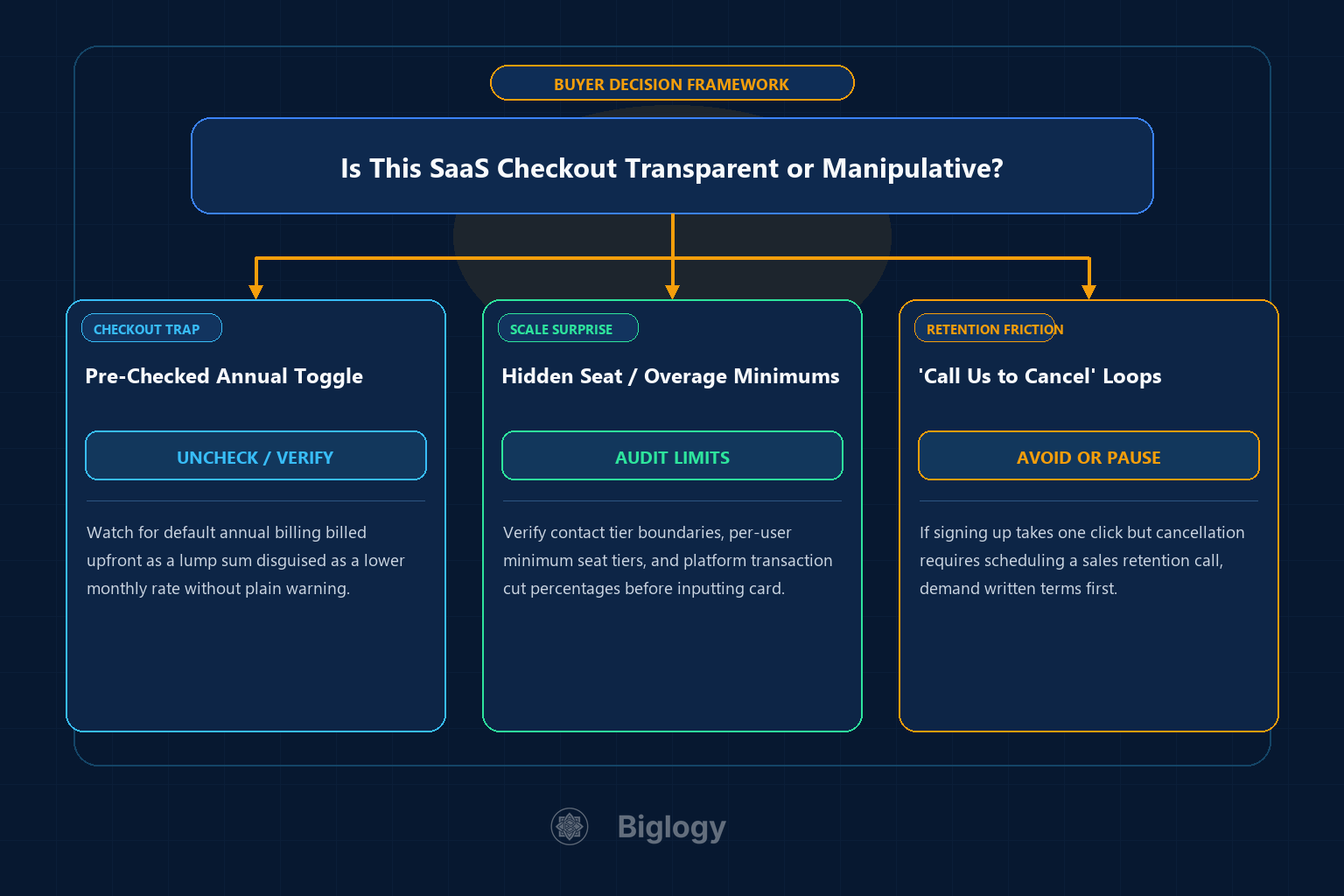
Pre-Purchase Checkout Gate: Inspect Before You Subscribe
Run every new subscription through this 3-branch filter before approving corporate expense card charges.
No-Tool First Step: The 60-Second Virtual Card & Invoice Audit
- Use Virtual Cards with Merchant Spending Limits: Generate a dedicated virtual card (via Privacy.com, Revolut, or your corporate banking suite) capped at the exact expected monthly amount. If a vendor attempts an unannounced price hike or unauthorized auto-renewal, the charge declines cleanly.
- Inspect Terms of Service for Mandatory Arbitration & Renewal Rules: Search the vendor’s legal page for keywords:
renew,written notice,days prior, andarbitration. - Confirm Instant Online Cancellation Exists: Check the customer support knowledge base for ‘how to cancel’. If the official documentation says ‘please contact your account representative,’ demand a written self-service cancellation guarantee via email.
Copyable Pre-Purchase Subscription Audit Checklist
PRE-PURCHASE SAAS CHECKOUT AUDIT
Tool Name:
Advertised Price: $____/mo   Actual Billed Amount Today: $____

PASS ONLY IF ALL 5 ITEMS ARE SATISFIED:
[ ] 1. BILLING CADENCE: Confirmed whether charge is true monthly vs annual lump sum.
[ ] 2. SEAT INTEGRITY: Verified zero forced minimum seats added to invoice.
[ ] 3. OVERAGE CONTROLS: Confirmed system alerts or pauses before billing overages.
[ ] 4. SELF-SERVICE CANCELLATION: Verified account can be closed via web dashboard.
[ ] 5. CALENDAR REMINDER: Created calendar alert 30 days before trial or annual renewal date.

Audited By: _____________   Date: ____-__-__
Promoting Ethical Software Architecture
At Biglogy, we believe sustainable business software wins on product excellence, reliable infrastructure, and customer trust. Our Publishing Charter and Software Evaluation Methodology explicitly penalize vendors who employ manipulative retention patterns or obscure pricing limits in our editorial ratings.
Frequently Asked Questions
Are pre-checked annual billing boxes illegal?
In many jurisdictions (including the European Union and several US states), dark patterns and negative option billing that deceive consumers into unintended recurring charges face strict regulatory enforcement and fines.
How can I stop a SaaS vendor from billing me if they refuse to cancel online?
Send an explicit cancellation request in writing to their support email, pause or cancel the virtual card linked to the account, and dispute unauthorized subsequent charges with your card issuer citing your written cancellation request.
Why do companies enforce 3-seat minimums?
Vendors enforce seat minimums to elevate Average Revenue Per User (ARPU) and filter out micro-accounts that require support without generating high enterprise margins.
What is the safest way to trial software without getting trapped?
Opt for free trials that do not require credit card entry upfront, or use single-use virtual debit cards with a $1 limit to prevent unexpected post-trial subscription billing.
Does Biglogy accept affiliate compensation from vendors using dark patterns?
No. Under our transparent publishing charter, editorial ratings remain strictly independent of affiliate relationships, and platforms with egregious billing complaints receive explicit warning badges in our buyer reviews.
Editorial transparency: This consumer protection framework is an independent educational asset with zero sponsored placements. Read our complete standards in our Content Philosophy.
Related posts:
 Monthly or Annual? How to Decide on a Payment Plan for a SaaS Subscription?
 How to Verify SaaS Pricing Information: A Buyer’s Guide to Pricing Tables, Checkout Traps, and Plan Limits
 How to Audit Overlapping SaaS Subscriptions Without Disrupting Work
 Why Is It Risky to Purchase Software Without Reading the Terms of Service?


Leave a Reply
Want to join the discussion?Feel free to contribute!