
Self-Hosted n8n vs Make: VPS Setup, Maintenance Hours, and Real TCO (2026)
Quick decision summary: Open-source software is free to download, but hosting it is never free to operate. If your organization runs fewer than 20,000 operations per month and lacks an in-house Linux engineer, Make’s managed cloud ($9 to $29/mo) easily beats self-hosted n8n once server updates, SSL renewal, and downtime monitoring are calculated. However, once volume scales past 50,000 monthly operations, a $10–$20/mo self-hosted n8n instance unlocks massive savings—dropping task costs by up to 80%.
The true cost of self-hosted infrastructure is not the $6 VPS bill; it is the two hours spent debugging Docker logs and PostgreSQL connection pools when an automated webhook goes down on a weekend.
The Open-Source Paradox: Zero License Cost vs. Real Server Overhead
Technical founders and developers often rush to self-host automation tools, believing they can bypass commercial SaaS pricing entirely. While n8n’s Fair-Code / source-available model allows self-hosting without software license fees for internal use, the host environment requires real infrastructure: virtual private servers (VPS), automated offsite volume backups, reverse proxies (Caddy/Nginx), SSL certificates, and database vacuum maintenance. In our established Zapier vs Make vs n8n cost analysis for 1,000 leads, we modeled high-level execution costs; this guide isolates the precise operational engineering overhead of running n8n yourself versus paying Make’s managed cloud.
12-Month Total Cost of Ownership (TCO) Comparison Matrix
| Cost Component | Make Cloud (Core Plan ~10k Ops) | Self-Hosted n8n on Cloud VPS (Hetzer/DO) |
|---|---|---|
| Software License | $9 to $29 / month ($108 – $348 / year) | $0 (Free for internal business workflows) |
| Compute / Hosting | Included (Fully managed multi-tenant cloud) | $6 to $15 / month VPS (2 vCPU, 4GB RAM, SSD) |
| Automated Backups & Storage | Included in platform architecture | $2 to $5 / month (S3 / B2 offsite backup volume) |
| Setup & Configuration Labor | 15 minutes (Instant cloud activation) | 2 to 4 hours (Docker, Traefik/Caddy, DNS, Postgres) |
| Ongoing Maintenance & Upgrades | 0 hours (Managed by vendor engineering) | 1 to 2 hours / month (Security patches, version updates) |
| Est. First-Year Total Cost | $108 – $348 | $144 – $240 (Hosting) + ~$600 in dev hours |
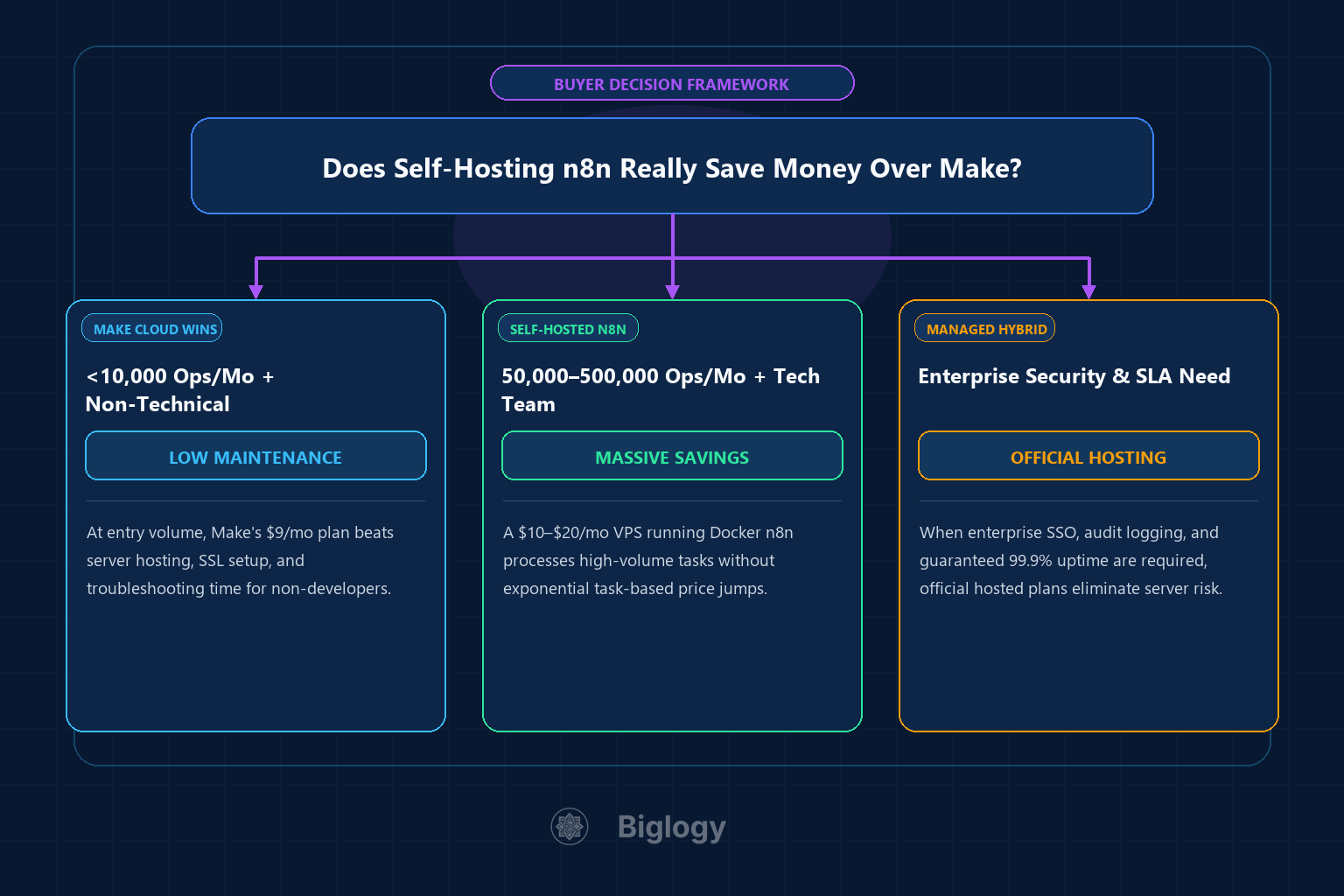
TCO Decision Gate: Volume vs. Technical Maintenance
Use this 3-lane evaluation path to select the right execution environment based on your team’s technical capacity.
No-Tool First Step: Audit Your Monthly Execution Curve
- Map Peak Hourly Volume: Check how many webhook calls fire simultaneously during product launches or batch imports. High concurrency causes cheap VPS instances with <2GB RAM to crash.
- Evaluate Data Sensitivity & GDPR Residency: If company policy forbids customer PII from touching third-party US cloud servers, self-hosted n8n in a regional EU data center (e.g., Frankfurt) satisfies compliance immediately.
- Test Make’s Visual Debugger First: Compare developer productivity using our detailed Make comprehensive review before committing engineering resources to Linux container management.
Production-Grade Docker Compose Template for n8n
If your team chooses the self-hosted route, deploy n8n with an external PostgreSQL database and Caddy reverse proxy for automated HTTPS rather than running on raw SQLite:
# docker-compose.yml
version: '3.8'
services:
  caddy:
    image: caddy:latest
    restart: unless-stopped
    ports:
      - "80:80"
      - "443:443"
    volumes:
      - ./Caddyfile:/etc/caddy/Caddyfile
      - caddy_data:/data
    networks:
      - n8n_net

  postgres:
    image: postgres:15-alpine
    restart: unless-stopped
    environment:
      - POSTGRES_DB=n8n
      - POSTGRES_USER=n8n_user
      - POSTGRES_PASSWORD=SECURE_DB_PASSWORD_HERE
    volumes:
      - db_storage:/var/lib/postgresql/data
    networks:
      - n8n_net

  n8n:
    image: docker.n8n.io/n8nio/n8n:latest
    restart: unless-stopped
    environment:
      - DB_TYPE=postgresdb
      - DB_POSTGRESDB_DATABASE=n8n
      - DB_POSTGRESDB_HOST=postgres
      - DB_POSTGRESDB_USER=n8n_user
      - DB_POSTGRESDB_PASSWORD=SECURE_DB_PASSWORD_HERE
      - N8N_HOST=n8n.yourdomain.com
      - N8N_PORT=5678
      - N8N_PROTOCOL=https
      - WEBHOOK_URL=https://n8n.yourdomain.com/
    volumes:
      - n8n_storage:/home/node/.n8n
    networks:
      - n8n_net

volumes:
  caddy_data:
  db_storage:
  n8n_storage:

networks:
  n8n_net:
Evaluating Architecture Transparency at Biglogy
Whether choosing managed cloud or private infrastructure, software decisions should prioritize operational reliability over ideological purism. Learn how we evaluate automation software and infrastructure economics in our Software Evaluation Methodology and Publishing Charter.
Frequently Asked Questions
Is n8n completely free for commercial companies?
n8n uses a Fair-Code license (Sustainable Use License). It is free to self-host for internal company operations and internal automation, but cannot be re-sold as a hosted commercial multi-tenant service without a commercial license.
What happens if my self-hosted n8n VPS runs out of memory?
When RAM is exhausted, the Linux Out-Of-Memory (OOM) killer will terminate the n8n process, causing silent webhook drops until restarted. We recommend a minimum of 4GB RAM and a 2GB swap file.
How does Make handle task errors compared to self-hosted n8n?
Make provides native error-handler directives (Resume, Rollback, Commit, Ignore) on the visual canvas. n8n offers custom error workflows and sub-workflows, which offer immense flexibility but require manual configuration.
Can I migrate workflows between Make and n8n easily?
No. Both tools use completely different JSON workflow specifications and data mapping syntax. Migrating complex scenarios requires rebuilding logic manually.
Does Make offer private on-premise deployments?
Make is primarily a multi-tenant cloud service, though enterprise custom agreements can provide dedicated private cloud instances at high annual contract values.
Editorial transparency: This technical analysis is non-commercial buyer guidance. Read Biglogy’s full standards in our Content Philosophy.
Related posts:
 Zapier vs Make vs n8n: Real Cost Analysis for Automating 1,000 Leads (2026)
 Make.com vs n8n 2026: Best Automation Platform for Technical and Non-Technical Teams
 Best Workflow Automation Tools for Small Businesses: A Buyer’s Guide
 Zapier Review (2026): Is 7,000+ App Connectivity Worth the Task Pricing?


Leave a Reply
Want to join the discussion?Feel free to contribute!