

Jungle Scout Review for Amazon Sellers: 2026 Pricing, Product Research, and Listing Tools
Research updated: November 11, 2026
Affiliate disclosure: Biglogy has not verified an active Jungle Scout affiliate relationship for this review. The links below point directly to official product and documentation pages; this draft contains no tracked commercial CTA.
Jungle Scout remains one of the most recognizable Amazon seller platforms, but the product is no longer just a Chrome extension for estimating sales. Its current seller platform—Jungle Scout Catalyst—combines product discovery, keyword research, listing tools, supplier research, sales analytics, inventory management, advertising analysis, and review-request workflows.
That breadth can make Jungle Scout genuinely useful. It can also make the buying decision confusing. The least expensive plan excludes several tools that active sellers are likely to need, while the enterprise-oriented Cobalt platform solves a different problem from Catalyst. Pricing looks substantially cheaper when billed annually, but the annual figure is a prepaid commitment rather than a flexible monthly subscription (see our guide to verifying SaaS pricing and plan limits).
This Jungle Scout review explains what the platform can and cannot do, which plan makes sense for different sellers, and how to test its estimates without pretending that third-party software can predict the future.
Jungle Scout review: the short verdict
Jungle Scout Catalyst is a strong fit for private-label Amazon sellers who want a structured workflow for moving from a product idea to keyword research, listing preparation, launch, and ongoing performance monitoring.
Its main strength is not one magical metric. It is the way its tools connect:
- Find a possible niche with Product Database or Opportunity Finder.
- inspect Amazon search results with the browser extension;
- track promising ASINs over time;
- research competitors’ keywords with Keyword Scout;
- prepare a listing with Listing Builder;
- connect Seller Central for sales, advertising, inventory, and profitability workflows.
That sequence is easier to understand than assembling five unrelated research tools.
However, Jungle Scout does not independently verify supplier quality, landed costs, patent risk, regulatory compliance, real conversion rates, or the amount of advertising required to launch a product. Its sales and demand figures are estimates. They should generate hypotheses—not authorize inventory purchases by themselves.
Our verdict at a glance
| Question | Verdict |
|---|---|
| Best for | New and growing private-label Amazon sellers |
| Best-value plan for an active seller | Growth Accelerator, subject to current checkout terms |
| Main advantage | Connected product-research-to-operations workflow |
| Main limitation | Starter excludes many operating and export features |
| Is there a free trial? | No; standard Catalyst plans have a seven-day money-back guarantee |
| Can estimates be treated as actual sales? | No |
| Best alternative for a broader seller stack | Helium 10 |
| Best alternative for reseller sourcing | SellerAmp |
| Best alternative for market and seller intelligence | SmartScout |
| Overall decision | Worth shortlisting if Amazon product research is a recurring workflow—not for a one-off product idea |
Who Jungle Scout is for
Jungle Scout is most appropriate for:
- A prospective private-label seller comparing several product categories.
- A seller preparing a first or second Amazon launch.
- A small brand that wants product, keyword, listing, and basic operating tools in one platform.
- A seller who needs to track product and keyword trends instead of relying on a single day’s Amazon results.
- A small team that will use Seller Central-connected analytics, inventory, advertising, or review-request features.
- An established Amazon brand that needs competitive intelligence, provided it evaluates Brand Owner or Cobalt separately.
Jungle Scout is less compelling for:
- Someone who has not yet decided whether to sell on Amazon.
- A seller who needs only an occasional sales estimate.
- A retail-arbitrage seller whose main question is whether a specific store purchase will be profitable.
- A Walmart-, eBay-, Shopify-, or TikTok-first business.
- A company that requires Vendor Central support; Catalyst is built around Seller Central.
- A brand that needs portfolio-level market share, Buy Box, unauthorized-seller, or executive reporting across a large catalog. Those are closer to Cobalt’s scope.
- Anyone expecting software to identify a guaranteed “winning product.”
What is Jungle Scout?
Jungle Scout is a collection of research and operating tools built primarily for Amazon sellers.
The current product family has two main platforms:
- Jungle Scout Catalyst is the self-service platform for new, smaller, and growing Amazon sellers. It covers product research, keywords, listings, sales analytics, advertising insights, inventory, and review automation.
- Jungle Scout Cobalt is positioned for established brands, agencies, retailers, and teams that need category-level intelligence, market-share analysis, Buy Box monitoring, custom reporting, and advanced advertising analytics.
Jungle Scout also offers an MCP product that exposes Cobalt-powered intelligence through compatible AI environments. It does not turn an ordinary Catalyst subscription into Cobalt. Jungle Scout’s official platform guide treats Catalyst, Cobalt, and MCP as distinct ways of working with its data.
For most readers researching a standard “Jungle Scout subscription,” Catalyst is the relevant product.
Jungle Scout’s main tools
Browser Extension
The browser extension adds research data to Amazon search and product pages. It is designed for quick market inspection: open an Amazon results page, run the extension, and compare listings without manually collecting every ASIN, review count, price, rank, and estimated sales figure.
This is useful for answering questions such as:
- Is revenue concentrated among one or two dominant listings?
- Does the first page contain several products with meaningful demand?
- Are review counts so high that a new entrant would struggle to appear credible?
- Is the apparent opportunity based on one seasonal spike?
- Are prices high enough to leave room for fees, advertising, returns, and landed cost?
The extension is included across the current Catalyst plans. It is a research interface, not proof that a product will sell at the estimated rate.
Product Database
Product Database lets sellers filter Amazon’s catalog by criteria such as category, price, reviews, rank, and estimated sales.
Its proper use is discovery. A seller can define a business model—price range, product size, minimum demand, maximum review competition—and generate candidates for further investigation.
The danger is over-filtering until a supposedly perfect product appears. Product Database does not know whether a supplier quote is viable, whether a design is defensible, whether a category has regulatory complications, or whether advertising costs will erase the margin.
Treat the results as a shortlist.
Opportunity Finder
Opportunity Finder approaches research from the niche or keyword side. Instead of beginning with individual products, it helps identify clusters of demand and competition.
It is most useful when you want to study the shape of a market:
- Is search demand stable or seasonal?
- Are several different products serving the same query?
- Is the niche dominated by a few brands?
- Does the first page show weak listings that a differentiated product could realistically challenge?
Starter currently limits Opportunity Finder to 100 searches per month. Growth Accelerator and Brand Owner provide materially broader access, according to the current Catalyst plan comparison.
Product Tracker
Product Tracker records changes over time for selected products. That is more useful than judging an opportunity from a single snapshot.
A product may look attractive during a temporary promotion, stockout, holiday surge, or short-lived rank improvement. Tracking multiple comparable ASINs for several weeks can reveal whether the category is stable, volatile, or seasonal.
Current published limits are:
| Plan | Products tracked | Historical product-tracking data |
|---|---|---|
| Starter | 50 | 30 days |
| Growth Accelerator | 150 | 6 months |
| Brand Owner | 2,000 | 2 years |
The higher limits do not make the estimates more certain. They increase the number of products and the historical context available for analysis.
Keyword Scout
Keyword Scout supports keyword, reverse-ASIN, and multi-ASIN research. A seller can begin with a phrase or enter competing ASINs to see relevant search terms.
The tool can help with:
- building a keyword bank;
- finding terms shared by competing listings;
- identifying longer-tail phrases;
- studying historical search trends;
- preparing listing copy;
- planning rank tracking and advertising research.
Jungle Scout’s Keyword Scout documentation says that multi-ASIN research can compare up to ten ASINs. Published plan limits currently range from 50 searches per month on Starter to 250 on Growth Accelerator, with broader access on Brand Owner.
Keyword volume should not be confused with sales. A phrase may have substantial search activity but weak purchase intent, expensive advertising, dominant competitors, or poor economics for your product.
Listing Builder and Listing Analyzer
Listing Builder helps organize keywords while drafting an Amazon title, bullet points, description, and backend terms. It shows which target keywords have been used and provides an optimization score.
It can reduce mechanical work, especially when the keyword list has already been researched. It cannot determine whether a claim is legally supportable, whether the copy accurately describes the product, or whether the listing will convert.
Jungle Scout’s Listing Builder documentation places the feature on Growth Accelerator and Brand Owner rather than Starter.
A new listing still has to be created in Seller Central. Jungle Scout’s documentation also distinguishes between drafting new content and syncing eligible existing listings.
Listing Analyzer provides a structured way to inspect listings, but the usage allowance varies by plan. The live comparison currently shows 50 analyses per month for Growth Accelerator and 300 for Brand Owner.
Supplier Database and Supplier Tracker
Supplier Database can help investigate manufacturers and import relationships. It is more useful as a lead-generation and verification aid than as a substitute for supplier due diligence.
You still need to verify:
- business identity;
- product specifications;
- sample quality;
- certifications;
- intellectual-property exposure;
- minimum order quantity;
- manufacturing lead time;
- inspection process;
- freight, duties, and insurance;
- payment protection.
The Supplier Database is not included with Starter. Jungle Scout also notes that its supplier data is based on goods imported into the United States, even if a supplier may ship elsewhere.
Sales Analytics and profitability tools
After connecting an eligible Seller Central account, Growth Accelerator and Brand Owner provide access to operating tools such as profit analysis, advertising analytics, product costs, inventory, and other transaction reporting.
These features make Jungle Scout more valuable after launch. They bring actual account data closer to the research workflow.
Their output is still only as good as the inputs. If cost of goods, inbound freight, duty, prep, returns, storage, or advertising costs are missing, a profitability dashboard can present an incomplete margin.
Inventory Manager
Inventory Manager is designed to monitor stock and help sellers think about replenishment.
It can support reorder planning, but forecasts depend on historical sales, lead-time assumptions, and the quality of the account data. A sudden promotion, supplier delay, category change, or Amazon receiving problem can invalidate a clean-looking forecast.
Starter does not include Inventory Manager. That is one reason the cheapest plan is better viewed as a research plan than an ongoing business-management plan.
Review Automation
Review Automation helps eligible sellers send Amazon-compliant review requests for orders. It is included on Growth Accelerator and Brand Owner, not Starter.
This should not be interpreted as a promise of positive reviews. The workflow automates a permitted request; it cannot control whether a buyer responds or what rating they provide.
Sellers remain responsible for Amazon’s communication and review policies. Any strategy based on incentives, review manipulation, or selective suppression would be a separate compliance risk.
Jungle Scout pricing in 2026
Jungle Scout displays monthly and annual billing separately. Annual prices are paid for a full year, even though the site also presents their average monthly equivalent.
The official Catalyst pricing page displayed the following prices when checked for this review:
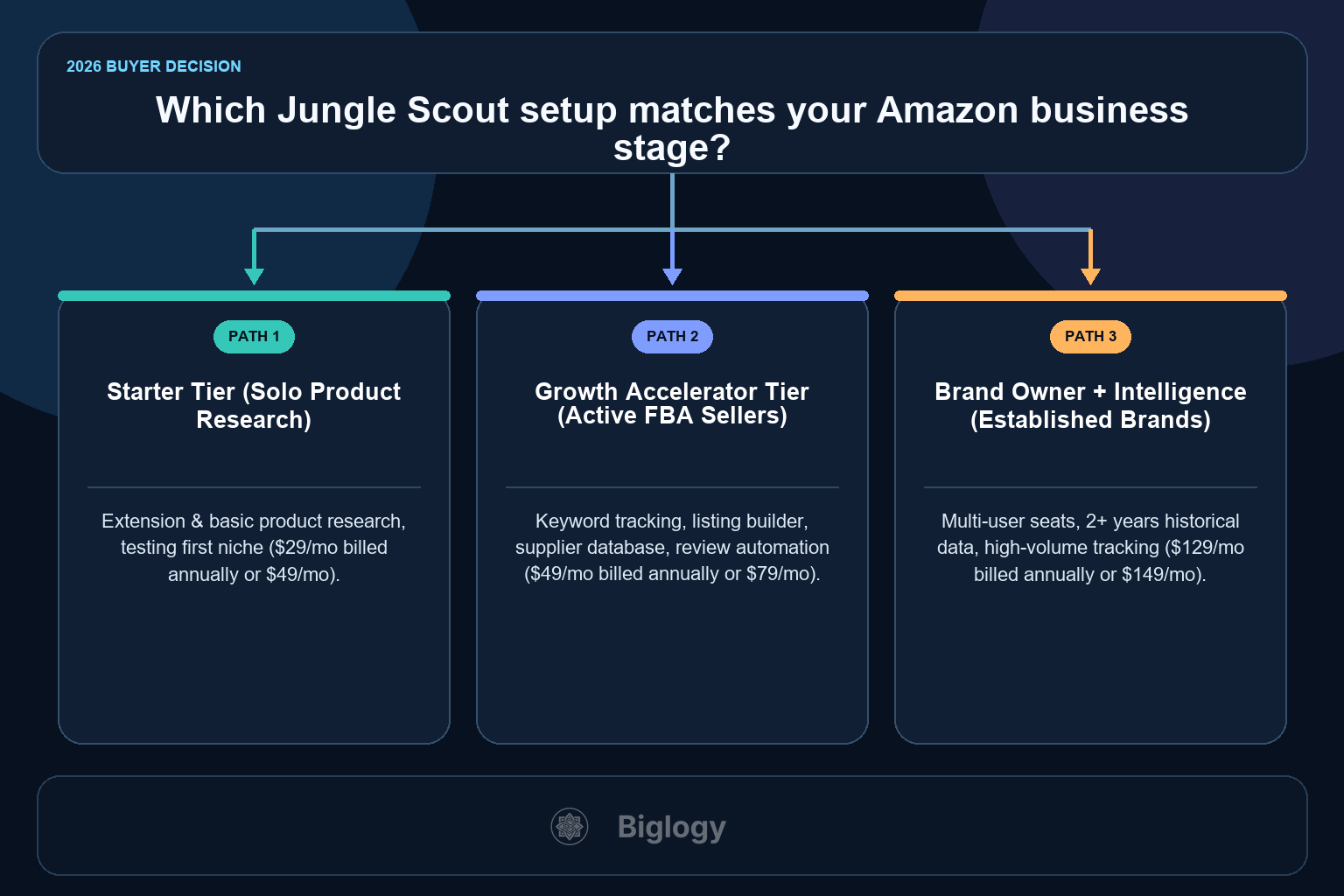
| Catalyst plan | Month-to-month | Annual payment | Effective monthly cost on annual billing |
|---|---|---|---|
| Starter | $49/month | $348/year | $29/month |
| Growth Accelerator | $79/month | $588/year | $49/month |
| Brand Owner + Competitive Intelligence | $149/month | $1,548/year | $129/month |
Taxes, currency conversion, promotions, add-ons, and renewal changes can alter the amount paid. Verify the final checkout screen before purchasing.
Starter
Starter is the least expensive entry point. It includes the browser extension, Academy, and limited product and keyword research.
Important current limits include:
- one user;
- 50 tracked products;
- 30 days of historical product data;
- 500 Sales Estimator uses per month;
- 100 Product Database searches per month;
- 100 Opportunity Finder searches per month;
- 50 Keyword Scout searches per month;
- no CSV export;
- no Supplier Database;
- no Rank Tracker;
- no Listing Builder;
- no Inventory Manager;
- no Advertising Analytics;
- no Competitive Intelligence.
Starter makes sense for structured research before a first launch. It becomes restrictive once you need to export data, operate a live catalog, or run repeated keyword and listing workflows.
Growth Accelerator
Growth Accelerator is the practical baseline for many active private-label sellers.
It raises research limits and adds the operating features missing from Starter, including Supplier Database, Rank Tracker, Listing Builder, Sales Analytics, Inventory Manager, advertising analysis, review automation, and eligible API trial access.
Published allowances include:
- one included user;
- optional paid additional seats;
- 150 products in Product Tracker;
- six months of historical product tracking;
- 1,000 Sales Estimator uses per month;
- broader Product Database and Opportunity Finder access;
- 250 Keyword Scout searches per month;
- one year of historical keyword data;
- 500 tracked keywords;
- 50 Listing Analyzer uses per month;
- 100 AI Assist uses per month.
For an active seller, the difference between Starter and Growth Accelerator is not merely higher quotas. Growth unlocks much of the platform’s post-research value.
Brand Owner
Brand Owner adds substantially higher limits and Catalyst’s Competitive Intelligence features.
Published allowances include:
- 2,000 tracked products;
- two years of historical product data;
- 5,000 Sales Estimator uses per month;
- broader Keyword Scout access;
- 5,000 tracked keywords;
- 300 Listing Analyzer uses per month;
- 500 AI Assist uses per month;
- Competitive Intelligence;
- market analysis and benchmarking;
- priority onboarding and support.
There is an important inconsistency on Jungle Scout’s current pricing page: the feature grid lists three included seats, while a FAQ on the same page says Brand Owner includes ten users. Team buyers should obtain the applicable seat count in writing before purchasing. Do not build a cost comparison around the more favorable number until checkout or sales confirms it.
Cobalt pricing
Cobalt is sold through a demo and custom quote. It should not be compared directly with a $49 or $79 Catalyst subscription.
Cobalt targets established brands and agencies that need market-level intelligence, Vendor Central support, category benchmarking, Share of Voice, Buy Box monitoring, broader advertising data, and custom reporting.
If your problem is “Which first product should I launch?”, Catalyst is the relevant product. If it is “Why is our category share declining across a large portfolio?”, Cobalt may be the relevant conversation.
The real first-year cost
Subscription price is only one part of the decision.
A realistic Jungle Scout budget may include:
- the subscription;
- additional user seats;
- Jungle Scout API usage beyond an included trial allowance;
- optional competitive-intelligence segments;
- supplier samples and inspection;
- Amazon Professional selling fees;
- product photography and creative work;
- trademark or legal review;
- freight, duty, prep, and storage;
- advertising spend;
- inventory financing;
- returns and damaged stock.
A $588 annual Growth Accelerator subscription may be reasonable if it supports repeated product, keyword, listing, and operational decisions. It is expensive if you use it for one weekend, copy three sales estimates, and never return.
Is Jungle Scout accurate?
Jungle Scout does not have access to every competitor’s private Seller Central records. Sales figures for products you do not own are estimates.
The company says its algorithms use signals such as orders, shipments, Best Seller Rank, inventory, prices, categories, and subcategories. That explains the inputs behind the estimates, but a vendor description does not independently prove a universal accuracy percentage.
Accuracy can vary by:
- marketplace;
- category;
- sales velocity;
- variation structure;
- seasonality;
- stockouts;
- promotions;
- rank volatility;
- newly launched products;
- the period being examined.
The responsible question is not “Is Jungle Scout accurate?” as though one percentage applies everywhere. It is:
> Is Jungle Scout accurate enough in my marketplace, category, and workflow to improve a decision compared with the alternatives?
Do not rely on a sales estimate alone when placing an inventory order. Cross-check demand using historical trends, multiple competing ASINs, keyword behavior, actual costs, Amazon fee calculations, supplier evidence, and—where available—your own Seller Central data.
A practical 1–2 hour Jungle Scout test
Jungle Scout does not currently offer a conventional free trial. Standard Catalyst plans instead have a seven-day money-back guarantee. Refunds are not automatic; eligible customers must contact support within the stated window.
If you subscribe, use the first session as a controlled test.
Test 1: research consistency
Choose three product ideas in the same marketplace.
For each idea:
- Run an Amazon search and save the date and search phrase.
- Record the first ten relevant organic ASINs.
- Run the browser extension.
- Note price, reviews, estimated sales, estimated revenue, seller concentration, and obvious outliers.
- Add the same ASINs to Product Tracker.
- Open Opportunity Finder for the associated niche.
- Run Keyword Scout against several leading ASINs.
- Record where the tools agree and where they tell different stories.
The goal is not to select a winner immediately. It is to see whether the platform exposes risks that would otherwise be missed.
Test 2: estimation error on products you control
If you already sell on Amazon, select several ASINs with known unit sales.
Compare Jungle Scout’s estimate for the same marketplace and period with actual Seller Central sales. Record both absolute unit error and percentage error. Separate low-volume products, because a small unit difference can create a misleadingly large percentage.
Do not publish one carefully selected success as proof of overall accuracy. Use a representative sample from your own catalog.
Test 3: plan-fit test
Attempt the tasks you expect to perform every month:
- export research;
- track products;
- run reverse-ASIN keyword searches;
- track keywords;
- prepare a listing;
- connect Seller Central;
- inspect profit and advertising data;
- add a team member.
This quickly reveals whether Starter is sufficient or whether the workflow depends on Growth Accelerator features.
Two realistic seller scenarios
Scenario 1: A first private-label launch
Imagine a seller considering a compact kitchen accessory.
A responsible Jungle Scout workflow would be:
- Use Product Database to create a broad shortlist.
- Use Opportunity Finder to inspect search demand and seasonality.
- Run the extension across several related Amazon searches.
- Remove opportunities dominated by one brand or a small number of listings.
- Track at least ten relevant ASINs instead of trusting a single snapshot.
- Use Keyword Scout to understand how shoppers describe the product.
- obtain supplier quotes and calculate landed cost independently;
- calculate Amazon fees using current dimensions and weight;
- examine patents, trademarks, safety requirements, and review complaints;
- decide whether the product has a defensible improvement.
Jungle Scout contributes demand and competition evidence. It does not complete steps seven through nine.
For this seller, Starter may be adequate during early exploration. Growth Accelerator becomes more attractive when the product moves toward supplier, listing, rank-tracking, and inventory workflows.
Scenario 2: A growing brand with several ASINs
Imagine a brand with twelve active products and three launches planned.
Its recurring needs might include:
- monitoring keywords;
- reviewing advertising performance;
- tracking profit;
- planning inventory;
- refreshing listings;
- requesting reviews;
- comparing competitors;
- coordinating access for a team member.
Starter is a poor fit because many of these tools are unavailable. Growth Accelerator is the logical baseline.
Brand Owner becomes relevant if the company needs much longer history, thousands of tracked keywords, substantially higher product limits, more users, or competitive market analysis.
Cobalt should enter the discussion only when the company’s questions move beyond individual products toward category share, portfolio performance, unauthorized sellers, Buy Box losses, executive reporting, or Vendor Central.
Jungle Scout pros and cons
Advantages
- A coherent workflow from product discovery to ongoing seller operations.
- Browser extension and web application are included across Catalyst plans.
- Product, keyword, listing, supplier, and account tools can share one working environment.
- Annual pricing is significantly lower than paying month to month for a full year.
- Growth Accelerator includes the features most active private-label sellers are likely to use.
- Product Tracker encourages time-based research instead of one-day snapshots.
- Keyword Scout supports keyword, reverse-ASIN, and multi-ASIN workflows.
- The product line now distinguishes self-service sellers from enterprise intelligence buyers more clearly.
Limitations
- Starter excludes exports and many important seller-management features.
- Sales and revenue numbers are estimates, not audited competitor records.
- Full feature availability varies by marketplace.
- The seven-day guarantee is not the same as a free trial, and refunds require an active request.
- Annual savings require an upfront annual commitment.
- Current documentation contains a material inconsistency about Brand Owner’s included seats.
- Catalyst is Amazon-centric rather than a broad multichannel commerce platform.
- Cobalt pricing is not public and requires a sales process.
- No software can validate differentiation, compliance, supplier quality, or launch economics by itself.
Marketplace support
Jungle Scout states that Catalyst is fully compatible with Amazon in the United States, Canada, Mexico, the United Kingdom, France, Germany, Italy, and Spain.
It lists partial support for the Netherlands, Turkey, India, Saudi Arabia, the United Arab Emirates, Japan, Australia, Singapore, and Brazil. Feature availability varies by marketplace. The extension supports a somewhat different set of stores from the full web platform.
Check the official marketplace breakdown for every tool you intend to use. “Jungle Scout supports my country” does not necessarily mean every database, historical chart, supplier function, and operating tool is available there.
Jungle Scout alternatives
| Alternative | Better starting point when… | Main trade-off |
|---|---|---|
| Helium 10 | You want a broader Amazon stack, deeper connected keyword workflows, advertising automation, or Walmart/TikTok functionality | Larger platform, higher active-seller plan prices, and more complexity |
| SmartScout | Your questions focus on brands, sellers, subcategories, wholesale research, and marketplace structure | Less centered on the simple first-product workflow |
| SellerAmp | You do retail arbitrage, online arbitrage, or wholesale sourcing and need fast profitability checks | Not a direct substitute for a private-label launch suite |
| Keepa | Historical Amazon price, rank, offer, and seller data is your main requirement | Requires more interpretation and does not replace listing or seller-operations tools |
| Seller Central plus spreadsheets | Your budget is limited and your needs are narrow | More manual work and less competitor-research convenience |
Jungle Scout vs Helium 10
Jungle Scout is easier to justify when the buyer wants a focused Amazon product-research and launch workflow. Helium 10 is usually the stronger shortlist candidate when product research must connect to a wider keyword, advertising, AI, and multichannel toolset (see our head-to-head Helium 10 vs Jungle Scout review and our dedicated Helium 10 review, as well as our Amazon keyword research guide).
Neither should win based on the number of tools printed on a pricing page. Compare the specific quotas and workflows you will use.
Jungle Scout vs SmartScout
SmartScout emphasizes marketplace structure—brands, sellers, subcategories, maps, and broader competitive analysis. It can be attractive to wholesale sellers, agencies, and researchers studying who controls a market.
Jungle Scout Catalyst is more naturally organized around discovering, validating, launching, and managing individual products.
Jungle Scout vs SellerAmp
SellerAmp is designed around sourcing questions such as:
- Can I sell this ASIN?
- What will the fees be?
- What profit and return on investment could remain?
- How crowded is the offer?
- Does Amazon share the Buy Box?
That makes it a more direct fit for arbitrage and wholesale sourcing. Jungle Scout is the more complete option for private-label product discovery, keywords, listings, and launch planning.
Jungle Scout coupon and discount information
The dependable public discount is annual billing. On the pricing checked for this review, annual payments reduced the effective monthly cost relative to paying month to month.
Do not assume that an external “50% off” code is valid. Coupon websites can show expired, account-specific, or fabricated offers. Verify any promotion on Jungle Scout’s own checkout before paying.
The standard seven-day money-back guarantee may exclude special promotions or trials. Cancellation alone does not automatically start a refund request.
A 30–60 minute setup checklist
After creating an account:
- Confirm the selected plan and renewal date.
- Record the refund-request deadline.
- Set the primary marketplace.
- Install the official browser extension.
- Create one research project rather than saving unrelated products.
- Define product filters based on your actual budget and operating model.
- Add a small, relevant ASIN set to Product Tracker.
- Run Keyword Scout against the same competitors.
- Save the key terms to a keyword list.
- If you already sell, connect Seller Central only after reviewing the requested permissions.
- Enter complete cost data before trusting profit reports.
- Configure inventory lead times conservatively.
- Invite users through individual seats instead of sharing credentials.
- Decide which weekly decisions Jungle Scout will support.
- Cancel or downgrade before renewal if those workflows do not justify the cost.
Frequently asked questions
Is Jungle Scout worth it for beginners?
It can be, if the beginner has a defined Amazon product-research process. Starter provides a relatively inexpensive annual entry point, the browser extension, Product Database, Opportunity Finder, Product Tracker, Keyword Scout, and training.
It is not worth buying merely to browse “winning products.” A beginner should first understand Amazon fees, sourcing, compliance, differentiation, advertising, and inventory risk.
Which Jungle Scout plan is best?
Starter is suitable for limited research. Growth Accelerator is the better baseline for an active private-label seller because it adds exports, supplier research, rank tracking, listing tools, inventory, advertising analytics, profitability features, and review automation.
Brand Owner is for higher limits and competitive intelligence. Cobalt is a separate enterprise decision.
Does Jungle Scout have a free trial?
No conventional free trial is currently advertised. Standard Catalyst plans instead offer a seven-day money-back guarantee. Refunds are not automatic, so an eligible customer must contact Jungle Scout within the applicable window.
Can I cancel Jungle Scout at any time?
Jungle Scout says Catalyst customers can cancel, after which access continues until the current paid term ends and no further renewal charge is made. Canceling an annual subscription does not convert the unused portion into monthly billing.
Refund eligibility is separate from cancellation.
Is Jungle Scout accurate for Amazon sales?
It provides estimates based on marketplace signals and proprietary models. Accuracy varies by product, category, marketplace, and period. No universal percentage should be assumed.
Use the estimates for comparison and screening, then test them against products with known Seller Central sales whenever possible.
Does Jungle Scout work without Seller Central?
Research tools and the extension can be used without connecting a Seller Central account. Features involving your sales, profit, advertising, inventory, reimbursements, or operating data require an eligible account connection.
Can Jungle Scout find a guaranteed profitable product?
No. It can help identify demand, competition, keywords, and trends. Profitability still depends on sourcing, landed cost, Amazon fees, conversion, advertising, returns, inventory, compliance, and execution.
Does Jungle Scout support retail arbitrage?
It may provide useful product data, but its primary Catalyst workflow is better aligned with product research and private-label operations. SellerAmp or Keepa may be a more direct starting point for arbitrage sourcing.
Is Jungle Scout only for the United States?
No, but support varies. Catalyst has full compatibility across eight listed Amazon marketplaces and partial compatibility across several others. Individual tools can have narrower coverage.
Is Brand Owner the same as Cobalt?
No. Brand Owner is the highest published Catalyst plan and includes Competitive Intelligence features. Cobalt is a separate enterprise platform for larger brands, agencies, Vendor Central users, market-level analysis, custom dashboards, and advanced reporting.
Does Jungle Scout replace Amazon Seller Central?
No. Seller Central remains the system used to operate the Amazon seller account. Jungle Scout adds research, analysis, and workflow tools around it.
Does Jungle Scout replace supplier and legal due diligence?
No. A supplier appearing in a database does not prove quality, capacity, certifications, intellectual-property safety, or commercial reliability. Samples, inspections, contracts, compliance checks, and professional advice remain separate.
Final verdict: Is Jungle Scout worth it in 2026?
Jungle Scout is worth shortlisting when Amazon product research is a repeatable business process rather than a one-time curiosity.
For a first private-label seller, its strongest advantage is the structured path from market discovery to product tracking, keyword research, and listing preparation. For an operating seller, Growth Accelerator adds enough account, inventory, advertising, and review tools to make the platform useful beyond research.
Starter is affordable on annual billing but deliberately limited. Growth Accelerator is the most sensible comparison point for a serious seller. Brand Owner can support larger research and competitive-intelligence workloads, although the current seat-count inconsistency should be resolved before purchase. Cobalt is for a different class of business problem and requires a tailored quote.
The final decision should depend on one question:
> Which recurring decision will Jungle Scout improve enough to justify its full first-year cost?
If you can name that decision, test it during the refund window, and verify the result against real business data, Jungle Scout may be a practical investment. If you cannot describe the workflow—or if you expect estimated sales to remove the risk of launching a product—postpone the subscription.
Editorial methodology and official sources
This is a desk-researched review. Biglogy did not claim to operate a paid Jungle Scout account, conduct a controlled sales-estimate benchmark, or measure an Amazon launch caused by the software.
Primary sources:
- Jungle Scout Catalyst pricing and plan limits
- Catalyst, Cobalt, and MCP platform guide
- Jungle Scout tools overview
- Keyword Scout documentation
- Listing Builder documentation
- Marketplace compatibility
- Money-back guarantee
ARTICLE_ID=RREV-004 / EXACT_WP_ID=UNKNOWN / OPERATION=OFFLINE_CANONICAL_REVISION SOURCE_QA=PASS_WITH_DISCLOSED_SEAT_CONTRADICTION INDEPENDENT_QA=STALE—existing receipt is bound to the mismatched placeholder, not this draft CTA=HOLD / MEDIA=HOLD / LIVE_MUTATIONS=ZERO NEXT_SINGLE_ACTION=Save this draft as canonical_synthesis.md, calculate its exact SHA-256, then run nonauthor exact-SHA QA.


Leave a Reply
Want to join the discussion?Feel free to contribute!