

Surfer vs Frase for Solo SEO Publishers: 2026 Comparison, Pricing, and Workflow Reality
Primary keyword: Surfer SEO vs Frase Last fact-check: November 11, 2026
> Editorial disclosure: This comparison is based on current official product pages and documentation, not a sponsored product test. Biglogy has not independently benchmarked ranking improvements, AI citations, or traffic gains produced by either platform. Prices and plan limits can change, so verify the checkout page before purchasing.
The short answer: Surfer SEO or Frase?
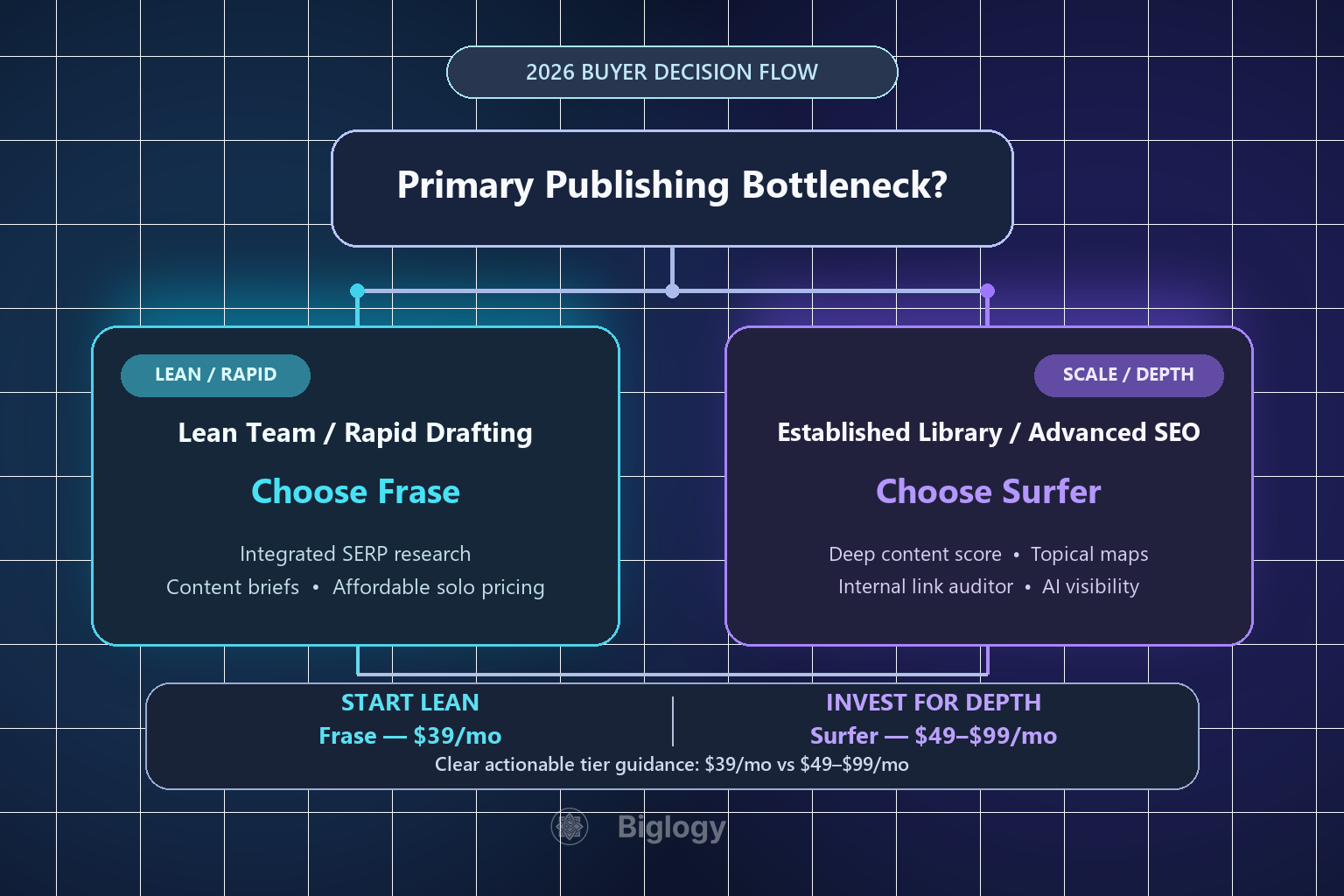
Choose Frase if your main job is turning a keyword into research, a content brief, an AI-assisted draft, and a publishable page without assembling several separate tools. Its lower entry price, integrated SERP research, article workflow, SEO and GEO scoring, CMS publishing, and monitoring features make it the more practical choice for many solo publishers.
Choose Surfer SEO (reviewed in detail in our Surfer SEO review) if your priority is deeper content optimization, controlled competitor selection, ongoing content auditing, internal-link management, and detailed AI-visibility tracking. Surfer is particularly compelling for SEO specialists, agencies, and publishers managing an established content library rather than simply producing first drafts.
The practical difference is this:
- Frase is the stronger research-to-publication system for lean teams.
- Surfer is the stronger optimization and visibility system for mature SEO operations.
Neither tool is automatically “better.” A freelancer producing four carefully researched articles per month has a different cost equation from an agency managing hundreds of pages across five brands. The right choice depends on where your workflow is currently slow, expensive, or inconsistent.
Surfer SEO vs Frase at a glance
| Decision factor | Surfer SEO | Frase |
|---|---|---|
| Best suited to | SEO specialists, established publishers, agencies | Solo publishers, content managers, lean teams |
| Core strength | Content optimization and visibility management | Research, briefs, writing, publishing, and monitoring in one loop |
| SERP research | Detailed competitor-driven optimization guidelines | Fast page, heading, question, and gap analysis |
| Content briefs | Strong, especially when the editor controls competitors | Faster research-to-brief workflow |
| AI-assisted writing | Surfy and AI-supported content optimization | Frase Agent and integrated article creation |
| Optimization model | Content Score, SEO Score, and AI Search Score | SEO and GEO scoring |
| AI-visibility tracking | Built into higher plans; standalone tracker available | Included from Starter, with engine coverage increasing by tier |
| Existing-content monitoring | Content Audit and ranking-drop workflows | Site Audit and Content Guard |
| Internal linking | One-click internal linking on eligible plans | Suggestions begin on Professional |
| CMS workflow | WordPress, Google Docs, Contentful, Zapier | WordPress, Webflow, Sanity, Wix, and FraseCMS |
| Lowest annual-billed entry price checked | $49 per month | $39 per month |
| Free evaluation | Seven-day Pro trial | Seven-day trial, no credit card |
| Better default for most solo publishers | Only when optimization depth is the priority | Yes |
| Better for multi-brand SEO operations | Usually | Possible, especially on Scale or Enterprise |
Pricing was checked on November 11, 2026. Taxes, regional billing, optional usage, and add-ons may change the final cost.
What Surfer SEO and Frase actually do
Surfer and Frase occupy the same broad category, but they approach the content problem from different directions.
Surfer began with a strong emphasis on analyzing search results and giving writers real-time optimization guidelines. Its Content Editor examines competing pages and recommends subjects, terms, structure, and coverage targets. Surfer has since expanded into content auditing, topical planning, internal linking, AI-assisted writing, and AI-search visibility.
Frase approaches the problem as a content operating system. It connects SERP research, briefs, drafting, optimization, publishing, and post-publication monitoring. The aim is to reduce handoffs between a research tool, writing environment, optimizer, CMS, and monitoring product.
That distinction matters because many comparisons stop at the writing screen. The real purchasing question is not simply which editor displays the better score. It is which product removes the most expensive friction from your complete workflow.
A solo publisher may need:
- Fast SERP research.
- A dependable outline.
- AI assistance without surrendering editorial control.
- SEO and AI-search guidance.
- Direct WordPress publishing.
- A way to notice when an older page needs attention.
An SEO agency may care more about:
- Managing several brands.
- Standardizing optimization guidelines.
- Detecting cannibalization.
- Refreshing large page inventories.
- Scaling internal linking.
- Measuring visibility across AI answer engines.
- Sharing reports with clients.
Frase is often the cleaner fit for the first list. Surfer becomes more attractive as the second list grows.
Research and content briefs
How Frase handles SERP research
Frase is especially good at compressing the first hour of content research.
Its SERP Analyzer gathers the pages ranking for a keyword and displays information such as page length, heading structure, and apparent coverage gaps. The tool can then carry that analysis into a brief rather than forcing the editor to reconstruct it in a separate document.
According to Frase’s official SERP Analyzer page, the system lines up ranking pages, extracts their headings, compares page length, and identifies sections a draft may be missing. Those are vendor-described capabilities, but they explain why Frase appeals to content managers who regularly brief freelance writers.
The main advantage is workflow continuity. Research does not end as a collection of browser tabs. It becomes a usable outline, question set, and writing plan.
Frase is likely to be the better fit when:
- You frequently brief outside writers.
- Your research process is repetitive.
- You want to move from keyword to outline quickly.
- One person performs research, drafting, and editing.
- You need a consistent brief format across many articles.
- You prefer a single environment over spreadsheets and shared documents.
The danger is treating the extracted SERP pattern as an editorial command. Competitor headings show what currently ranks; they do not prove what readers actually need. Copying the same structure can produce a derivative article that adds no original value.
A good Frase workflow still requires an editor to ask what the existing results omit, which claims need primary sources, and what decision the article helps the reader make.
How Surfer handles research and briefs
Surfer’s Content Editor is more optimization-oriented. It analyzes selected competing pages and provides real-time recommendations concerning relevant terms, structure, and topical coverage.
Surfer’s Content Editor documentation says the tool uses top-ranking pages to generate structural and keyword guidelines. It also displays Content Score, SEO Score, and AI Search Score feedback.
Surfer gives the editor more reasons to inspect the competitive set carefully. A search result may include forums, product pages, category pages, outdated articles, or pages satisfying a different intent. If unsuitable competitors remain in the analysis, their language and structure can distort the recommendations.
That extra control is valuable for an experienced SEO editor. It may feel like unnecessary complexity to someone who simply wants a usable brief for a straightforward article.
Surfer is likely to be better when:
- You want to control which competitors influence the brief.
- Search intent is ambiguous or mixed.
- You already have an editorial research process.
- Optimization guidance matters more than one-click briefing.
- Writers need live feedback as they revise.
- You manage content in multiple languages or locations.
Briefing winner
For fast, repeatable research-to-brief production, Frase wins.
For a more controlled optimization brief managed by an experienced SEO editor, Surfer wins.
Content optimization and scoring
Both products use scores to turn a complicated set of recommendations into a visible target. That convenience can also lead to misuse.
Surfer’s optimization approach
Surfer’s Content Editor provides live guidance while a page is written or revised. Its recommendations are derived from the selected competitive landscape, which helps explain why it is widely associated with on-page optimization work.
The useful part is not the score alone. It is the combination of:
- Recommended subjects and terms.
- Competitor selection.
- Suggested content structure.
- Questions and topical coverage.
- Live optimization feedback.
- Existing-page refresh workflows.
- One-click optimization on eligible plans.
- Content auditing and ranking-drop detection.
This makes Surfer particularly useful when a draft already exists but needs a systematic optimization pass. It also supports a broader maintenance process in which published pages are monitored and returned to the editor when their performance or coverage appears to weaken.
However, maximizing a Surfer score is not a substitute for editing. A page can satisfy term recommendations and still contain weak reasoning, repeated sections, unsupported claims, or an answer that arrives too late.
Frase’s optimization approach
Frase integrates optimization with the research and drafting process. Its current platform positioning includes conventional SEO scoring alongside GEO guidance intended for AI-search discoverability.
This creates a smoother experience for a solo operator: research the topic, build the brief, draft the page, check coverage, and publish without changing systems.
Frase’s advantage is cohesion. Its disadvantage is that a cohesive workflow can encourage users to approve an article simply because every stage appears complete inside the platform.
An SEO or GEO score cannot verify:
- Whether a claim is accurate.
- Whether the source is independent.
- Whether pricing is current.
- Whether the article adds original value.
- Whether the recommendation fits the stated buyer.
- Whether an AI answer engine will cite the page.
- Whether Google will rank it.
Optimization winner
For detailed on-page optimization and established-content refreshes, Surfer has the advantage.
For keeping research, writing, scoring, and publication inside one system, Frase is more convenient.
AI writing: useful assistant or expensive shortcut?
Both platforms now extend beyond simple keyword recommendations, but neither removes the need for editorial judgment.
Surfer AI and Surfy
Surfer separates the optimization framework from the writing decision. A writer can work manually inside Content Editor or use AI assistance. Surfer’s documentation explicitly distinguishes the editor’s guidance from automated article creation.
This is a sensible model for SEO teams that want AI to help with specific tasks rather than generate every page from a single instruction.
Surfy can assist with revisions and content development while the optimization environment remains visible. That makes it useful for operations where the editor starts with an existing draft, fixes a weak section, adds missing coverage, or updates an aging page.
The strongest Surfer AI use case is not “write the whole article without supervision.” It is “help an editor execute a structured optimization plan.”
Frase Agent and article workflow
Frase places AI more centrally in the research-to-publication loop. Its platform combines article creation, SEO and GEO scoring, publishing, monitoring, and optional automation.
That can reduce production time, especially when a solo publisher handles every stage. Frase also connects publication to several CMS platforms, which limits the copy-and-paste work that commonly introduces formatting errors.
The tradeoff is governance. The faster a tool can move from topic to published page, the more important approval rules become. Automation should not publish:
- Unverified product claims.
- Fabricated experience.
- Unsupported statistics.
- Outdated pricing.
- Legal, medical, or financial advice without review.
- Competitor-derived language that is too close to the source.
- Affiliate claims that do not match the actual relationship.
Frase indicates that users control whether automated publishing is enabled. For most independent publishers, human review should remain the default regardless of what the software permits.
AI-writing winner
For a fast, integrated draft-production workflow, Frase is stronger.
For AI assistance inside a deliberate optimization process, Surfer is more controlled.
AI-search and GEO visibility
The gap between the products has narrowed because both now position themselves for traditional search and AI-generated answers.
Surfer AI Tracker
Surfer offers detailed AI-visibility capabilities through its content plans and a standalone AI Search Analytics subscription.
The standalone product tracks prompts across ChatGPT, Perplexity, Google AI Mode, Google AI Overviews, and Gemini. It includes visibility, mention-gap, sentiment, and competitive reporting. According to Surfer’s AI Search Analytics documentation, its standalone plans track 50, 100, 200, or an unlimited number of prompts with daily refreshes.
Within Surfer’s main platform, AI Tracker access varies by plan. Standard tracks 25 prompts with weekly refreshes, Pro tracks 50 with daily refreshes, and Peace of Mind tracks 100 with daily refreshes.
That makes Surfer attractive when AI visibility is a measurement discipline rather than a marketing label. A team can define prompts, monitor competitors, inspect cited sources, and follow changes over time.
It is still important not to confuse tracking with causation. A rising visibility chart does not prove that one optimization caused an AI engine to cite a page. Answer engines change frequently, and prompt samples represent only part of the market.
Frase AI Visibility and GEO scoring
Frase includes AI Visibility from its Starter tier, but the number of prompts and engines expands with higher plans.
Starter tracks 20 prompts and includes ChatGPT and Google AI coverage. Professional raises the allowance to 50 prompts and adds Perplexity. Scale tracks 75 prompts and adds Claude and Gemini, according to the current Frase pricing page.
Frase’s appeal is that visibility monitoring sits beside the content workflow. An editor can identify a gap, create or update a page, publish it, and continue monitoring within the same platform.
That integrated corrective loop may be more useful to a small team than a more specialized analytics product. Conversely, an agency building a dedicated AI-visibility service may prefer Surfer’s deeper tracker and multi-brand tooling.
AI-visibility winner
For dedicated, more granular AI-search monitoring, Surfer wins.
For affordable AI visibility connected directly to research, writing, and page maintenance, Frase offers better accessibility.
Content auditing, refreshes, and internal linking
The cost of a content platform should be judged against the entire library, not only new articles.
Surfer for established libraries
Surfer’s stronger case appears when a site already has dozens or hundreds of pages. Its ecosystem includes content auditing, page tracking, ranking-drop alerts, coverage analysis, topical planning, and internal-link workflows.
At that stage, the main SEO problem often changes. Publishing more articles may be less valuable than:
- Updating pages losing relevance.
- Consolidating overlapping intent.
- Improving internal links.
- Finding underdeveloped clusters.
- Correcting old claims and product limits.
- Identifying pages with realistic improvement potential.
Surfer Pro also includes features such as one-click internal linking, content ideas and coverage gaps, custom voices, and a cannibalization report. Those features make more sense for a mature site than for a new blog with ten posts.
Frase for monitoring and corrective action
Frase combines Site Audit with Content Guard. Current plans allow Content Guard to watch 10 pages on Starter, 75 on Professional, and 300 on Scale.
Frase describes Content Guard as a system that watches for Google ranking or traffic decay and proposes corrective work. Republish actions require approval by default unless the user opts into greater automation.
Frase Professional also adds internal-link suggestions and a content calendar. That means a growing publisher can obtain a meaningful maintenance workflow without immediately moving to an agency-priced plan.
Maintenance winner
For deep content operations, internal linking, and broader established-site optimization, Surfer has the edge.
For a smaller site that wants monitoring and proposed fixes inside its existing writing system, Frase is more economical.
Integrations and publishing
Surfer currently lists integrations with WordPress, Google Docs, Contentful, and Zapier. This is a practical set for SEO teams whose editorial process already happens in Google Docs or a conventional CMS.
Frase publishes to WordPress, Webflow, Sanity, and Wix. It also offers FraseCMS, including a limited free hosting tier with paid upgrades.
The choice depends on whether direct publishing is an important part of the purchase.
Frase’s broader CMS story is helpful when the goal is to move a reviewed page from research to publication with minimal reformatting. Surfer’s integrations are sufficient when the organization already has a separate editorial and publishing process.
A direct publishing feature should never be mistaken for publication approval. Teams should still define:
- Who checks factual claims.
- Who approves AI-generated text.
- Who verifies links.
- Who checks page formatting.
- Who confirms canonical and metadata settings.
- Who can publish or republish live content.
Surfer SEO vs Frase pricing in 2026
Surfer pricing
The current Surfer pricing page lists the following annual-billed effective monthly prices:
| Surfer plan | Annual-billed price | Selected limits and positioning |
|---|---|---|
| Discovery | $49/month | 120 documents and 10 tracked pages |
| Standard | $99/month | 360 documents, 25 AI prompts refreshed weekly |
| Pro | $182/month | 360 documents, 50 AI prompts refreshed daily, five brand spaces |
| Peace of Mind | $299/month | Unlimited documents under fair usage, 100 AI prompts, API access |
| Enterprise | Custom | Custom scale, onboarding, security, and support |
Surfer also offers AI Search Analytics separately. Its annual-billed price begins at $82 per month for 50 daily tracked prompts.
Surfer says new customers can use a seven-day Pro trial. Annual subscriptions are paid upfront, unused limits do not roll over, and applicable VAT may be added.
Frase pricing
The current Frase pricing page lists:
| Frase plan | Annual-billed price | Monthly price | Selected limits |
|---|---|---|---|
| Starter | $39/month | $49/month | 1 seat, 1 site, 10 articles, 50 audited pages |
| Professional | $103/month | $129/month | 3 seats, 5 sites, 40 articles, 250 audited pages |
| Scale | $239/month | $299/month | 5 seats, 10 domains, 100 articles, 1,000 audited pages |
| Enterprise | Custom | Custom | Custom volume, security, and reporting |
Frase offers a seven-day trial without requiring a credit card. Starter stops when its monthly limits are reached. Professional and Scale offer optional pay-as-you-go usage, which is turned off by default.
Which is cheaper in practice?
Frase has the lower entry price: $39 per month when billed annually versus Surfer Discovery at $49.
That $10 difference is not the complete cost comparison.
A solo publisher should calculate:
- How many articles will be researched each month?
- How many existing pages need monitoring?
- Is AI-visibility tracking genuinely required?
- Is direct CMS publishing valuable?
- Will another tool still be needed for audits or internal links?
- How many sites and seats are required?
- Is annual prepayment affordable?
- What happens when the plan limit is reached?
Frase Starter includes more of the full content loop at its entry tier. Surfer Discovery is attractive when the primary requirement is content optimization, but it excludes the AI-prompt monitoring available in Standard and above.
For a solo publisher choosing strictly between the entry plans, Frase Starter generally offers the broader package.
For a publisher whose priority is Surfer’s optimization environment, paying more can still be rational. A cheaper tool is poor value if it does not solve the bottleneck that consumes the most editorial time.
Which tool should different buyers choose?
Solo publisher with one website
Choose Frase Starter in most cases.
It includes one site and one seat, supports ten articles and 50 audited pages per month, and connects research, writing, scoring, publishing, and monitoring. That is a sensible capacity for a quality-focused solo site.
Choose Surfer Discovery instead if you already have reliable writing and publishing systems and mainly want Surfer’s optimization guidance.
Freelance content writer
Choose Frase if clients expect complete briefs and first drafts. It can reduce the time spent gathering headings, questions, and topic gaps.
Choose Surfer if clients supply briefs and pay primarily for SEO-focused optimization or content refreshes.
Content manager working with freelancers
Frase is the easier starting point when your bottleneck is briefing. A repeatable SERP-to-brief process can reduce back-and-forth and help writers begin with clearer expectations.
Surfer is preferable when the content manager wants greater control over the competitor set and plans to conduct a structured optimization pass after receiving each draft.
SEO consultant or agency
Choose Surfer Pro if content auditing, internal linking, cannibalization analysis, brand workspaces, daily AI-prompt tracking, and ongoing optimization are core client services.
Frase Scale remains a credible alternative for agencies that prioritize a complete content-production loop, multiple domains, client-ready reporting, and larger article and audit allowances.
SaaS content team
Choose Surfer when the strategy depends heavily on:
- Bottom-of-funnel comparison pages.
- Product-led content optimization tools and organic traffic.
- Content refreshes.
- Cannibalization management.
- Internal linking.
- AI-search share-of-voice tracking.
Choose Frase when the team needs to produce researched briefs and drafts efficiently, publish across several CMS environments, and monitor the resulting pages without maintaining a large tool stack.
New website with little published content
Choose Frase—or begin with a manual workflow.
A new site may not yet benefit from advanced cannibalization reports, large audit allowances, or extensive AI-prompt tracking. Research quality, firsthand expertise, credible sourcing, and distinctive editorial value matter more than acquiring every available SEO dashboard.
Surfer SEO advantages and disadvantages
Advantages
- Strong, established content-optimization workflow.
- Controlled competitor analysis.
- Real-time Content Score, SEO Score, and AI Search Score.
- Useful existing-page refresh and auditing tools.
- Ranking-drop detection.
- Internal-link and cannibalization features on appropriate plans.
- Detailed AI-visibility tracking.
- Multiple brand workspaces at higher tiers.
- WordPress and Google Docs integrations.
- Good fit for specialized SEO teams.
Disadvantages
- The most compelling operational features require higher tiers.
- Discovery does not include AI-prompt tracking.
- Pro is significantly more expensive than entry-level Frase.
- Scores can encourage mechanical optimization.
- The broader feature set may be excessive for a small new site.
- Annual billing requires upfront payment.
- Product guidance cannot replace source research or editorial review.
Frase advantages and disadvantages
Advantages
- Lower entry price.
- Fast SERP-to-brief workflow.
- Research, writing, optimization, publishing, and monitoring in one system.
- SEO and GEO scoring from Starter.
- AI-visibility monitoring included from Starter.
- Seven-day trial without a credit card.
- Direct publishing to several CMS platforms.
- Content Guard for post-publication monitoring.
- Useful solo and freelancer plan.
- Professional includes three seats, five sites, and internal-link suggestions.
Disadvantages
- Entry-tier article and audit allowances may be restrictive.
- AI-engine coverage varies by plan.
- Advanced multi-site teams may need Scale or Enterprise.
- Integrated automation increases the need for strict human review.
- A SERP-derived brief can still produce derivative content.
- Scores do not prove ranking potential or factual quality.
- Optional overages on higher plans require budget controls.
- Dedicated AI-visibility operations may find Surfer’s tracker more specialized.
Alternatives worth considering
Surfer and Frase are not the only valid choices.
A publisher may prefer:
- Clearscope for a more focused enterprise content-optimization workflow (see our full Surfer vs Clearscope comparison and our guide to Surfer alternatives).
- Semrush when keyword research, competitive intelligence, rank tracking, and site auditing must live in a broader SEO suite.
- Ahrefs when backlink analysis and competitive search research matter more than AI-assisted content production.
- A manual workflow using Google Search, Search Console, primary sources, a spreadsheet, and a normal editor.
- A general AI assistant plus human research when article volume is low and a specialized platform would be underused.
The manual option is especially important. A content optimizer is a productivity tool, not a requirement for producing useful search content. A careful editor with good sources and a clear decision framework can outperform a weak article that achieves a high software-generated score.
Buying checklist
Before selecting either platform, answer these questions:
- Is our primary bottleneck research, drafting, optimization, publication, or maintenance?
- How many new articles do we realistically complete each month?
- How many existing pages need monitoring?
- Do we manage one website or several?
- How many people need seats?
- Do we require direct CMS publishing?
- Are internal-link suggestions important?
- Will we genuinely monitor AI prompts every week?
- Which AI engines must be included?
- Do we need client-facing reports?
- Is annual prepayment acceptable?
- What happens when we exceed an article, audit, or prompt allowance?
- Who reviews AI-assisted content?
- Who verifies prices, legal claims, statistics, and product limits?
- Can we evaluate the product with a real workflow during the trial?
Test one representative assignment rather than an artificially simple keyword. For example, build a commercial comparison that requires current pricing, product limitations, several official sources, and a clear buyer recommendation. Measure research time, revision effort, formatting, and the usefulness of the finished brief.
Frequently asked questions
Is Frase better than Surfer SEO?
Frase is usually better for solo publishers who want research, briefs, AI-assisted writing, optimization, CMS publishing, and monitoring in one affordable system.
Surfer is better when deeper content optimization, auditing, internal linking, cannibalization management, or detailed AI-visibility tracking is the priority.
Which is cheaper, Surfer or Frase?
Frase has the lower annual-billed entry price. Frase Starter costs $39 per month when billed annually, while Surfer Discovery costs $49 per month when billed annually.
Compare limits and required features rather than looking only at the headline price.
Which tool is better for content briefs?
Frase has the more direct SERP-to-brief workflow and is the stronger default for quickly briefing writers.
Surfer offers more optimization control, particularly when an experienced editor wants to choose which competitors influence the recommendations.
Which is better for AI writing?
Frase is better for an integrated research-to-draft workflow. Surfer is better when AI assistance supports a more controlled optimization process.
Neither tool should publish factual or commercial content without human review.
Can Surfer or Frase guarantee higher rankings?
No. Both vendors provide research, optimization, and monitoring tools, but neither can guarantee a ranking, traffic increase, or AI citation.
Search performance also depends on authority, technical quality, links, originality, search intent, competition, and the usefulness of the page.
Which is better for AI-search visibility?
Surfer provides the more specialized tracking product, with detailed prompt monitoring and a standalone AI Search Analytics option.
Frase makes AI Visibility accessible at a lower entry tier and connects the monitoring data to its writing, publishing, and maintenance workflow.
Does Frase replace Surfer?
It can replace Surfer for publishers whose main requirements are SERP research, briefs, drafting, scoring, publishing, and light monitoring.
It may not replace Surfer for teams that rely on Surfer’s specific optimization process, internal-link tooling, cannibalization analysis, or detailed AI Tracker workflow.
Do I need both tools?
Most solo publishers do not.
Using both can create duplicated SERP analysis, scoring, and writing features. Consider both only if Surfer’s optimization and tracking capabilities solve a separate, measurable problem that Frase does not address.
Final verdict: Frase for the lean publishing loop, Surfer for deeper SEO operations
For most solo publishers comparing Surfer SEO and Frase in 2026, Frase is the more practical starting choice. It costs less at the entry level and brings research, briefing, AI-assisted writing, SEO and GEO scoring, CMS publishing, AI visibility, and content monitoring into one system.
That does not make Frase universally superior.
Surfer is the stronger choice when content optimization is itself a specialized operation. Its controlled competitor analysis, page auditing, ranking-drop detection, internal-link capabilities, cannibalization reporting, brand workspaces, and deeper AI Tracker make more sense as the number of pages, sites, clients, and optimization decisions grows.
Use this final decision rule:
- Choose Frase when your main problem is producing well-researched, optimized content efficiently.
- Choose Surfer when your main problem is managing, improving, and measuring an established content portfolio.
- Choose neither until you can name the workflow bottleneck the subscription will remove.
RREV-003 / WP ID UNKNOWN / OFFLINE CANONICAL DRAFT SOURCE_QA=PASS_CURRENT_OFFICIAL_PAGES / INDEPENDENT_QA=NOT_RUN WP_COLLISION=HOLD / MEDIA=HOLD / CTA=HOLD_UNVERIFIED LIVE_MUTATIONS=ZERO NEXT_SINGLE_ACTION=RUN_NONAUTHOR_EXACT-SHA_EDITORIAL_QA_BEFORE_RELEASE


Trackbacks & Pingbacks
[…] To match specific tools to those jobs, evaluate our standalone Semrush review for small content sites, compare lightweight keyword options in our Mangools vs Ahrefs breakdown, and review on-page editorial tooling in our Surfer SEO review and Surfer vs Frase comparison. […]
[…] Content Editor NLP Scoring: Unlike optimization platforms covered in our Surfer SEO review and Surfer vs Frase comparison, Mangools stops at topic discovery and SERP validation. Writers must structure drafts separately or […]
[…] is not automatically the best fit for every publisher. You can compare specific contenders in our Surfer vs Frase comparison, our Surfer vs Clearscope analysis, and our Mangools vs Ahrefs breakdown. The right Surfer […]
Leave a Reply
Want to join the discussion?Feel free to contribute!