
Small-Business Lead Routing: Why Forms Break Between Webhook and CRM (Architecture Guide)
Quick architectural takeaway: Point-to-point webhook connections (e.g., Web Form -> CRM) are inherently fragile. When a CRM API experiences latency, rate limiting, or temporary maintenance, the incoming webhook times out and customer revenue inquiries are dropped forever. Building a resilient pipeline requires three decoupled layers: a persistent intake buffer (Sheet/DB), an idempotent processing worker, and a dead-letter notification queue.
Never make your primary CRM the first point of contact for raw HTTP webhooks. If the CRM is down for five minutes, your marketing budget is paying to deliver HTTP 504 errors to prospective buyers.
The Fragile Pipeline: How Direct Integrations Drop Real Revenue
Most small businesses wire their lead capture through basic linear triggers: a visitor submits a WordPress contact form, the form plugin fires an HTTP POST request to a Zapier or CRM endpoint, and the data is piped directly into pipeline stages. This works reliably in low-volume testing, but breaks during real marketing operations. In our companion guide on diagnosing automation silent failures, we analyzed how workflows return HTTP 200 while still dropping data; this guide details the structural architecture needed to guarantee zero dropped leads.
Three Fragile Points in Standard Lead Routing
- API Rate Limiting (HTTP 429): A successful ad campaign or newsletter launch sends 50 form submissions in two minutes; the CRM API throttles incoming connections and drops the excess submissions.
- Schema Drift & Unescaped Characters: A prospect enters emojis, quotation marks, or international phone formatting that crashes downstream CRM string validation.
- Missing Idempotency: A prospect double-clicks ‘Submit’, firing two identical webhooks that create duplicate contacts, triggering double auto-responder emails.
Resilient 3-Tier Lead Architecture Blueprint
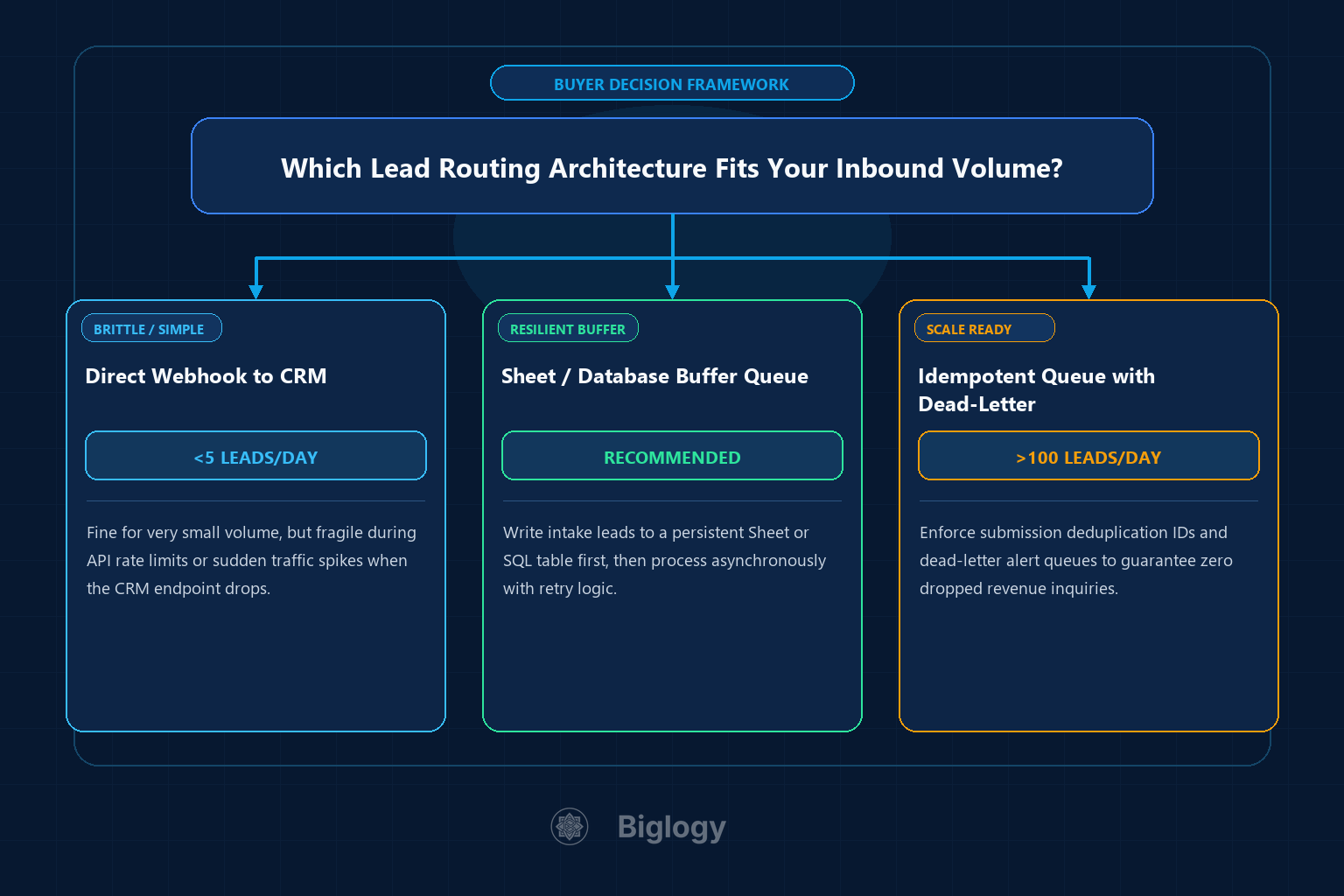
Review the decoupled intake architecture below that ensures every submission is durably stored before CRM processing begins.
No-Tool First Step: Implement the ‘Persistent Buffer First’ Rule
You do not need an enterprise Apache Kafka queue to solve this problem. Implement this 3-step pattern inside your existing tools:
- Layer 1 (The Durable Buffer): The web form writes immediately to an append-only Google Sheet or SQL database table. This step has zero complex filters and completes in <500ms.
- Layer 2 (The Idempotent Consumer): A scheduled automation runs every 2 to 5 minutes, querying new rows marked
PENDING. It computes a deduplication hash (e.g.,MD5(email + date_hour)) to prevent duplicate contact creation. - Layer 3 (The Dead-Letter Alert): If the CRM API returns an error or field validation reject, the row status is updated to
FAILEDand an instant alert is dispatched to a team Slack channel with the raw payload.
Copyable Apps Script for Idempotent Lead Processing
// Idempotent Lead Router Buffer
function processPendingLeads() {
  const sheet = SpreadsheetApp.getActiveSpreadsheet().getSheetByName("Intake_Buffer");
  const data = sheet.getDataRange().getValues();

  for (let i = 1; i < data.length; i++) {
    const row = data[i];
    const status = row[5]; // Column F: Status

    if (status === "PENDING") {
      const email = row[1];
      const payload = row[4];

      try {
        // Post to CRM endpoint with retry logic
        const crmResponse = postToCRM(email, payload);
        if (crmResponse.success) {
          sheet.getRange(i + 1, 6).setValue("PROCESSED");
          sheet.getRange(i + 1, 7).setValue(crmResponse.id);
        } else {
          sheet.getRange(i + 1, 6).setValue("FAILED_RETRY");
        }
      } catch (err) {
        sheet.getRange(i + 1, 6).setValue("ERROR_ALERT");
        sendSlackAlert("Lead routing failed for: " + email + " Error: " + err.message);
      }
    }
  }
}
Connecting Robust Architecture to Business Operations
Reliable lead infrastructure pays dividends across every marketing channel. For full guidance on setting up forms, sheets, and follow-up sequences cleanly, consult our comprehensive lead capture automation guide and Software Evaluation Methodology.
Frequently Asked Questions
What is idempotency in lead capture?
Idempotency means that executing the same operation multiple times with identical parameters produces the exact same result without creating duplicate records or triggering duplicate emails.
Does adding a database buffer delay instant sales notifications?
A buffered queue adds between 30 and 120 seconds of latency—a negligible trade-off that guarantees 100% data durability and eliminates lost customer inquiries.
Can Google Sheets handle enterprise lead volume?
Google Sheets handles up to several thousand rows per month comfortably. For organizations capturing >500 leads daily, migrate the buffer layer to a serverless PostgreSQL database (e.g., Supabase, Neon) or Redis queue.
How should we handle form spam before it hits our CRM?
Implement a hidden honeypot field and client-side time-to-submit verification (discarding submissions completed in <2 seconds) at the form layer before writing to your buffer.
What is a dead-letter queue (DLQ)?
A DLQ is an isolated storage holding submissions that failed automated delivery, allowing engineers or operations staff to inspect, fix formatting errors, and reprocess records manually.
Editorial transparency: This architecture guide is independently authored by Biglogy’s technical editorial desk. Review our complete standards in our Publishing Charter.


Leave a Reply
Want to join the discussion?Feel free to contribute!