

Best SEO Tools for Affiliate Websites: An Evidence-Based Selection Guide
Editorial disclosure: This guide contains no tracked affiliate links. Bottom CTA buttons (/go/semrush/ and /go/surfer/) currently route directly to official vendor homepages via Biglogy’s bridge directory with no active affiliate token applied. No tool is ranked because of commission availability; if approved paid links are activated later, this notice will update and links will carry rel="sponsored".
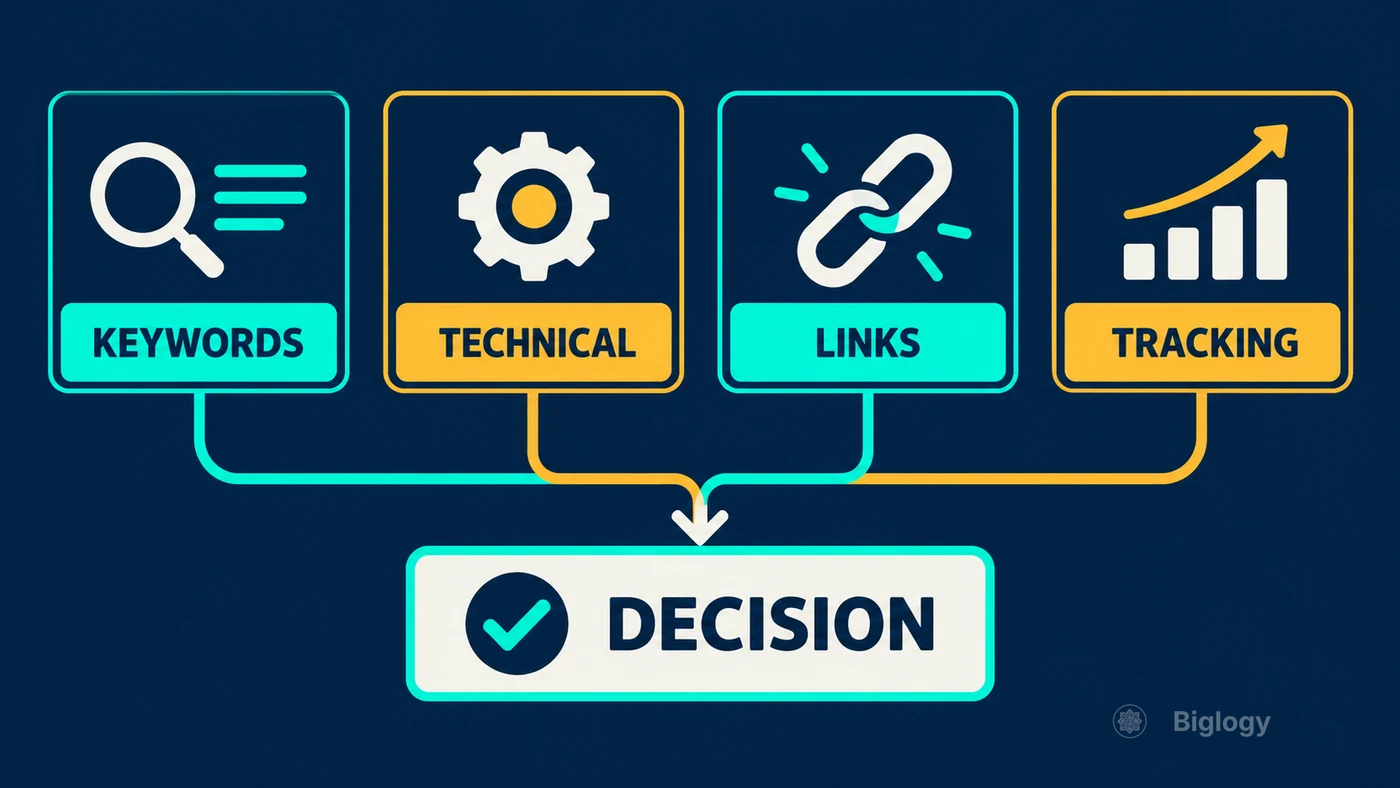
The best SEO tool for an affiliate website depends on the decision you need to make. Search performance monitoring, keyword discovery, backlink research, technical crawling, content inventory, and rank tracking are different jobs. Buying one large suite before defining the job often creates dashboards that are expensive to maintain and easy to misinterpret.
Short Answer
Begin with first-party evidence from Google Search Console and your analytics or conversion system. Add a crawler when you need sitewide technical evidence, a keyword database when you need broader market discovery, a backlink tool when link analysis will change a concrete action, and rank tracking when a stable query set needs scheduled monitoring. No third-party tool is approved by Google, and no tool can guarantee rankings.
The Six Jobs an SEO Stack May Need to Do
| Job | Question answered | Evidence type |
|---|---|---|
| Search monitoring | Which queries and pages receive impressions and clicks in Google Search? | First-party Search Console data |
| Analytics | What happens after a visitor arrives? | On-site events, conversions, and paths |
| Technical crawling | Which URLs, status codes, directives, links, and metadata need review? | A crawler’s snapshot of the site |
| Keyword research | How might people describe the problem and how competitive is the topic? | Third-party estimates plus SERP review |
| Backlink analysis | Which referring pages and link patterns deserve investigation? | Third-party link indexes |
| Rank tracking | How does a defined set of queries change over time? | Scheduled third-party observations |
Start with First-Party Search Evidence
Google Search Console is the baseline for understanding how Google Search sees and serves your property. It can support performance review, indexing investigation, and issue monitoring. Connect that evidence to the site’s own analytics and commercial outcomes. A page with fewer clicks may still be valuable if it supports a high-intent decision; a page with many impressions may require a clearer answer rather than more keywords.
Google’s current guidance explicitly recommends evaluating third-party SEO advice against official Search documentation. It also warns that Google does not evaluate or approve third-party services and that using a tool does not guarantee ranking success. That principle should govern every vendor claim.
When a Technical Crawler Is Worth It
- You need to inventory status codes, canonicals, index directives, titles, descriptions, headings, and internal links across many URLs.
- A migration or template change may have created systematic errors.
- You need evidence of orphaned pages, redirect chains, broken internal links, or duplicate metadata.
- The site is too large for reliable manual inspection.
A crawler does not decide which page is strategically important. It produces evidence that an editor or technical owner must interpret. Biglogy’s annual content audit guide provides a broader framework for combining technical findings with editorial decisions.
When Keyword and Competitor Databases Help
Third-party keyword databases can help discover language, questions, competitors, and topic patterns. Their volumes, traffic estimates, and difficulty scores are modeled—not direct access to another site’s private analytics. Use them to form hypotheses, then inspect the live results, the reader’s intent, and your own first-party performance.
- Use keyword discovery to identify problems and vocabulary, not to manufacture pages for every phrase.
- Use competitor gaps to find unanswered reader needs, not to clone headings.
- Use difficulty metrics comparatively within one tool, not as universal truth.
- Record the country, device, date, and database scope behind any exported metric.
For a problem-first approach, see Biglogy’s human-centered SEO guide.
To match specific tools to those jobs, evaluate our standalone Semrush review for small content sites, compare lightweight keyword options in our Mangools vs Ahrefs breakdown, and review on-page editorial tooling in our Surfer SEO review and Surfer vs Frase comparison.
When Backlink Analysis Is Necessary
A backlink tool is useful when the output changes a real action: investigating a manual action or suspicious pattern, reclaiming broken links, evaluating digital PR coverage, comparing linkable assets, or reviewing a migration. It is not automatically necessary for every small affiliate site. Biglogy’s backlink analysis decision guide helps define that threshold.
A Buyer’s Scorecard
| Criterion | Evidence to request | Warning sign |
|---|---|---|
| Decision fit | A named workflow and the decision each report supports | Buying because the suite has “everything” |
| Data transparency | Documentation explaining source, freshness, scope, and modeled metrics | Metrics presented as exact facts without methodology |
| Site limits | Projects, crawl units, rows, exports, history, and user limits | Critical limits appear only after setup |
| Workflow | Saved views, exports, APIs, alerts, and collaboration required by the team | Reports cannot reach the people who act on them |
| Total cost | Current plan plus required add-ons and future scale | Comparison uses only the entry price |
| Portability | Export tests for the reports and historical data you need | Cancellation removes access before evidence is preserved |
A Lean Stack by Stage
New or small site
Start with Search Console, analytics, manual SERP review, and a simple content inventory. Add a crawler only when manual checks no longer scale or a technical issue needs systematic evidence.
Growing editorial site
Add scheduled crawling and one research database when they support a documented content or maintenance process. Establish naming, export, and review conventions before adding more seats or projects.
Mature affiliate portfolio
Consider specialized link research, rank tracking, log or crawl analysis, and workflow automation only where each tool has an owner and a measurable decision. Tool overlap should be reviewed quarterly.
Common Mistakes
- Treating estimated traffic or search volume as first-party fact.
- Buying a backlink suite without a link-related decision to make.
- Publishing pages solely because a keyword gap report found them.
- Assuming an “SEO score” represents Google’s ranking system.
- Tracking hundreds of unstable queries without a response process.
- Exporting reports that nobody reviews.
- Allowing an affiliate relationship to determine the winner.
Recommendation
Build the smallest stack that answers your current decisions with evidence you understand. Search Console and on-site analytics establish the baseline. Add one specialist capability at a time, test it on your actual site, document how modeled metrics should be interpreted, and cancel tools that do not change an action. The best SEO tool is not the one with the largest dashboard; it is the one that improves a specific decision without distorting the evidence.
Official Sources Reviewed
- Google Search guidance on third-party SEO tools and advice
- Google Search Console monitoring guidance
- Google guidance on Search Console and Analytics data
Source review date: October 24, 2026. Tool features, databases, and commercial terms can change; verify official documentation during evaluation.


Leave a Reply
Want to join the discussion?Feel free to contribute!