

Surfer Review for AI Visibility and SEO Editors: 2026 Practical Guide
Surfer has evolved from a content-scoring tool into a broader SEO and AI-visibility platform. To see how it measures up against its closest competitor, see our Surfer vs Frase comparison, explore our guide to Surfer alternatives, or compare with our Semrush review for small content sites. Its main value is still practical: it turns search-result analysis into a structured editing workflow. Writers receive recommendations for topics, terms, headings, and page structure without manually comparing every competing page.
That convenience does not make Surfer a ranking guarantee. Its recommendations describe patterns in competing content; they cannot determine whether a page deserves to rank, satisfies the reader, attracts links, or demonstrates genuine expertise.
Quick verdict
Surfer is best for publishers and content teams with an established production workflow who want consistent, SERP-informed briefs and editing standards. It becomes easier to justify when several writers or clients share the same process.
It is harder to justify for occasional bloggers, very small sites, or teams expecting a content score to substitute for editorial judgment.
| Decision factor | Assessment |
|---|---|
| Best for | SEO editors, agencies, in-house content teams, and active publishers |
| Main strength | Fast, repeatable analysis and optimization workflow |
| Main limitation | Expensive if content volume is low |
| AI visibility | Useful monitoring layer, but not proof that optimization caused mentions |
| Learning curve | Moderate; the interface simplifies the data, but recommendations still need judgment |
| Overall verdict | Strong workflow tool for frequent users; excessive for occasional optimization |
What is Surfer?
Surfer analyzes search results for a target query and converts its findings into writing and optimization guidance. Its Content Editor helps users compare a draft with pages already appearing in the search results.
This is more sophisticated than counting repetitions of one keyword. Surfer says its recommendations use NLP, machine learning, competitor analysis, and hundreds of web and AI signals. Its interface then presents those signals through suggested terms, structural guidance, and a Content Score. These are Surfer’s descriptions of its methodology—not independent proof that following every recommendation improves rankings. Surfer’s platform and pricing overview
The distinction matters. Search-result correlation can reveal what successful pages tend to cover, but it cannot show why each page ranks. Authority, links, intent satisfaction, originality, technical quality, and brand reputation can all influence results.
Surfer is therefore most useful as a decision-support system for editors—not an automatic SEO rulebook.
How the Content Editor fits into a publishing workflow
A typical Surfer workflow looks like this:
- Create a Content Editor document for a target query.
- Review the competing pages included in the analysis.
- Build or revise the outline.
- Write in Surfer or use a supported integration.
- Evaluate missing topics and terms.
- Edit for clarity, completeness, and intent.
- Treat the Content Score as a diagnostic signal rather than the publication goal.
The final step is the important one. A higher score can indicate that a draft covers more of the vocabulary and subtopics found among competitors. It does not prove that the writing is original, accurate, persuasive, or pleasant to read.
Google explicitly warns against unnatural repetition and keyword stuffing. It also recommends people-first content that adds original information or analysis rather than merely summarizing existing pages. Google’s people-first content guidance and spam policies
Core Surfer features
Content Editor and Content Score
Content Editor is Surfer’s central feature. It gives writers a live optimization environment with recommendations derived from competing search results.
The Content Score is useful for locating obvious coverage gaps. For example, a low score might expose an article that omits an important concept or uses a vocabulary inconsistent with the search intent.
The score becomes less useful when editors chase a perfect number. Adding every suggested phrase can make a draft repetitive and less natural. The right stopping point is when the article answers the reader’s question comprehensively—not necessarily when the score reaches 100.
Auto-Optimize
Auto-Optimize applies Surfer’s recommendations more automatically inside the Content Editor. Current Surfer documentation says the feature is built into Content Editor across its new plan structure. Surfer subscription migration documentation
This can save time on an existing draft, but automated additions still require editorial review. Check that new passages are accurate, non-repetitive, consistent with the article’s voice, and genuinely useful.
AI Tracker and AI visibility
Surfer’s AI Tracker monitors whether selected brands or domains appear in answers generated by systems such as ChatGPT, Gemini, and Perplexity. It reports metrics including mention rate, visibility, average position, and competing brands.
Current limits are 25 tracked prompts on Standard, 50 on Pro, and 100 on Peace of Mind. Standard data is refreshed weekly, while higher tiers provide daily tracking. Surfer AI Tracker documentation
This is useful for observing changes and finding prompts where competitors appear more frequently. It should not be treated as an attribution system. An increase in mentions after editing content does not, by itself, prove that Surfer caused the change.
Topical Map, audits, and internal linking
Surfer has expanded into planning, auditing, and internal-linking workflows. However, these capabilities are not available equally across every plan.
Under Surfer’s current packaging:
- AI Tracker is included from Standard upward.
- Topical Map is included with Pro and higher.
- Content Audit is available on Pro and higher.
- SERP Analyzer and API access require Peace of Mind or Enterprise.
- Rank Tracker remains separately available.
Teams should choose a plan from the features they will actually use rather than from the broadest feature list.
Surfer pricing in 2026
Surfer’s pricing and plan names changed during 2026. Older reviews referring to Essential, Scale, or entry prices around $29–$89 may no longer describe the current offer.
The official pricing page currently displays these effective monthly prices when billed annually:
| Plan | Annual-billing rate | Approximate annual charge | Intended fit |
|---|---|---|---|
| Discovery | $49/month | $588/year | Basic content optimization |
| Standard | $99/month | $1,188/year | Regular publishing plus AI visibility |
| Pro | $182/month | $2,184/year | Agencies and multi-brand workflows |
| Peace of Mind | $299/month | $3,588/year | High-volume teams requiring API and advanced analysis |
| Enterprise | Custom | Custom | Organizations with negotiated requirements |
Annual subscriptions are charged upfront. Surfer states that annual billing can save up to 17%, while account-specific migration or legacy pricing may differ. Always verify the checkout total and current limits before purchasing. Current Surfer pricing and pricing FAQ
The practical budget question is not “Can Surfer optimize an article?” It can. The question is whether the time saved across your monthly publishing volume is worth the subscription.
For more on evaluating changing SaaS costs, see Biglogy’s guide to verifying SaaS pricing and plan limits.
Surfer’s main strengths
A repeatable editorial process
Surfer gives editors a consistent framework for briefs, drafts, and refreshes. This is particularly helpful when several contributors interpret SEO requirements differently.
Faster competitive coverage analysis
The tool can surface topics and vocabulary that would take longer to identify through manual review. That makes it useful at the outline and revision stages.
Clear workflow integrations
Supported integrations can reduce copying between the optimization tool and the publishing environment. Existing customers affected by Surfer’s plan migration are instructed to check that their new plan preserves required Google Docs, WordPress, or Contentful integrations.
Broader AI-search monitoring
AI Tracker adds a useful observational layer for teams trying to understand whether their brand appears in generative answers. Prompt-level competitor comparisons can help prioritize further investigation.
Practical limitations
The subscription may exceed the value for small sites
Discovery lowers the entry point, but meaningful AI tracking begins with Standard. Audit, Topical Map, and more advanced workflows require higher plans.
A publisher optimizing only a few articles each month may save less time than the subscription costs.
Scores can distort editorial priorities
Writers may focus on satisfying the tool instead of satisfying the reader. This can produce repetitive phrases, unnecessary sections, or text that resembles the same competing pages the tool analyzed.
Vendor data does not prove ranking improvement
Surfer can show what competitors contain and how a draft compares. It cannot isolate the ranking impact of its recommendations from links, authority, technical changes, seasonality, or algorithm updates.
Plan limits and packaging can change
The 2026 migration moved several features into new plan tiers. A review or tutorial written under the previous Essential and Scale structure may now be misleading.
Two practical buying scenarios
Scenario 1: Solo affiliate publisher
Assume a solo publisher produces five to fifteen commercially important articles or updates each month.
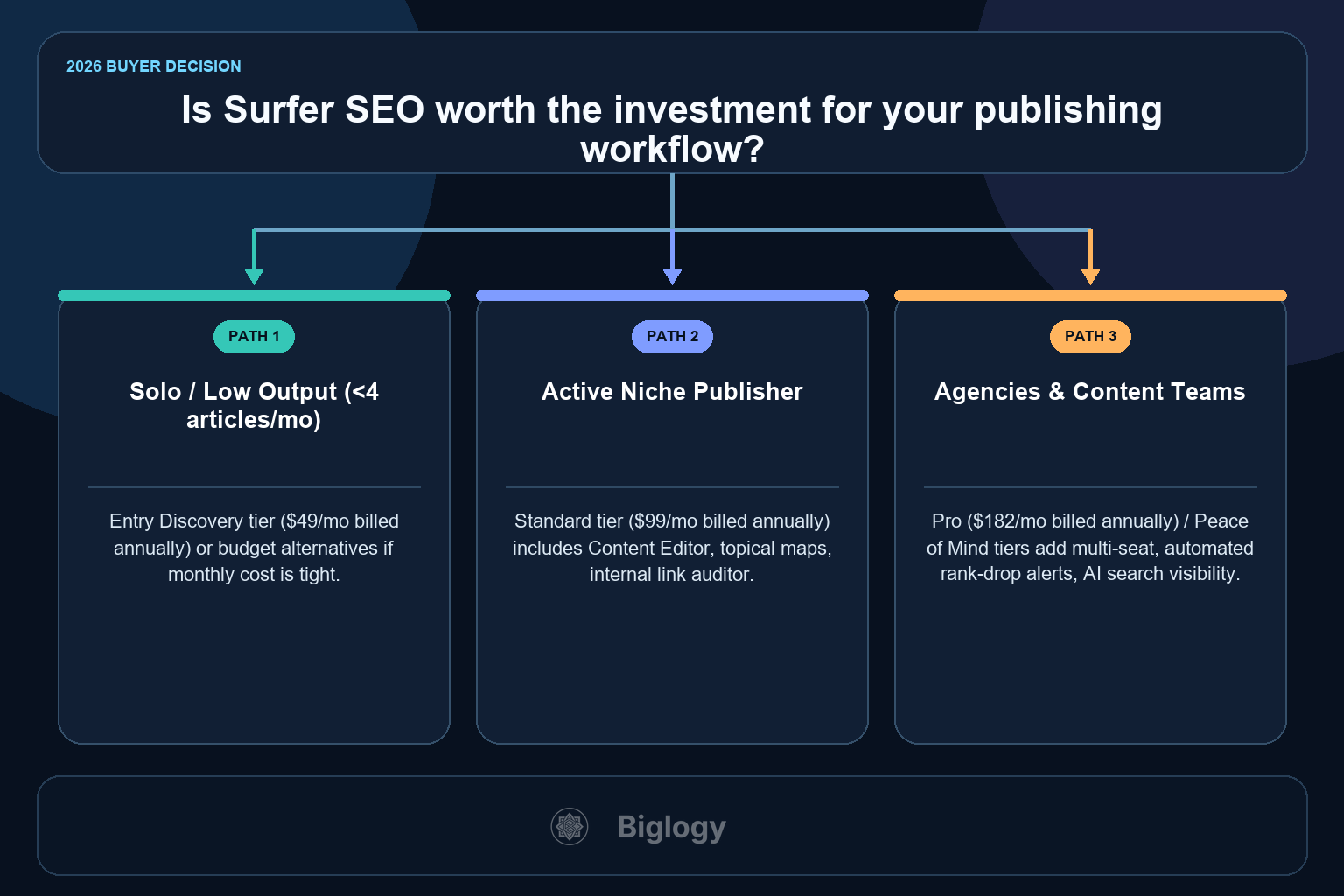
Surfer may help with outlines and content refreshes, but the publisher should compare the subscription with the value of the pages being optimized. Discovery may be enough when the main need is Content Editor access. Standard becomes more relevant when AI visibility monitoring is also part of the workflow.
A sensible test is to measure:
- Research and editing time before Surfer
- Time required after adopting it
- Number of actionable gaps discovered
- Whether those changes improve reader engagement or conversions
- Whether the same work could be completed using existing SEO tools
Do not judge the test by Content Score alone.
Scenario 2: Content agency or in-house team
For an agency with multiple writers, the value proposition is stronger. Surfer can standardize briefs, reduce subjective feedback, and give editors a shared vocabulary for revisions.
Pro is the more relevant starting point when the team needs multiple brand spaces, daily AI visibility data, internal-linking assistance, topical planning, audits, or cannibalization reporting.
Even then, editors should maintain a separate quality checklist for factual accuracy, original experience, citations, voice, and conversion intent. Surfer’s optimization layer does not replace those controls.
For a broader framework, read Biglogy’s guide to choosing an SEO tool by the job it needs to perform.
Surfer pros and cons
Pros
- Converts competitive analysis into actionable editorial guidance
- Supports repeatable briefs and optimization workflows
- Useful for coordinating multiple writers
- Combines conventional search optimization with AI visibility monitoring
- Provides planning, audit, and internal-linking capabilities on higher tiers
- Can reduce manual SERP-comparison work
Cons
- Expensive for low-volume publishers
- Important capabilities are separated by plan tier
- Content Score can encourage mechanical editing
- AI visibility metrics show observations, not causal results
- Pricing and feature packaging have changed substantially
- Still requires experienced editorial and SEO judgment
Who should choose Surfer?
Surfer is worth considering if:
- You publish or refresh content regularly.
- Several writers need consistent briefs.
- Manual competitive analysis consumes significant editor time.
- You will use AI visibility tracking as part of a defined reporting process.
- Your content has enough commercial value to justify the subscription.
- You understand that optimization recommendations are inputs, not rules.
Look for a simpler or cheaper alternative if:
- You publish only occasionally.
- Your main requirement is rank tracking or backlink research.
- You already receive comparable optimization guidance from another platform.
- You want a tool that can guarantee ranking improvements.
- Your process lacks fact-checking and editorial review after automation.
Frequently asked questions
Does Surfer guarantee higher rankings?
No. Surfer can identify patterns among competing pages and help editors find content gaps, but rankings depend on many factors outside its control.
Is a Content Score of 100 necessary?
No. A very high score may require unnecessary terms or repetition. Use the score to investigate gaps, then prioritize accuracy, readability, intent, and original value.
Is Surfer suitable for beginners?
The interface is accessible, but beginners may follow recommendations too literally. Basic knowledge of search intent, editorial quality, and keyword stuffing risks is still important.
Does Surfer track visibility in AI answers?
Yes. AI Tracker monitors selected prompts and reports brand mentions, visibility, average position, and competitor presence. Limits and refresh frequency depend on the plan.
Is Surfer worth the price for a solo publisher?
It depends on publishing volume and page value. A solo publisher should calculate time saved and business impact across a real trial workflow instead of buying solely to obtain a higher optimization score.
Final verdict
Surfer is a capable editorial workflow platform for teams that publish frequently enough to benefit from standardized competitive analysis. Content Editor remains its clearest advantage, while AI Tracker makes the platform more relevant to teams monitoring visibility beyond conventional search results.
Its biggest risk is misuse. Editors who treat recommendations as evidence and Content Score as the goal can produce derivative, over-optimized writing. Teams that combine Surfer with original research, factual review, and reader-focused editing are more likely to receive value from it.
Before subscribing, identify the exact features your workflow requires, calculate the annual cost, and test Surfer on several representative articles. Buy it for measurable time savings and better editorial decisions—not for a promised ranking result.
Editorial methodology: This is a desk-research review based on official Surfer documentation and Google Search guidance checked on November 11, 2026. It does not claim a hands-on product benchmark or controlled ranking experiment.
Affiliate disclosure: This draft contains no affiliate tracking links. Surfer operates a PartnerStack affiliate program, but participation or approval does not influence this assessment. The current public program describes tiered first-payment commissions and a 90-day attribution window. Surfer affiliate-program terms
Suggested meta title: Surfer Review 2026: Pricing, AI Visibility, Pros & Cons Suggested meta description: Is Surfer worth its 2026 price? Review its Content Editor, AI Tracker, plan limits, strengths, risks, and best use cases.
EDITORIAL_DRAFT=COMPLETE_IN_CHAT; local persistence and independent exact-SHA QA remain NOT_RUN because this workspace is read-only.


Trackbacks & Pingbacks
[…] Surfer SEO (reviewed in detail in our Surfer SEO review) if your priority is deeper content optimization, controlled competitor selection, ongoing content […]
Leave a Reply
Want to join the discussion?Feel free to contribute!