

Semrush Review for Small Content Sites: 2026 Feature Breakdown and Value Analysis
Semrush is one of the broadest SEO platforms available, but breadth is not the same as value. Publishers looking for simpler or more budget-friendly alternatives can also review our Mangools vs Ahrefs comparison or our in-depth Surfer SEO review. For a small content site, the real question is whether you will use enough of its keyword research, competitive analysis, site auditing, backlink analysis, and rank tracking every month to justify a recurring subscription.
The short verdict: Semrush is a strong fit for publishers who run several repeatable SEO workflows and make decisions from competitor and ranking data. It is difficult to justify for a small site that needs only occasional keyword ideas or a basic technical check. The lowest-priced full SEO tier, SEO Classic Pro, starts at $139.95 per month. Semrush One, the broader bundle that combines SEO with AI Visibility tools, starts at $199.95 per month. Those are different products, so price comparisons need to name the exact toolkit.
This is an evidence-based review built from current Semrush product documentation and plan limits. It does not claim that Biglogy conducted a controlled performance test, and it does not treat Semrush’s own database-size claims as independent proof that its estimates will be accurate for every niche.
Semrush at a Glance
| Decision factor | What a small publisher should know |
|---|---|
| Best for | Publishers, consultants, and small teams that repeatedly research competitors, audit sites, and track rankings |
| Less suitable for | A new or low-revenue site needing only occasional keyword ideas |
| Lowest SEO Classic tier | Pro at $139.95/month |
| Broader SEO + AI bundle | Semrush One from $199.95/month |
| Pro capacity | 5 monitored websites, 500 tracked keywords, 100,000 crawled pages/month, 10,000 results/report |
| Main upgrade trigger | Historical Data, Topic Research, SEO Writing Assistant, multi-target tracking, or more projects and keywords |
| Trial | Seven days for most toolkits; the selected plan starts billing unless canceled |
| Main risk | Paying for a broad platform while using only one or two features |
What Semrush Actually Includes in 2026
Semrush is no longer easiest to understand as one subscription with three simple plans. Its current catalog includes separate toolkits for SEO, AI visibility, content, traffic and market research, local marketing, social media, advertising, and other jobs. The two starting points most relevant to a content publisher are:
- SEO Classic: The traditional Pro, Guru, and Business structure for keyword research, competitor research, backlinks, site auditing, and position tracking.
- Semrush One: A bundle combining the SEO Toolkit with the AI Visibility Toolkit. Semrush lists this from $199.95 per month.
That distinction matters. A small publisher focused on Google search may not need to pay for the broader Semrush One bundle merely because it is the vendor’s recommended starting point. Conversely, a brand actively measuring visibility in ChatGPT, Gemini, and other AI surfaces may find the bundle more relevant than SEO Classic alone.
The practical buying rule is simple: choose a toolkit from the work you need to repeat, not from the longest feature list.
Keyword and Competitor Research
Keyword research is one of the clearest reasons to consider Semrush (see our guide to keyword research tools usage and verifying SaaS pricing). Its Keyword Magic Tool turns a seed query into related terms, questions, and topical groups. You can filter results, evaluate difficulty, review search intent, and organize terms into lists for a content plan.
Semrush currently describes its keyword database as containing more than 28 billion keywords across 142 geographic databases. That scale is useful when researching multiple markets or exploring a niche from several angles. However, a large database does not guarantee that every volume estimate or difficulty score will match the results for your site. Treat the numbers as decision inputs, not forecasts.
The more valuable workflow for a small publisher is often competitive rather than purely generative:
- Identify domains competing for the same search topics.
- Find terms and pages producing visibility for those sites.
- Separate relevant gaps from topics outside your audience or authority.
- Build a small, prioritized publishing or updating queue.
- Track whether the selected pages improve after the work is completed.
This is where an integrated platform can save time. Keyword discovery, domain comparison, and ongoing tracking happen in the same environment instead of being stitched together from unrelated exports. The value comes from the workflow, not simply from having access to a large list of keywords.
Backlink Analysis
Semrush includes Backlink Analytics across its SEO Classic tiers. A small publisher can use it to compare referring domains, inspect links to competing pages, and find sites that may be relevant for outreach or digital PR.
There are two limits to keep in mind. First, no commercial backlink database sees every link on the web. Counts will differ between Semrush, other SEO tools, and Google Search Console. Second, a list of competitor links is not automatically an outreach list. Relevance, editorial quality, traffic, placement, and the reason the link exists all matter.
For a small site, backlink data is most useful when tied to a specific job: understanding why a competing page may be difficult to outrank, identifying publications that cover the niche, or monitoring whether important links disappear. Buying Semrush only to watch a headline backlink count is unlikely to produce enough value.
Site Audit and Position Tracking
SEO Classic Pro includes a monthly allowance of 100,000 crawled pages. That is far above the page count of most small content sites. Capacity is therefore unlikely to be the constraint; the harder part is turning audit findings into a sensible repair order.
A useful audit workflow is to prioritize issues that can affect crawling, indexing, page delivery, or site-wide templates before polishing low-impact warnings. An automated audit can surface patterns, but it cannot decide which template change is safe for your WordPress setup or whether a flagged page is intentionally excluded from search.
Position Tracking provides a consistent view of selected keyword rankings and updates custom target lists daily. Pro includes 500 tracked keywords. For a small publisher, that is enough to monitor a focused set of commercial pages, informational clusters, and important updates without tracking every phrase a page might rank for.
The combination is more useful than either tool in isolation: Site Audit helps identify technical work, while Position Tracking can show whether priority pages are moving after changes. It still does not prove that a particular fix caused a ranking change; search results move for many reasons.
Semrush Pricing and Plan Limits
The current Semrush SEO Toolkit plan documentation lists these monthly starting prices and core limits:
| SEO Classic plan | Monthly price | Websites monitored | Keywords tracked | Pages crawled/month | Results/report |
|---|---|---|---|---|---|
| Pro | $139.95 | 5 | 500 | 100,000 | 10,000 |
| Guru | $249.95 | 15 | 1,500 | 300,000 | 30,000 |
| Business | $499.95 | 40 | 5,000 | 1,000,000 | 50,000 |
These prices cover SEO Classic. Semrush One, which combines SEO and AI Visibility, starts at $199.95 per month. Specialist toolkits can add further cost, and team access can also change the total. Always check the checkout page for the exact product, billing period, taxes, and account configuration before purchasing.
Why Guru Is More Than a Capacity Upgrade
Guru is not simply Pro with larger limits. Semrush currently lists several capabilities beginning at Guru:
- Historical Data
- Topic Research
- SEO Writing Assistant
- Multi-targeting in Position Tracking
- Data Studio reporting integrations
This is an important correction to older Semrush reviews that discuss historical archives or content tools as though they were part of Pro. If your decision depends on those features, compare against Guru’s $249.95 monthly price rather than Pro’s $139.95 price.
Business is aimed at agencies and larger organizations that need much higher limits, API access, and Share of Voice tracking. It is rarely the logical starting point for a small content site.
Is Semrush Worth $139.95 per Month for a Small Site?
Site size is a poor shortcut for answering this question. A 30-page site in an expensive niche may have more use for competitive data than a 500-page hobby blog. The better test is to list the recurring jobs Semrush would replace or improve.
Pro becomes easier to justify when you will use several of these every month:
- competitor and content-gap research;
- keyword qualification for new articles and updates;
- technical audits after site or template changes;
- daily tracking for a focused keyword set;
- backlink comparison and prospect discovery;
- reports for client work or multiple owned sites.
It becomes harder to justify when you need only a few keyword ideas, publish irregularly, have no capacity to act on audit findings, or are still validating whether the site can attract an audience. In those cases, free first-party data from Google Search Console and a narrower paid tool may cover the immediate job at a lower cost.
The subscription should fund a repeatable decision process. Access to more data is not a return on investment by itself.
Two Realistic Publisher Scenarios
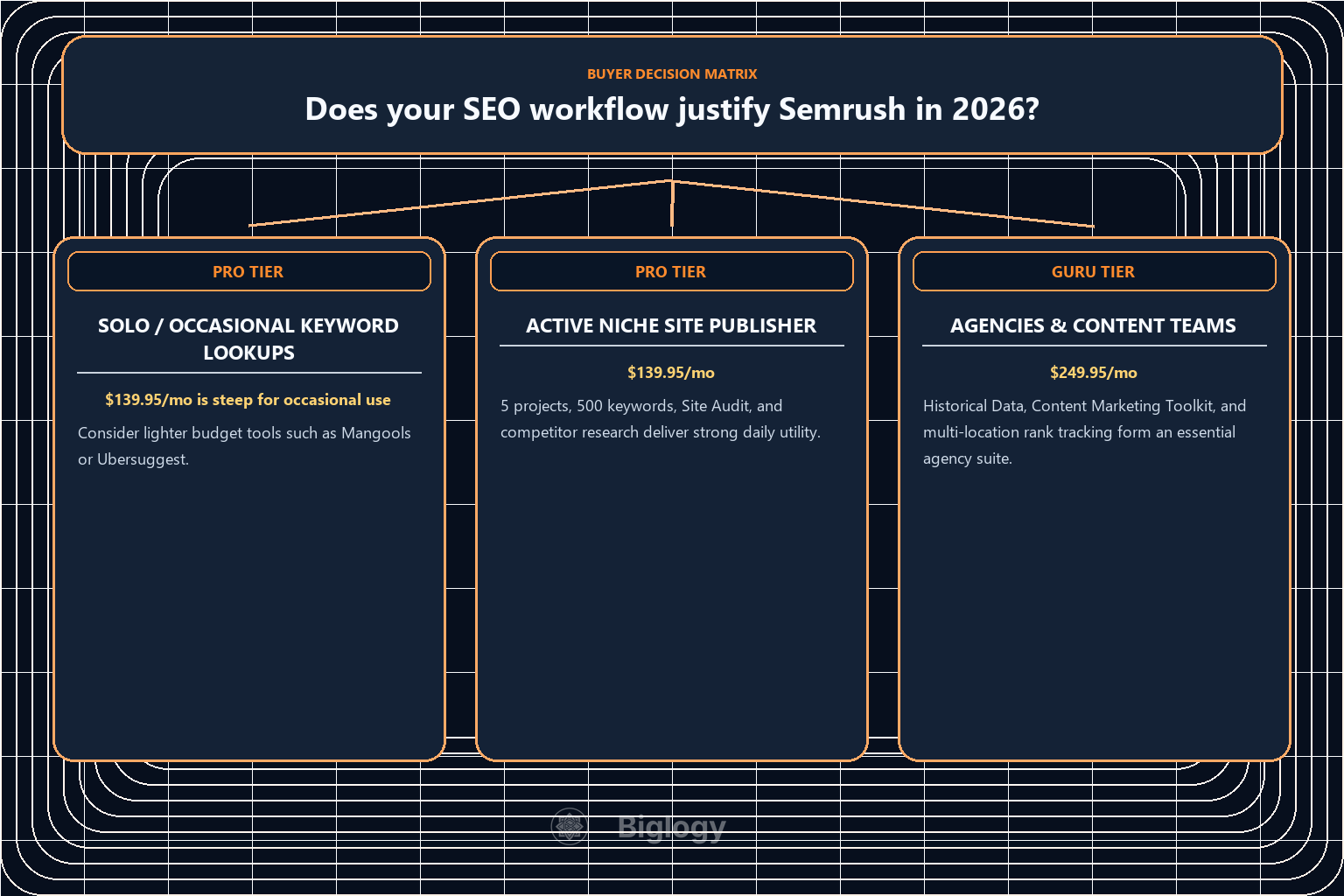
Scenario A: A Solo Affiliate Site With Fewer Than 50 Posts
This publisher releases two articles a month and updates older pages occasionally. The site has limited revenue and no dedicated SEO operator.
Semrush Pro can produce a competitor map, a technical baseline, and a tracked keyword set. But if the owner will not repeat those workflows or act on the findings, a continuous $139.95 subscription is difficult to defend. A short, planned research period may be more rational than an open-ended subscription, provided the owner understands the trial and export restrictions.
Verdict: Useful for a concentrated research sprint; questionable as a permanent expense until publishing volume or revenue grows.
Scenario B: A Growing Network With 10 or More Sites
This publisher manages several niches, updates content regularly, compares performance across sites, and needs historical context. Pro’s five-site limit is too small. Guru supports 15 monitored websites and 1,500 tracked keywords, while also adding Historical Data and content workflow tools.
The higher monthly cost can be easier to justify because the same platform supports more properties and more recurring decisions. The team still needs a defined process for turning reports into briefs, repairs, updates, and outreach.
Verdict: Guru is the more realistic tier when the network genuinely needs historical analysis and more than five monitored sites.
Pros and Limitations
What Semrush Does Well
- Combines keyword, competitor, backlink, audit, and tracking workflows.
- Provides enough Pro capacity for most single-site publishers.
- Supports daily tracking for selected keyword sets.
- Offers a large vendor-stated keyword database across many geographic markets.
- Creates a clearer upgrade path for teams needing historical data or more projects.
Where Small Publishers Should Be Cautious
- The $139.95 entry price is high if only one feature is used.
- The broad interface can create a learning burden and encourage unfocused analysis.
- Important content and historical features begin at the $249.95 Guru tier.
- Semrush One and separate toolkits make the total product catalog more complex than a simple three-plan comparison.
- Vendor estimates should be checked against first-party data and real business outcomes.
- A subscription cannot compensate for weak positioning, poor content, or lack of execution time.
How to Use the Seven-Day Trial
Most Semrush toolkits currently offer a seven-day trial. According to Semrush’s subscription documentation, the trial converts to the selected paid plan unless you cancel before it ends. Trial exports are disabled, and prior trial or paid use can affect eligibility.
Use the trial as a decision test rather than a feature tour:
- Record the selected plan, billing date, and cancellation deadline.
- Create one real project for your site.
- Run a Site Audit and classify the top issues by impact and effort.
- Build a small keyword set around pages you can actually create or update.
- Compare two or three genuine search competitors.
- Set up Position Tracking for the queries that matter.
- Decide whether the resulting work queue is worth the ongoing fee.
Do not rely on exporting everything at the end; Semrush says exports are disabled during trials. Capture decisions and implementation tasks in your own notes as you work.
Editorial and Affiliate Disclosure
Biglogy may earn a commission if a reader purchases through an approved affiliate link, at no extra cost to the reader. Compensation does not change the decision standard used in this review.
Semrush operates its public affiliate program through Impact and lists a 120-day cookie window. Its public commission table varies by toolkit, and partner tier can affect compensation. That variability is another reason not to recommend a plan merely because it pays a higher commission. A free trial should never be described as a coupon or exclusive discount.
Frequently Asked Questions
Is Semrush good for beginners?
It can be, especially for a beginner who wants one environment for keyword research, audits, competitor analysis, and rank tracking. The tradeoff is that the interface and feature range can be overwhelming. A beginner should start with one project and two or three workflows rather than trying every tool.
Is there a free Semrush plan?
Semrush offers limited free access to some tools and a seven-day trial for most paid toolkits. The trial is not a permanent free plan, and it converts to the chosen paid plan unless canceled. Eligibility and restrictions can depend on account history.
What is the difference between SEO Classic Pro and Semrush One?
SEO Classic Pro is the lower-priced traditional SEO tier at $139.95 per month. Semrush One combines the SEO Toolkit with AI Visibility capabilities and starts at $199.95 per month. Choose based on whether monitoring visibility in AI platforms is a recurring need, not simply because One is the broader bundle.
Does Semrush Pro include historical data?
No. Semrush’s current plan documentation lists Historical Data from the Guru tier, which starts at $249.95 per month. Guru also adds Topic Research, SEO Writing Assistant, multi-target Position Tracking, and reporting integrations.
Which Semrush plan is best for a small content site?
Pro is the logical starting tier when a small publisher needs recurring SEO research, audits, and tracking for no more than five sites. Guru is appropriate when more projects, more tracked keywords, historical data, or its content workflow features are necessary. If you need only occasional keyword research, neither may offer enough ongoing value.
Final Verdict
Semrush is worth considering for a small content site when it replaces several recurring SEO tasks and the publisher has time to act on the output. Its strength is not one magic metric; it is the ability to connect competitive research, keyword planning, technical auditing, backlinks, and rank tracking in one workflow.
For a solo publisher with a young or low-revenue site, the recurring cost is the decisive limitation. Start by defining the jobs you need done. If those jobs fit Pro and will be repeated every month, the $139.95 tier can be reasonable. If historical analysis, content workflow tools, or more than five sites are essential, evaluate Guru at $249.95 instead. If AI visibility monitoring is a real business requirement, compare Semrush One from $199.95 rather than assuming it is included in SEO Classic Pro.
Before subscribing, confirm five things:
- the exact toolkit and plan name;
- the current monthly or annual checkout price;
- the project, keyword, crawl, and report limits you will use;
- whether a Guru-only feature is central to your workflow;
- the trial conversion date and cancellation steps.
Bottom line: Semrush is a capable professional platform, but a small site should buy it for a defined monthly workflow—not for the comfort of having more data.
Related posts:
 Surfer Alternatives for Content Teams: 2026 Comparative Guide to Top SEO Tools
 Mangools vs Ahrefs for Budget SEO: 2026 Feature and Cost Comparison
 Surfer vs Frase for Solo SEO Publishers: 2026 Comparison, Pricing, and Workflow Reality
 What to Look for When Choosing an SEO Tool? The Difference Between Keywords, Backlinks, Rank Tracking, and Audits


Trackbacks & Pingbacks
[…] a simpler workflow. Content publishers considering larger all-in-one SEO suites can also read our Semrush review for small content sites or our guide to Surfer alternatives. Choose Ahrefs if technical audits, deep competitor research, […]
Leave a Reply
Want to join the discussion?Feel free to contribute!