

Digital Product Sales Funnel Cost Calculator: 12-Month TCO Breakdown (2026)
Editorial & Affiliate Disclosure: Biglogy preserves strict financial accuracy in every cost model. This 12-month Total Cost of Ownership (TCO) breakdown uses verified 2026 subscription rates, platform transaction fees, and standard Stripe/PayPal merchant processing rules. Links to systeme.io (/go/systeme-io/) carry an active partner tracking parameter marked rel="nofollow sponsored", while links to Unbounce (/go/unbounce/) and GetResponse (/go/getresponse/) point via Biglogy’s neutral directory without paid sponsorship tokens.
Asking “what does a sales funnel cost?” usually gets you a dangerously incomplete answer: either “$0 on Gumroad” or “$97/month on ClickFunnels.” Neither number reflects what actually leaves a digital creator’s bank account over a real 12-month operating year.
Why? Because a functioning digital product business pays across four stacked cost layers simultaneously: (1) funnel/checkout pages, (2) email list delivery and automation, (3) course or file hosting, and (4) transaction fees + payment processing. A marketplace with “$0 monthly rent” that pockets 10% of every sale quickly becomes 4× to 10× more expensive than a paid SaaS stack once revenue crosses modest thresholds. This TCO calculator lays out the complete 12-month math across four real stacks and gives you the exact break-even formula before you launch.
Short Answer: Which Sales Funnel Stack Has the Lowest 12-Month Cost?
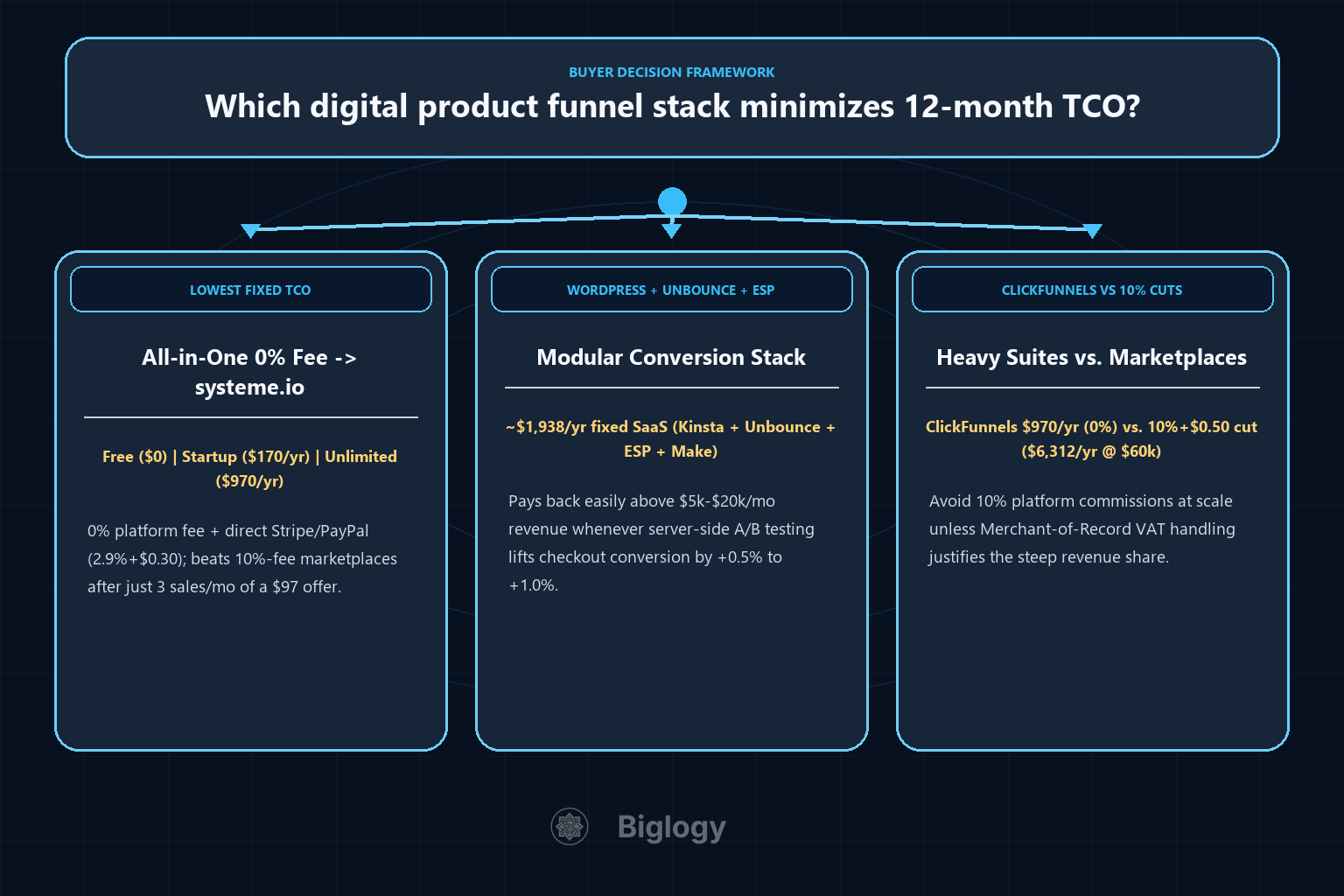
- Best Lowest Fixed-Cost & 0% Fee Winner ($0 to $5,000/mo revenue): systeme.io (Free tier up to 2,000 contacts/3 funnels/1 course with 0% platform fee; Startup tier at $170/year or $17/mo for 5,000 contacts).
- Biggest Hidden Cost Trap Above $2,000/mo Sales: Marketplaces charging 5%–10% platform transaction fees (such as Gumroad’s flat 10% + $0.50 fee). At $5,000/month in gross sales ($60,000/yr), a 10% platform fee drains over $6,000/year before standard tax obligations.
- Best Conversion-Control Stack ($10,000+/mo scaling brands): A modular WordPress + managed hosting + A/B tested landing page + dedicated ESP architecture recovers high fixed tool costs whenever split-testing lifts checkout conversion by even +0.5% to +1.0%.
1. The Four Real Cost Layers Inside Every Digital Product Funnel
Before modeling stacks, align the four budget buckets evaluated in our checkout, email, and delivery setup guide and pre-launch sales funnel checklist:
- Layer 1 — Funnel & Checkout Pages: Opt-in pages, upsell/order-bump flows, and coupon handling.
- Layer 2 — Email Autoresponders & Segmentation: Post-purchase onboarding, abandoned cart sequences, and buyer tagging.
- Layer 3 — Asset Hosting & Fulfillment: Protected PDF downloads, video streaming, or cohort access.
- Layer 4 — Merchant Card Processing vs. Platform Cuts: Standard Stripe/PayPal direct processing runs roughly 2.9% + $0.30 per US domestic card transaction regardless of software—never confuse payment gateway rates with extra 5%–10% platform commissions charged by certain funnel hosts.
2. The Exact Platform Fee Break-Even Formula
Whenever you weigh a “$0/month + Transaction Fee %” tool against a flat “Monthly SaaS Subscription + 0% Fee” tool, use this simple break-even formula before deciding:
Monthly Revenue Break-Even ($) = (Stack B Fixed Monthly Cost - Stack A Fixed Monthly Cost)
                                 / (Stack A Platform Fee % - Stack B Platform Fee %)

Example — Gumroad (0 fixed, ~10% flat cut) vs. systeme.io Startup ($17/mo, 0% extra cut):
  Assume direct Stripe processing on systeme.io averages ~3.2% blended (2.9% + $0.30 on a $97 product).
  Fee Delta ≈ 10.0% - 3.2% = 6.8% net savings per sale!
  Break-Even Revenue = $17 / 0.068 = $250/month (just 3 sales of a $97 product!).
Look at that result again: selling just three $97 ebooks or mini-courses per month on a 10%-fee platform already loses more money than paying $17/month on a 0%-transaction-fee funnel platform—a classic example of why “free” starter software frequently ends up costing more.
3. 12-Month TCO Breakdown: Four Real Funnel Stacks Compared
Suppose you sell a $97 flagship digital product across three realistic 12-month revenue trajectories (using annual SaaS billing where discounted, plus direct US Stripe fees of 2.9% + $0.30 where payment isn’t bundled inside a marketplace cut):
Case 1: Side-Hustle Creator ($1,000/mo Gross = ~10 Sales/mo = $12,000/yr)
Case 2: Full-Time Solo Creator ($5,000/mo Gross = ~52 Sales/mo = $60,000/yr)
Case 3: Scaling Digital Academy ($20,000/mo Gross = ~206 Sales/mo = $240,000/yr)
| Funnel Stack Model | Fixed 12-Mo SaaS Cost | Extra Platform Fee | Total Year-1 Outflow @ $12k Sales (incl. Processing) | Total Year-1 Outflow @ $60k Sales (incl. Processing) | Total Year-1 Outflow @ $240k Sales (incl. Processing) |
|---|---|---|---|---|---|
| Stack 1: systeme.io All-in-One (Free → Startup $170/yr → Unlimited $970/yr) | $0 – $970 / yr | 0% | ~$385 (on Free tier: $0 SaaS + ~$385 Stripe) | ~$2,097 ($170 Startup + ~$1,927 Stripe) | ~$8,674 ($970 Unlimited + ~$7,704 Stripe) |
| Stack 2: ClickFunnels 2.0 (Launch $970/yr → Scale $1,970/yr) | $970 – $1,970 / yr | 0% | ~$1,355 ($970 SaaS + ~$385 Stripe) | ~$2,897 ($970 SaaS + ~$1,927 Stripe) | ~$9,674 ($1,970 Scale + ~$7,704 Stripe) |
| Stack 3: Modular Pro Stack (Kinsta ~$350 + Unbounce ~$900 + ESP ~$580 + Make ~$108) | ~$1,938 / yr | 0% | ~$2,323 (Overbuilt for $1k/mo stage) | ~$3,865 | ~$9,642 (Full data ownership + A/B split testing) |
| Stack 4: High-Fee Marketplace (e.g., 10% + $0.50 flat per sale, $0 SaaS) | $0 / yr | 10% + $0.50 | ~$1,260 (~$1,200 + $60 tx fees) | ~$6,312 (~$6,000 + $312 tx fees) | ~$25,236 (Massive revenue tax at scale!) |
Note on Merchant of Record (MoR) vs. Direct Stripe: Platforms operating as a Merchant of Record (such as Gumroad, Paddle, or Lemon Squeezy at 5% + $0.50) absorb global EU VAT / US sales-tax remittance filing in exchange for higher percentage cuts. If you sell strictly to global B2C audiences without tax automation software (like Stripe Tax or Quaderno), factoring ~$500–$1,200/yr in compliance overhead narrows the gap on lower tiers—yet at $240,000/yr, paying 10% ($24,000+) remains vastly costlier than pairing Kajabi, systeme.io, or WordPress with Stripe Tax.
4. When Paying More Fixed SaaS Actually Increases Net Profit
Minimizing fixed expenses isn’t always profit-maximizing once traffic flows consistently. Consider a $5,000/month funnel running paid ads or steady SEO traffic—where every 1,000 landing-page visitors currently convert at 2.0% (20 sales × $97 = $1,940). If upgrading into dedicated server-side A/B testing (explored in our Unbounce review) or faster checkout hosting (Kinsta review) raises conversion from 2.0% to 2.5%, that adds 5 extra sales/month (+$5,820/year)—paying for a $1,938/year modular stack three times over.
To balance all-in-one simplicity against modular flexibility without falling into unnecessary tool sprawl, weigh our comparisons between systeme.io vs. ClickFunnels and systeme.io vs. Kajabi alongside Biglogy’s simple vs. all-in-one tool framework.
5. Pre-Checkout TCO Verification Checklist
- Verify Email Contact Caps Alongside Funnel Caps: Many cheap plans advertise “Unlimited Pages” while gating subscribers at 1,000 contacts.
- Check Custom Domain SSL & Sub-User Seats: Adding 2 virtual assistants or connecting 3 brands often triggers forced Pro tier upgrades.
- Inspect Order Bump & 1-Click Upsell Restrictions: Several entry funnel plans restrict upsells—the very mechanism that drives 15%–30% extra cart margin.
- Audit Annual Refund & Cancellation Windows: Read our guide on reading SaaS terms before annual billing.
6. Frequently Asked Sales Funnel Cost Questions
Do all-in-one funnels include a custom domain email address?
No. Funnel platforms host web pages and send broadcasts on your behalf after DNS DKIM/SPF verification, but you still need a domain registrar (~$12–$15/year) plus an inbox provider like Google Workspace (~$7–$8/user/month) or Zoho Mail if you want replies sent from [email protected].
How much do order bumps change true net SaaS ROI?
Suppose a creator sells 50 copies per month of a $97 guide ($4,850 gross) and adds a $27 template pack order bump accepted by 20% of buyers (10 × $27 = +$270/month = +$3,240/year). Using a funnel checkout tool that supports native 1-click order bumps covers an entire $170/year systeme.io or ClickFunnels subscription many times over.
Official Sources & Documentation Reviewed (2026)
- systeme.io Official Pricing Tiers & 0% Fee Policy: https://systeme.io/pricing
- ClickFunnels 2.0 Pricing Plans: https://www.clickfunnels.com/pricing
- Stripe Standard Card Processing & Gumroad Fee Schedules: Stripe Pricing and Gumroad Pricing
Related posts:
 systeme.io Review for Digital Product Sellers: 2026 Funnels, Email, and Course Hosting Reality
 systeme.io vs ClickFunnels for Funnel Creators: 2026 Comparison, Pricing, and Migration Reality
 systeme.io vs Kajabi for Course Creators: 2026 Platform and Pricing Comparison
 What You Need to Know Before Setting Up a Sales Funnel


Leave a Reply
Want to join the discussion?Feel free to contribute!