

systeme.io vs Kajabi for Course Creators: 2026 Platform and Pricing Comparison
Meta title: Systeme.io vs Kajabi (2026): Pricing, Courses and Apps Research updated: November 11, 2026
Editorial disclosure: This comparison is based on current official documentation and desk research. It does not claim hands-on testing. No affiliate tracking links are included in this draft. If commercial links are added later, Biglogy may earn a commission without changing the price you pay.
Systeme.io and Kajabi can both host courses, collect leads, send email, build landing pages, take payments, and deliver digital products. Those wanting a dedicated multi-platform perspective can also read our Thinkific vs LearnWorlds vs Podia comparison or our systeme.io vs ClickFunnels comparison. The meaningful difference is not a checklist item. It is the kind of business each platform lets you run without paying for capacity or polish you do not yet need.
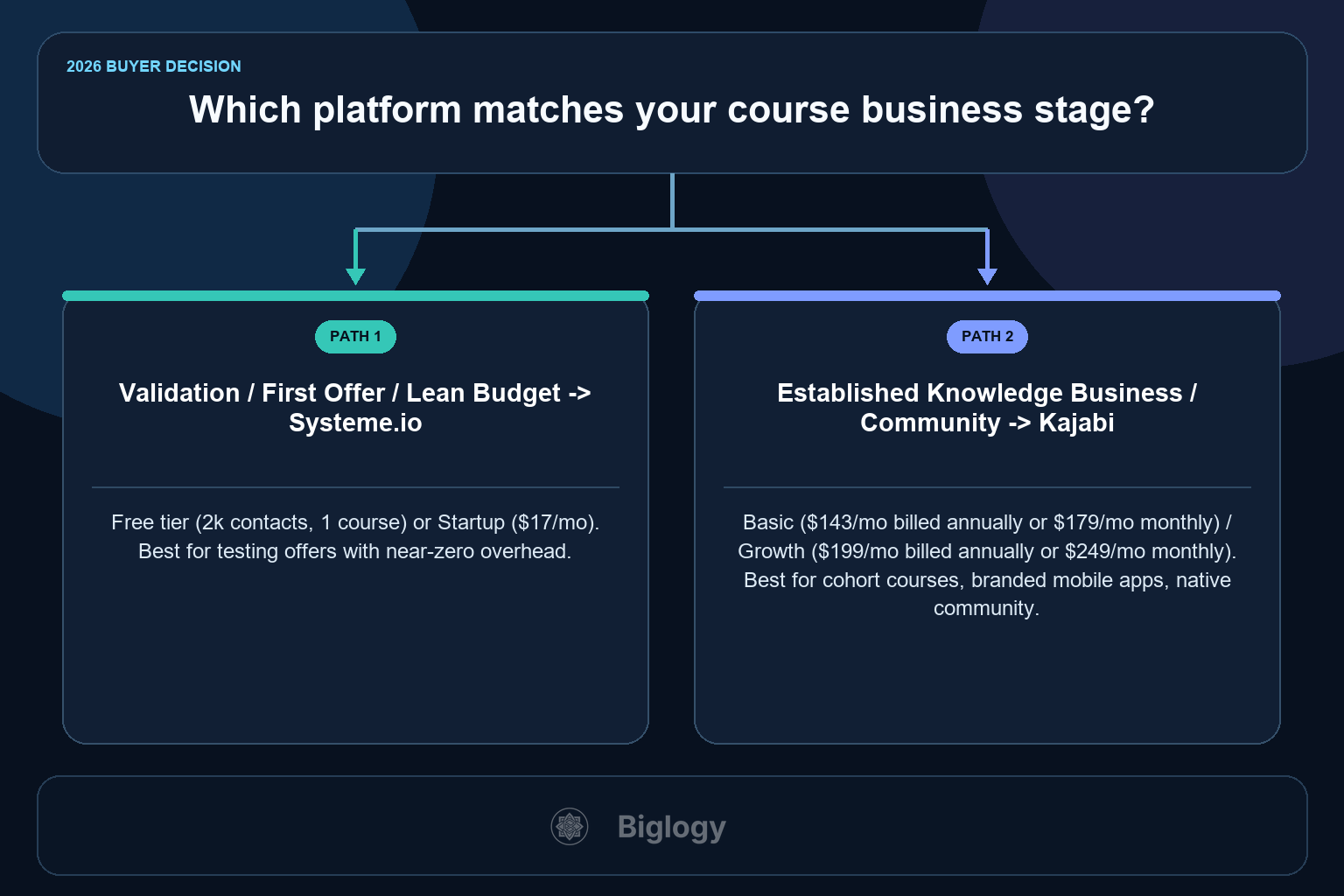
Systeme.io is the stronger default for a first course, a small audience, or an offer that still needs validation. Its permanent Free tier supports 2,000 contacts and one course, while Startup currently costs $17 per month.
Kajabi is the stronger fit for an established knowledge business that can use its broader course ecosystem: cohort courses on Growth and Pro, a mature community layer, podcasts, Wistia-powered video delivery, a shared mobile customer app, and an own-brand app on Pro.
> Quick verdict: Start with Systeme.io if your priority is validating and selling a course with minimal fixed cost. Choose Kajabi when specific experience or operating requirements—rather than prestige—justify at least $179 per month on monthly billing.
Systeme.io vs Kajabi at a glance
| Decision factor | Systeme.io | Kajabi |
|---|---|---|
| Lowest current option | Free | Basic at $179/month or $143/month billed annually |
| Best fit | First offers, solo creators, lean funnels | Established course and membership businesses |
| Contacts at entry level | 2,000 on Free | 2,500 on Basic |
| Course capacity | 1 on Free; 5 on Startup | 5 products on Basic; products include courses, coaching, memberships, downloads, and podcasts |
| Unlimited sends; contacts and automations vary by plan | Unlimited sends; contacts vary by plan | |
| Video | Native hosting, unlimited media storage, 2GB maximum per uploaded video | Wistia-powered encoding and streaming, 4GB maximum per uploaded video, no stated streaming-bandwidth limit |
| Community | Included, with limits by plan | Private community and unlimited access groups; cohort courses begin on Growth |
| Mobile | Mobile-friendly web experience; no own-brand learner app established in the reviewed documentation | Shared Kajabi customer app on all plans; branded app included on Pro or available as a paid add-on |
| Platform/payment caveat | 0% platform transaction fee; processor fees still apply | 0% revenue-share claim, but outside-processor fees may apply by plan |
| Main tradeoff | Lower cost, lighter learning ecosystem | Higher cost, richer knowledge-commerce experience |
Prices and plan details were checked against the official Systeme.io pricing page and Kajabi pricing page on November 11, 2026. Vendor pricing can change, so confirm the live checkout before paying annually.
The architectural difference
Systeme.io is a lean launch engine. Its core promise is that one account can handle a funnel, email sequence, checkout, course, community, and affiliate program without a creator assembling several subscriptions first. The Free tier is not merely a short trial, which makes it unusually practical for testing a real customer journey.
Kajabi is built around a more developed knowledge-commerce operation. It combines websites, funnels, email, checkout, courses, coaching, memberships, communities, podcasts, and mobile consumption. Its pricing assumes the buyer is not only testing whether one offer can sell, but is building a branded content business around multiple products and customer touchpoints.
That distinction explains most of the verdict. A beginner does not automatically benefit from a more sophisticated environment. An established educator should not automatically choose the cheapest platform if its students, team, or product mix require capabilities the cheaper option does not match.
Course creation and product delivery
Both platforms can organize lessons and deliver video, audio, text, and downloadable resources. Both can connect product access to a purchase. That covers the basic promise of an online-course platform.
Systeme.io Free includes one course, while Startup includes five. It is a sensible environment for a compact self-paced course, a paid workshop library, or a digital product attached to a funnel. Its value is strongest when course delivery is one step in a simple flow: landing page, checkout, email, access.
Kajabi supports courses, coaching, memberships, downloads, and podcasts as products. Basic currently allows five products, Growth 50, and Pro unlimited products. Its official course documentation also supports modules and submodules, quizzes, assessments, drip schedules, certificates, and mobile access. Growth and Pro add live cohort courses, which matters when every learner should start together and progress on a schedule.
The practical question is not “Which course builder has more features?” Ask instead:
- Will this be self-paced or cohort-based?
- Do students need quizzes, certificates, or a structured mobile experience?
- Is community participation part of the paid promise?
- Will one product be enough for the next year?
- Does the business also publish private podcasts or sell coaching?
If the answer is a single self-paced course with a basic community, Systeme.io may be sufficient. If the learning experience itself is the product and uses cohorts, podcasts, deeper community participation, or mobile engagement, Kajabi deserves the closer look.
Video hosting: useful, but not a magic price justification
Kajabi uploads are encoded and streamed through Wistia. Kajabi states that video files can be up to 4GB and that it does not limit streaming bandwidth. This reduces the need to configure a separate video host and gives learners adaptive delivery across devices. See Kajabi’s official video format and streaming documentation.
That infrastructure has real operational value, but it should not be converted into an invented “$50 to $100 per month” saving. The value depends on the size of the library, audience, bandwidth, analytics needs, and what an alternative service would actually cost.
Systeme.io also hosts uploaded video. Its documentation advertises unlimited media storage, with a 2GB maximum for each video file, and supports uploaded files, direct URLs, or embeds. See the official Systeme.io video-hosting guide.
Kajabi therefore has the clearer premium video-delivery story, but video hosting alone does not explain the whole price gap. Compare the total learning and business workflow.
Community and mobile experience
Systeme.io includes community tools with topics, posts, comments, members, moderation, scheduled posts, file uploads, links, and voice memos. That is enough for many creator communities, particularly when the main value remains the course rather than a high-frequency social experience.
Kajabi places community more deeply inside the product ecosystem. A community can be sold on its own or bundled with a course or membership. Official documentation lists channels, chat, events, challenges, leaderboards, direct messages, and mobile access.
The mobile distinction needs careful wording. Every Kajabi plan includes access through the shared Kajabi customer app on iOS and Android. Students can use courses, coaching, podcasts, and community from that app. That is not the same as receiving an app published under the creator’s own brand.
Kajabi Pro includes an own-brand app. Basic and Growth users can add one for $199 per month, according to the current Kajabi Branded App FAQ. If a branded app is central to the offer, compare Pro with the lower plan plus the add-on instead of assuming it is included everywhere.
Current pricing and total subscription exposure
Systeme.io pricing
The current monthly prices are:
- Free: $0, with 2,000 contacts, three funnels, and one course
- Startup: $17, with 5,000 contacts, 10 funnels, and five courses
- Webinar: $47, with 10,000 contacts, 50 funnels, 20 courses, and evergreen webinars
- Unlimited: $97, with unlimited contacts, funnels, courses, and automation rules
Systeme.io currently advertises two months free on annual plans, making Startup $170 per year, Webinar $470, and Unlimited $970.
Kajabi pricing
Kajabi’s current monthly prices are:
- Basic: $179, with 2,500 contacts and five products
- Growth: $249, with 25,000 contacts and 50 products
- Pro: $499, with 100,000 contacts and unlimited products
On annual billing, Kajabi lists effective monthly prices of $143 for Basic, $199 for Growth, and $399 for Pro. The annual charges are $1,716, $2,388, and $4,788 respectively.
The old Kickstarter $69 plan and Basic $149 figure in earlier comparison material do not match the live public pricing page checked for this article.
What the gap means
Comparing both vendors on annual billing, Systeme.io Startup at $170 per year is $1,546 less than Kajabi Basic at $1,716. Comparing Systeme.io Free with 12 months of Kajabi Basic paid monthly creates a $2,148 subscription-price difference.
Those figures are not guaranteed profit or total-cost savings. A buyer may need add-ons, payment processing, migration help, design work, or another specialist tool. A cheaper platform can also become expensive if it causes manual work or forces an early migration.
Use the price gap as a hurdle: which specific Kajabi capabilities are worth at least that difference to this business now?
Transaction fees and payment caveats
Systeme.io advertises a 0% platform transaction fee. Stripe, PayPal, or another gateway can still charge its normal processing fee.
Kajabi advertises 0% revenue share, but its current comparison table also lists fees for using some outside payment processors: 2% on Basic, 1% on Growth, and 0.5% on Pro. The table says these fees exclude PayPal and Kajabi Payments. Card-processing rates vary by plan, provider, and country.
This is exactly why “0% transaction fees” should not be copied from a headline without reading the plan table. Confirm the gateway, country, currency, subscription model, refund handling, and any platform fee before forecasting margins.
For a broader process, use Biglogy’s guide to verifying SaaS pricing and plan limits.
Two realistic creator scenarios
Scenario A: a first course with unproven demand
A solo creator has 800 email contacts, a $79 self-paced course, one lead magnet, and no evidence yet that paid traffic will work. The course needs video lessons, a checkout, a welcome sequence, and a basic student discussion space.
Systeme.io Free is the rational starting point. It keeps fixed software cost at zero while the creator tests the full path from landing page to delivery. If one campaign or automation rule becomes restrictive, Startup is $17 per month.
The creator should validate the workflow, not merely publish lessons. Test opt-in, checkout, payment confirmation, account creation, lesson access, transactional email, refunds, and support. Biglogy’s digital product checkout and email delivery guide and landing-page checkout flow provide useful checklists.
Paying for Kajabi at this stage may be justified if the course promise depends on its community or mobile experience. Otherwise, it buys capacity before the offer has earned it.
Scenario B: an established education brand
An established creator has 18,000 marketable contacts, several courses, a membership, a private podcast, a community, and a team. New programs launch in cohorts, advanced automations segment buyers, and customers expect a polished mobile experience.
Kajabi Growth is the natural comparison point because it includes 25,000 contacts, 50 products, cohort courses, advanced automations, an affiliate program, and removal of Kajabi branding. Pro becomes relevant if the business needs more contacts, unlimited products, three websites, API access, or its own branded app.
At this level, the question is not whether Kajabi is cheap. It is whether consolidating the experience and operations is worth more than the subscription and migration cost.
What about affiliate programs?
Affiliate commissions should not decide which platform a reader buys. They compensate publishers; they do not prove product quality.
Systeme.io’s current affiliate page states 60% lifetime recurring commission and a $30 payout threshold. Kajabi’s public Hero Partner page states 30% lifetime commission, but a newer Kajabi help article describes tiered rates and identifies 30% as a grandfathered legacy rate. Because those official pages conflict, this article does not present a universal Kajabi partner percentage.
No affiliate tracking links are present in this draft. If links are added later, the disclosure at the top should remain visible and every commercial link should use appropriate sponsored-link treatment.
Decision checklist
Choose Systeme.io when most of these are true:
- The offer is new or still being validated.
- One to five courses will cover the near-term plan.
- A lean funnel, checkout, email, and course flow is the priority.
- The list fits within the lower contact tiers.
- The budget should stay close to zero until sales are proven.
- A web-based community is sufficient.
Choose Kajabi when most of these are true:
- The business already has reliable course or membership revenue.
- Cohort courses, advanced automation, podcasts, or richer community features matter.
- Students will use a shared mobile app, or the business can justify a branded app.
- The contact list and product catalog fit a Kajabi tier.
- Consolidating several knowledge-business workflows has measurable value.
- The team has budget for the subscription, migration, and ongoing operations.
Before committing, build one real workflow in a trial: landing page, opt-in, checkout, welcome email, course access, community invitation, and refund. A successful demo is more useful than comparing 50 feature labels.
Frequently asked questions
Is Systeme.io better than Kajabi for beginners?
Usually, yes. Systeme.io Free lets a beginner build a functional funnel, email sequence, checkout, course, and community without a monthly subscription. Kajabi can be appropriate for a beginner with a larger budget and a product that depends on its specific learning or mobile features, but that is the exception rather than the default.
Is Kajabi worth the higher price?
It can be. Kajabi is easier to justify when a business uses its cohort courses, advanced automations, podcasts, community experience, Wistia-powered streaming, mobile app, larger product capacity, or branded app. It is harder to justify when the buyer needs only one self-paced course and a simple funnel.
Does Kajabi include video hosting?
Yes. Kajabi states that it encodes and streams uploaded video through Wistia, accepts files up to 4GB, and does not limit streaming bandwidth. That does not prove a fixed dollar value, and creators should still test upload, playback, captions, and mobile performance.
Does Systeme.io have a mobile app for students?
The reviewed official documentation supports mobile-friendly course creation and web access, but it did not establish a dedicated own-brand native learner app comparable to Kajabi’s branded-app option. If app-store distribution or push notifications are requirements, verify the current product directly before choosing.
Do Systeme.io and Kajabi charge transaction fees?
Systeme.io advertises a 0% platform transaction fee, although payment processors still charge their own fees. Kajabi advertises 0% revenue share but currently lists additional plan-based fees for some outside processors. Confirm the live terms for your provider and country.
Final verdict
Systeme.io wins the default recommendation for first-time and budget-conscious course creators. Its Free and $17 Startup tiers provide enough infrastructure to validate an offer without turning software cost into a monthly deadline.
Kajabi wins for an established knowledge business that will genuinely use its broader course, community, podcast, automation, and mobile ecosystem. The premium is defensible when those capabilities improve the product or remove other operating costs—not simply because Kajabi is positioned as the premium brand.
The safest decision is stage-based: start with Systeme.io when the main question is whether people will buy; choose Kajabi when the business already knows what it needs and can name the Kajabi features that justify the price gap.
Status: ARTICLE_ID=RREV-013 | EXACT_WP_ID=UNKNOWN | CANONICAL_WRITER=Codex | LIVE_MUTATIONS=NONE
Related posts:
 systeme.io Review for Digital Product Sellers: 2026 Funnels, Email, and Course Hosting Reality
 systeme.io vs ClickFunnels for Funnel Creators: 2026 Comparison, Pricing, and Migration Reality
 Thinkific vs LearnWorlds vs Podia: 2026 3-Way Online Course Platform Comparison
 GetResponse vs Mailchimp for Creators: 2026 Email Automation and Pricing Comparison

Trackbacks & Pingbacks
[…] to compare Kajabi’s all-in-one marketing stack against leaner creator suites? Read our systeme.io vs Kajabi comparison and check how course-focused tools stack up in our Thinkific vs LearnWorlds vs Podia […]
[…] a closer comparison of marketing-led course suites versus dedicated LMS architectures, consult our systeme.io vs Kajabi breakdown alongside our three-way Thinkific vs LearnWorlds vs Podia […]
[…] an online sales engine without paying for—and connecting—several separate applications like Kajabi, Teachable, ClickFunnels, and […]
[…] around different priorities. Creators comparing all-in-one alternatives should also consult our systeme.io vs Kajabi comparison, and those pairing their courses with dedicated creator email tools can read our Kit review for […]
[…] funnels, email, courses and affiliate management in one inexpensive account (compare also with our systeme.io vs Kajabi comparison). It offers a permanent Free plan, while its paid plans currently begin at $17 per […]
Leave a Reply
Want to join the discussion?Feel free to contribute!