

Surfer Alternatives for Content Teams: 2026 Comparative Guide to Top SEO Tools
Surfer is a capable content optimization platform, but it is not automatically the best fit for every publisher. You can compare specific contenders in our Surfer vs Frase comparison, our Surfer vs Clearscope analysis, and our Mangools vs Ahrefs breakdown. The right Surfer alternative depends on what you actually need to produce: inexpensive SERP-guided briefs, a low-friction editor for many writers, topical planning across a large site, or a content tool inside a broader SEO suite.
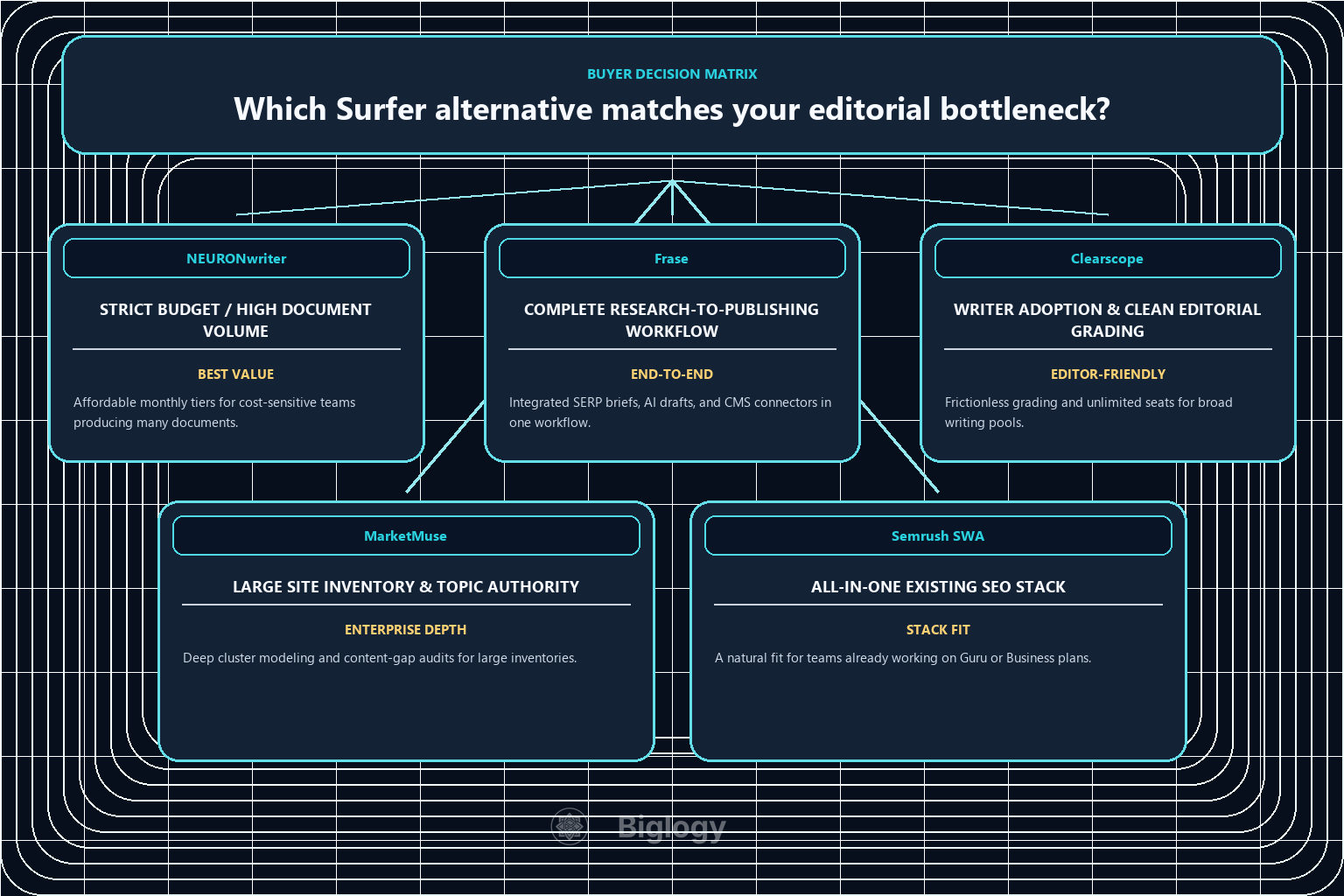
The short answer is:
- Choose NEURONwriter when price and document volume are the main constraints.
- Choose Frase when you want research, drafting, publishing, and monitoring in a more complete content workflow.
- Choose Clearscope when editorial adoption and unlimited users matter more than the lowest subscription price.
- Choose MarketMuse when content inventory, topic authority, and cluster planning are the real jobs to be done.
- Choose Semrush SEO Writing Assistant when your team already pays for Semrush Guru or Business and wants writing guidance inside the same SEO stack.
Surfer itself remains a strong benchmark for teams that want content scoring, optimization, audit signals, and AI-search visibility in one product. An alternative only saves money if it covers the work you would otherwise have to rebuild with other tools.
> Research and affiliate disclosure: This guide is based on official product and pricing documentation checked on November 11, 2026. It is desk research, not a hands-on performance test. Prices, currencies, quotas, and feature packaging can change. All product links below are direct, untracked links; this article contains no referral tracking links.
Best Surfer alternatives at a glance
| Tool | Best for | Public entry price observed | Important limit or tradeoff |
|---|---|---|---|
| NEURONwriter | Budget-conscious solo publishers | $23/month | Bronze includes 25 documents and two projects; team and integration features start higher |
| Frase | End-to-end content workflow | $49 monthly or $39/month billed yearly | Starter includes one seat, one site, and 10 articles per month |
| Clearscope | Editorial teams and contributor adoption | $129/month | Essentials includes 20 monthly Drafts despite unlimited users |
| MarketMuse | Topic authority and portfolio planning | Paid prices not displayed publicly | Paid tiers list only 5, 10, or 20 Content Briefs per month |
| Semrush SEO Writing Assistant | Existing Semrush customers | Guru is $249.95/month | Buying it only for the writing assistant means paying for a much broader SEO toolkit |
| Surfer | Broad optimization and AI-visibility workflow | Standard is EUR 99/month billed yearly | Annual billing and feature packaging make the headline price an incomplete cost comparison |
There is no universal winner. NEURONwriter is the clearest price-first substitute. Frase is the most direct workflow alternative. Clearscope is the strongest editorial-first option. MarketMuse is the strategic planning choice. Semrush makes sense when consolidation is more valuable than buying a standalone optimizer.
Why look for a Surfer alternative?
The annual commitment may not fit your budget
Surfer’s current public pricing lists Standard at EUR 99 per month and Pro at EUR 182 per month, both billed yearly. The page lists 360 documents on each plan, while Pro adds features such as daily AI-prompt tracking, five brand spaces, internal-link assistance, coverage-gap tools, templates, and custom voices.
That can be reasonable for a team using the full workflow. It is harder to justify for a solo publisher who only needs a handful of briefs each month. A lower-priced tool with a smaller document allowance may produce a much better cost per completed article.
You may need a different workflow, not a cheaper score
Content optimization tools overlap, but they are designed around different centers of gravity. Surfer emphasizes optimization and a growing set of visibility and content-operations features. Frase now extends from research and writing into publishing and monitoring. Clearscope concentrates on an editorial workflow. MarketMuse starts from inventory and topic strategy. Semrush puts content recommendations inside a broader SEO suite.
The buying question is therefore not “Which tool has the best score?” It is “Which recurring task will this tool remove from our process?”
Aggressive optimization can damage otherwise useful writing
Every score should be treated as a diagnostic signal. It is not a target that must be maximized. Adding every recommended phrase can make prose repetitive, pull a page away from its intent, and encourage writers to imitate the current results rather than contribute original value.
A sound workflow uses competitor and language data to find omissions, then applies editorial judgment. Biglogy’s guide to the risks of AI-generated SEO content explains why fluent output and a high optimization score do not establish accuracy, experience, or usefulness.
1. NEURONwriter: best budget Surfer alternative
NEURONwriter is the most obvious choice when a publisher wants a genuine SERP-guided optimization product at a lower monthly cost. Its official pricing page lists Bronze at $23 per month for two projects and 25 documents. Silver is $45 per month for five projects and 50 documents.
That combination is unusually practical for solo sites and small portfolios. Twenty-five documents can cover five new posts, several refreshes, and additional briefs in a typical month without forcing the buyer into an agency-level plan.
The tradeoff is packaging. Bronze and Silver provide the core content-planning and optimization allowance, but the official comparison places features such as advanced templates, unlimited team members, plagiarism checks, Google Search Console, WordPress and Shopify integrations, and API access on Gold or above. A low headline price can therefore stop being decisive once collaboration or publishing integrations become mandatory.
Choose NEURONwriter if you:
- manage one or a few sites;
- want 25 to 50 optimization documents per month;
- can work without advanced collaboration on the entry tiers; and
- value low predictable cost more than a polished enterprise rollout.
Skip it if your main requirement is organization-wide writer adoption, extensive onboarding, or strategic inventory analysis across a large domain.
2. Frase: best alternative for a connected content workflow
Frase has moved beyond the old idea of a brief generator with an AI writer attached. Its current plans connect research, optimization, drafting, CMS publishing, page monitoring, and AI-visibility features.
Starter costs $49 month to month or $39 per month when billed yearly. It includes one seat, one site, 10 articles, and 50 audit pages per month. Professional costs $129 month to month and includes three seats, five sites, 40 articles, and 250 audit pages per month. Scale costs $299 month to month and raises the allowance to five seats, 10 domains, 100 articles, and 1,000 audit pages. Extra seats on Professional and Scale are listed at $29 per month.
Those limits make Frase easier to model than a product with abstract credits. If your team publishes eight articles and refreshes 20 pages each month, Starter has an obvious fit. If it operates several sites with a calendar and internal-link workflow, Professional is the more relevant comparison.
Frase is the best Surfer alternative for teams that want the content process to continue after scoring a draft. It is not the cheapest option, and buyers should be cautious with any opt-in automated publishing feature. Human approval, source verification, and CMS rollback remain necessary even when a vendor can push content directly.
Choose Frase if you want:
- clear monthly article and audit-page allowances;
- research, writing, publishing, and monitoring in one workflow;
- multi-site support on higher plans; and
- optional overages rather than an immediate forced upgrade.
3. Clearscope: best premium editorial alternative
Clearscope is the editorial-first choice. Its value is less about offering the lowest cost per document and more about giving a broad contributor pool a focused research and writing environment.
The current Essentials plan is $129 per month. It lists 50 tracked queries, 50 pages, 20 monthly Discoveries, and 20 monthly Drafts. Business is $399 per month with 300 tracked queries, 300 pages, 50 monthly Discoveries, and the same 20 monthly Drafts. The pricing page lists unlimited users and projects on every plan.
That creates a specific buying case: a company with many editors, subject-matter experts, and occasional writers may prefer unlimited access even if its monthly draft allowance is modest. A small team producing high volume should look more carefully. Additional Drafts are separately priced, so the base subscription can understate the real cost of a busy content calendar.
Clearscope is best when:
- many people need occasional access;
- writer adoption matters more than maximizing feature count;
- the team publishes no more than about 20 optimized drafts per month on the base plan; and
- a clean editorial workflow is more valuable than extensive site auditing or automation.
The official page can establish its limits and product positioning, but it cannot prove that its recommendations are more accurate than another vendor’s. That would require a controlled test using the same queries, locations, competitor sets, and draft versions.
4. MarketMuse: best for topical authority and content planning
MarketMuse is the least direct Surfer substitute in this list—and that is precisely why some teams should consider it. Its current product structure is built around site inventory, tracked topics, personalized difficulty, content clusters, strategy documents, and briefs.
The public pricing page does not currently display prices for its paid plans, so an article quoting an old Standard or Team price would be unreliable. What the page does show is the operating scale:
- Free: one user and 10 queries per month, with no site inventory or content briefs.
- Optimize: one user, 100 tracked topics, 100 queries, five Content Briefs, and one Strategy Document per month.
- Research: three users, 1,000 tracked topics, unlimited queries, 10 Content Briefs, and three Strategy Documents per month.
- Strategy: five users, 10,000 tracked topics, unlimited queries, 20 Content Briefs, and five Strategy Documents per month.
MarketMuse is strongest when the expensive decision is not how to optimize a paragraph but what the organization should publish, consolidate, or update across a large body of content. Its tracked-topic and inventory model is better aligned with portfolio planning than a lightweight writing assistant.
The limitation is procurement uncertainty. You need a current quote to calculate total cost, and the brief allowances may be restrictive for a high-volume agency. Ask for the exact subscription fee, onboarding cost, included sites, renewal terms, and overage policy in writing.
5. Semrush SEO Writing Assistant: best suite add-on
Semrush SEO Writing Assistant evaluates a draft against target keywords and top-ranking competitors. Its recommendations cover SEO, readability, originality, and tone, while its AI features can rephrase or generate limited text.
It is not usually the best standalone Surfer replacement. It is a feature inside a larger SEO subscription. The current SEO Toolkit pricing lists Pro at $139.95 per month, Guru at $249.95, and Business at $499.95. Guru includes SEO Writing Assistant and Topic Research. Semrush’s documentation says Free and Pro users can generate only two documents per account, while Guru and Business users can generate unlimited documents each month.
The economics become attractive when the organization already needs Semrush for keyword research, position tracking, site audits, and competitive analysis. The writing assistant then consolidates another step into an existing bill. If content optimization is the only need, NEURONwriter, Frase, Clearscope, or Surfer itself provides a cleaner comparison.
2026 pricing and plan comparison
| Product and plan | Billing price observed | Content allowance | Included users | AI writing position | Cost caveat |
|---|---|---|---|---|---|
| NEURONwriter Bronze | $23 monthly | 25 documents | Entry plan is intended for an individual operator | 15,000 AI credits | Advanced templates, team features, and integrations require higher tiers |
| Frase Starter | $49 monthly or $39/month billed yearly | 10 articles and 50 audit pages monthly | 1 | Drafting and AI actions included within plan limits | Starter stops at its limits; Professional and Scale offer optional overages |
| Clearscope Essentials | $129 monthly | 20 Drafts, 20 Discoveries, 50 Pages monthly | Unlimited | Optimization-led editorial workflow | Additional Drafts are separately priced |
| MarketMuse Optimize | Quote required | 5 Content Briefs and 100 queries monthly | 1 | Strategy and optimization rather than commodity generation | Paid price is not public |
| Semrush Guru | $249.95 monthly | Unlimited SEO Writing Assistant documents monthly | Verify the subscription’s current user allowance | Smart Writer Words have separate monthly limits | Economical mainly when the wider SEO Toolkit is needed |
| Surfer Standard | EUR 99/month billed yearly | 360 documents listed | Team collaboration included; verify seat entitlement | Optimization plus AI-search workflow | Currency, annual commitment, and quota reset must be checked at checkout |
Do not compare these rows as if each “document,” “draft,” “article,” “brief,” or “query” were the same unit. Vendors meter different actions. Ask what consumes a credit, when it resets, whether unused capacity rolls over, and whether a refresh consumes the same unit as a new brief.
What the tools cost at 5, 20, and 50 articles per month
The following scenarios use public monthly prices and advertised document allowances. They are planning examples, not checkout quotes, and they exclude taxes, currency conversion, optional AI usage, onboarding, and other SEO tools.
Five articles per month
NEURONwriter Bronze has the lowest visible subscription cost at $23 and leaves room within its 25-document allowance for refreshes. Frase Starter is $49 month to month and adds publishing and monitoring functions. Clearscope Essentials costs $129 but can make sense if many contributors need access. MarketMuse Optimize advertises exactly five briefs, but its price requires a quote.
At this volume, the buyer should resist paying for scale it will not use. A simple brief-and-editor workflow is usually more valuable than a large feature inventory.
Twenty articles per month
NEURONwriter Bronze still fits on the published 25-document allowance at $23, although its limited project and collaboration structure may become restrictive. Clearscope Essentials fits exactly 20 monthly Drafts at $129. Frase Starter does not fit; Professional provides 40 articles for $129 month to month. Semrush Guru supports unlimited SEO Writing Assistant documents at $249.95, but its value depends on using the rest of the suite.
This is the volume where workflow starts to matter as much as list price. Editor access, project separation, CMS handoff, and refresh capacity may justify moving beyond the cheapest qualifying plan.
Fifty articles per month
NEURONwriter Silver lists 50 documents for $45, making it the lowest visible price that matches the nominal volume. However, a team producing 50 real articles may need Gold for collaboration and integrations. Frase Scale supplies 100 articles for $299 month to month; Professional includes 40 and would require optional overages. Semrush Guru continues to list unlimited monthly SEO Writing Assistant documents at $249.95.
Clearscope’s base plans both include 20 monthly Drafts, so a 50-article calendar requires separately priced capacity. MarketMuse’s largest publicly described tier lists 20 briefs per month. Obtain written quotes before assuming either can economically support this volume.
Generic AI writers are not direct Surfer alternatives
ChatGPT, Jasper, and Copy.ai can help brainstorm, structure, rewrite, or generate prose. That does not make them direct replacements for a SERP-guided content optimizer.
A true alternative in this comparison must connect the draft to search or competitor data and provide structured recommendations based on that analysis. A generic language model responds to its prompt and context. Unless a separate workflow retrieves current results, selects relevant competitors, normalizes their content, and feeds that evidence into the model, it cannot reproduce the same research layer.
The distinction matters because polished prose can still omit a searcher’s core question, use stale product information, or invent evidence. Conversely, SERP analysis does not guarantee truth or quality. Ranking pages can repeat the same error. The best process combines search-informed gap detection with primary-source verification and human editing.
Two practical buying scenarios
Scenario A: a solo niche-site publisher
The publisher produces five new articles and refreshes five older pages each month. There is one operator, no client reporting, and no need for multiple writer accounts.
Start with NEURONwriter Bronze if the priority is keeping the bill low while retaining genuine SERP-guided optimization. Its 25-document allowance gives the calendar room to grow. Choose Frase Starter instead if CMS publishing, audit pages, and ongoing monitoring can replace meaningful manual work. The extra $26 per month is justified only if those workflow features are used.
Do not select a tool merely because it can generate full drafts. The publisher still needs source checks, original examples, internal links, and a final edit.
Scenario B: a growing content agency
The agency manages several client sites, produces 30 to 50 articles per month, and works with staff and freelance writers.
Shortlist Frase Scale, Surfer Pro, and Clearscope—but for different reasons. Frase Scale has explicit multi-site, seat, article, audit, and reporting allowances. Surfer Pro is relevant when optimization, content gaps, internal linking, and AI visibility belong in one workflow. Clearscope is relevant when unlimited users and editorial adoption outweigh its lower base Draft allowance.
Run a paid or trial pilot with the same client assignment. Measure brief setup time, writer onboarding, revision cycles, CMS transfer, credit consumption, and the cost of any add-ons. A tool that saves an editor 20 minutes on every article can be cheaper than the lowest subscription; a tool writers avoid can be expensive at any price.
Frequently asked questions
What is the cheapest Surfer alternative?
Among the directly comparable products in this guide, NEURONwriter has the lowest public monthly entry price: $23 for Bronze with 25 documents. Price alone does not settle the decision because advanced collaboration and integrations require higher plans.
Is Frase better than Surfer?
Frase is a better fit when you want explicit monthly article and audit allowances plus a connected research, publishing, and monitoring workflow. Surfer is a better fit when its optimization, AI-visibility, content-gap, and internal-link features match your team’s process. Neither is universally better.
Is Clearscope worth $129 per month?
It can be for an editorial team that benefits from unlimited users and needs no more than 20 optimized Drafts per month on the base plan. It is harder to justify for a solo publisher or a high-volume team that would need many additional Drafts.
Can MarketMuse replace Surfer?
Partly. MarketMuse can cover content research, briefs, optimization, and strategic topic planning. Its stronger use case is deciding what to publish across a content portfolio. Teams wanting a high-volume, sentence-level editor should compare its brief limits and quoted price carefully.
Can ChatGPT replace a content optimization tool?
Not by itself. ChatGPT can draft and edit, but it does not automatically reproduce a dedicated optimizer’s current SERP retrieval, competitor selection, scoring, and recommendation workflow. It can participate in a custom research process if those inputs and controls are supplied separately.
Final decision framework
Before subscribing, answer these questions:
- How many new briefs, optimized drafts, and page refreshes will you complete each month?
- How many sites, editors, writers, and read-only reviewers need access?
- Do you need only writing guidance, or also inventory, audits, internal links, publishing, and monitoring?
- What exactly consumes a document, article, query, Draft, or AI credit?
- When do limits reset, and do unused credits roll over?
- Are extra seats, reports, plagiarism checks, AI words, and overages included?
- Is the advertised monthly figure billed monthly or tied to an annual commitment?
- Can the team test one real assignment before committing?
For the lowest-cost direct alternative, start with NEURONwriter. For a broader content-production loop, choose Frase. For an editorial team with many contributors, evaluate Clearscope. For sitewide topical planning, request a MarketMuse quote. If your organization already runs its SEO operation in Semrush, test SEO Writing Assistant before adding another subscription.
Finally, verify every price and limit at checkout. Biglogy’s guide to checking SaaS pricing and plan limits offers a reusable pre-purchase process, while its guide to choosing an SEO tool by the job can help prevent buying a content optimizer for a crawling, rank-tracking, or backlink-analysis problem.
Related posts:
 Surfer vs Frase for Solo SEO Publishers: 2026 Comparison, Pricing, and Workflow Reality
 Surfer vs Clearscope: 2026 Content Optimization Comparison for SEO Teams
 Surfer Review for AI Visibility and SEO Editors: 2026 Practical Guide
 Best SEO Tools for Affiliate Websites: An Evidence-Based Selection Guide


Trackbacks & Pingbacks
[…] up against its closest competitor, see our Surfer vs Frase comparison, explore our guide to Surfer alternatives, or compare with our Semrush review for small content sites. Its main value is still practical: it […]
Leave a Reply
Want to join the discussion?Feel free to contribute!